
Оборудование для вторичной упаковки нулевой удар
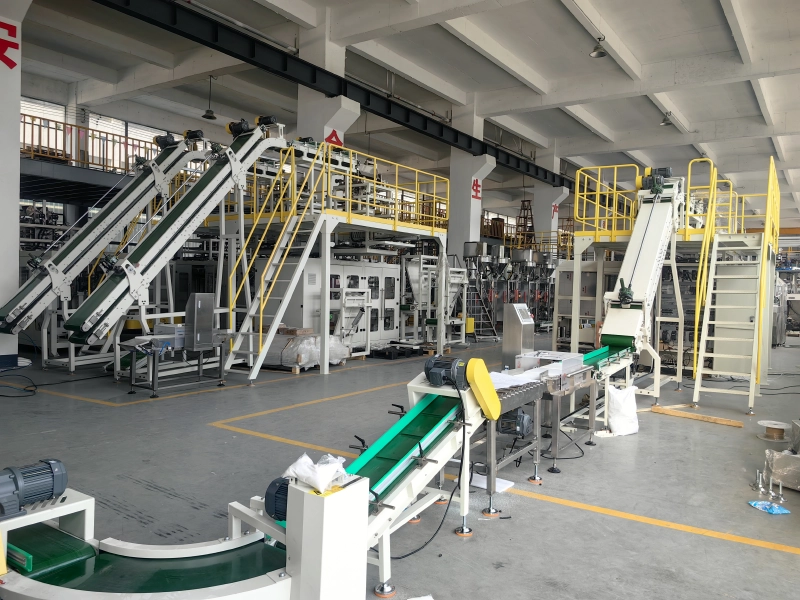
Your premium salt and chemical products are turning into “bricks” and “dust” before they even reach the retailer. The culprit isn’t your formula—it’s the microscopic cracks caused by aggressive handling and the “ballooning” effect that makes your pallets unstable. Stop shipping air and broken bags. Discover the “Zero Impact” automated line that treats 50kg industrial bags with the precision of a laboratory instrument.
The Hidden Crisis in Bulk Powder Logistics
In the aggressive environments of salt processing, fertilizer production, and starch manufacturing, “Zero Impact” isn’t a marketing buzzword—it is an operational necessity. When you are dealing with hygroscopic materials like Urea or corrosive agents like Sea Salt, a single micro-tear in a primary bag during the secondary packaging process triggers a chain reaction: moisture ingress, caking (turning powder into stone), and machinery corrosion.
Manual labor in these sectors is no longer just expensive; it is the biggest variable in your quality control. A tired worker dropping a 1kg salt bag into a woven sack from the wrong height creates a “shock” that weakens the seal. This article explores how the Вторичная Упаковочная Машина (Secondary Packaging Machine) eliminates these impacts, transforming your downstream logistics from a bottleneck into a competitive fortress.
The “Balloon Bag” & The “Flowering” Pallet
If you are packaging starch, flour, or fine chemical powders, you know the nightmare of “Aeration.” As the product rushes from the VFFS machine, it traps air. The result? A “balloon” bag that refuses to lie flat.
When workers force these aerated bags into a secondary woven sack, the result is a rounded, unstable master bag. Once stacked on a pallet, these round bags act like rollers. During truck transport across Russia’s vast distances, the vibration causes the stack to slide apart—a phenomenon known in the industry as “Flowering” (the pallet opens up like a flower). The result is rejected shipments at the distribution center.
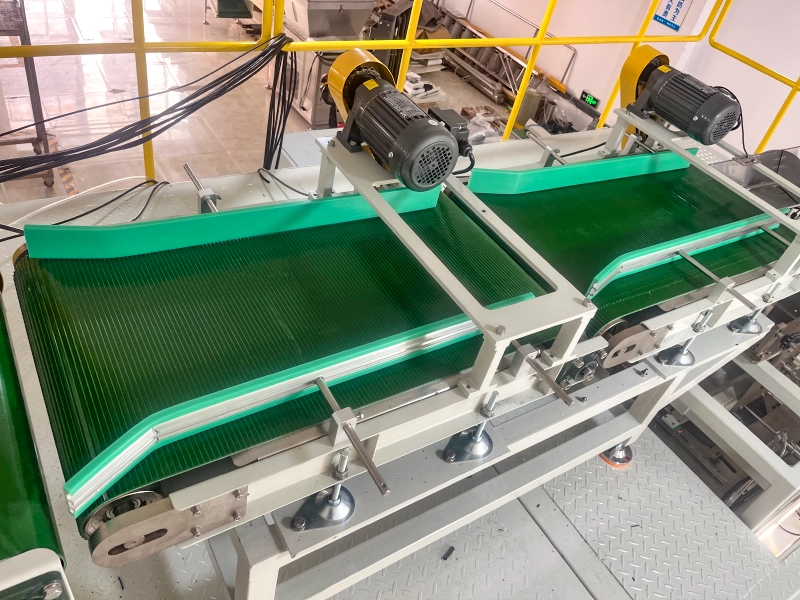
The Double-Deck Shaping Conveyor: Physically pressing “balloon” bags into flat bricks before they enter the secondary sack.
Engineering “Zero Impact”: How It Works
To solve the aeration and breakage issues, we don’t just “drop” bags; we guide them. Our Вторичная Упаковочная Машина utilizes a specific “Bag-in-Bag” logic designed for fragile and aerated products:
- Mechanical De-Aeration: Before grouping, every single small bag passes through a double-deck shaping conveyor (as seen above). This applies uniform pressure to force air out through the micro-perforations, turning a “balloon” into a “brick.”
- Servo-Controlled Descent: Instead of gravity-fed chutes that smash products together, our system uses servo-driven gates and sliding plates. The transition from the counting chamber to the master bag is a controlled slide, not a free fall. This is crucial for salt crystals that can puncture films upon impact.
- Soft-Landing Buffering: For extremely fragile items like seeds or urea prills, we implement a “soft landing” mechanism where the bottom of the master bag is mechanically supported and lowered gradually as it fills, maintaining a zero-drop height.
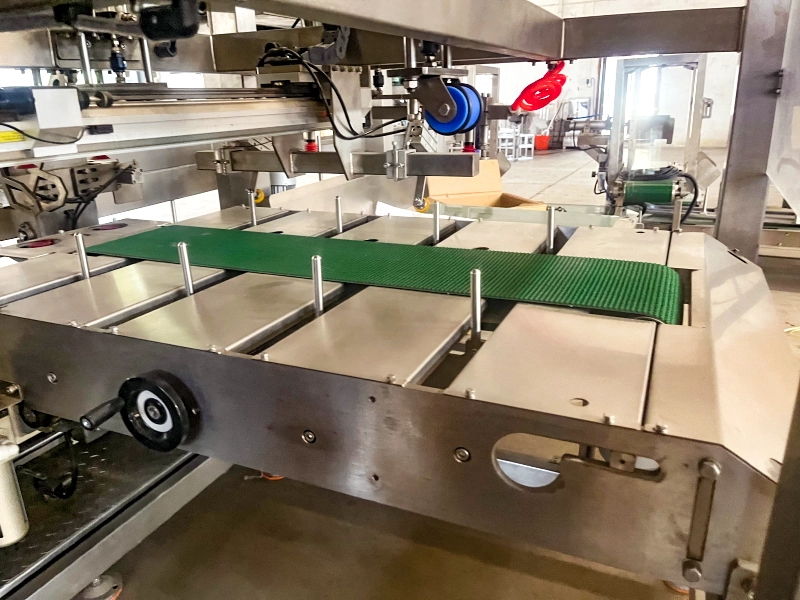
Precision Counting & Arranging: Servo-driven flaps ensure gentle grouping without crushing the product.
Built for the Corrosive Reality
In the salt and chemical industry, standard carbon steel equipment dissolves. Rust flakes contaminate your pure white product, leading to immediate batch rejection.
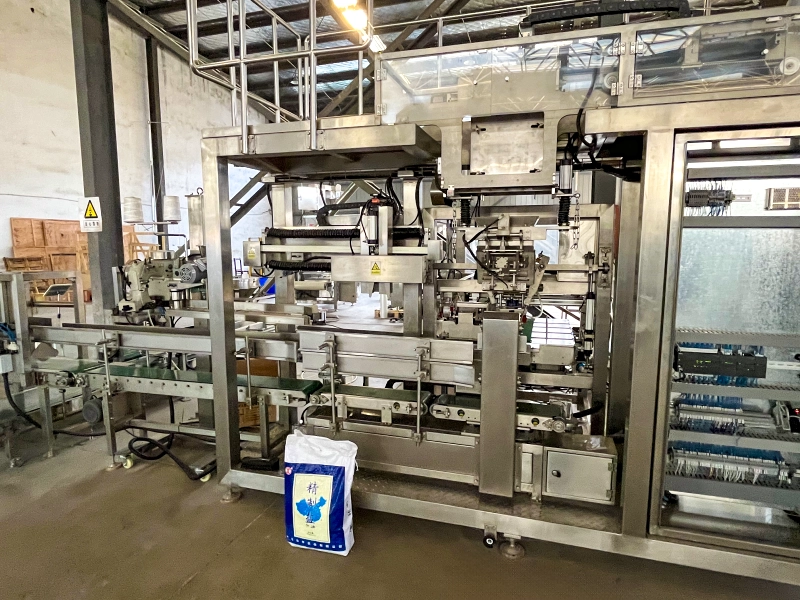
Our solution is armored against this reality. The core machine features 316L Stainless Steel contact parts—the same grade used in surgical instruments—to resist chloride attack. The electrical cabinets are isolated and purged to prevent conductive dust from shorting out the Siemens PLC controls. Furthermore, the system includes a specialized “Salt Filtering Conveyor” with diamond-pattern rollers that actively shake off and sieve out any external dust or leakage before the product enters the final bag.
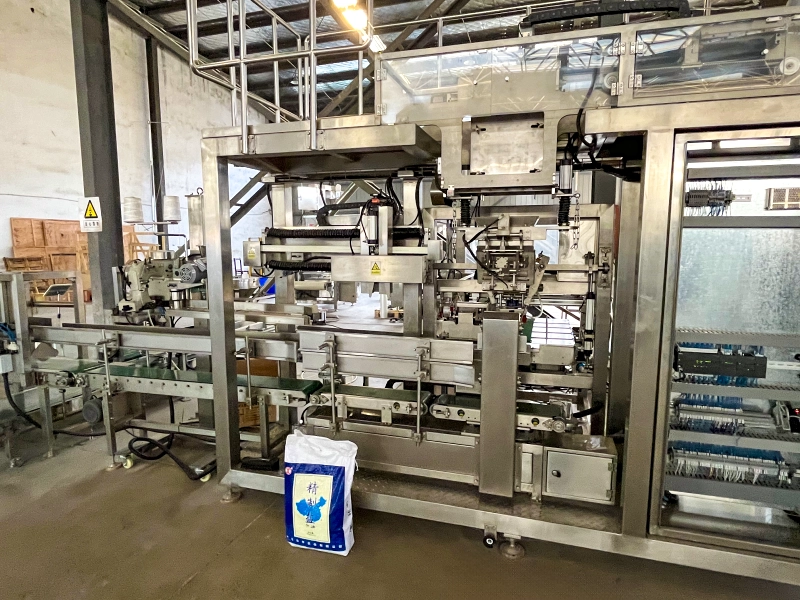
The Heart of the System: Automatic Bagging & Sewing Unit designed for heavy-duty woven sacks.
The Logistics Victory: From 750kg to 1.2 Tons
By replacing manual “loose” packing with machine-tightened, de-aerated “brick” packing, you change the physics of your logistics.
Manual pallets often cap out at 750kg because going higher risks collapse. With the Вторичная Упаковочная Машина and robot palletizing, you produce a dense, interlocking stack that is rock-solid. You can safely stack up to 1.2 tons per pallet. This means you are shipping 50% more product in the same truck or container, slashing your freight cost per ton immediately.
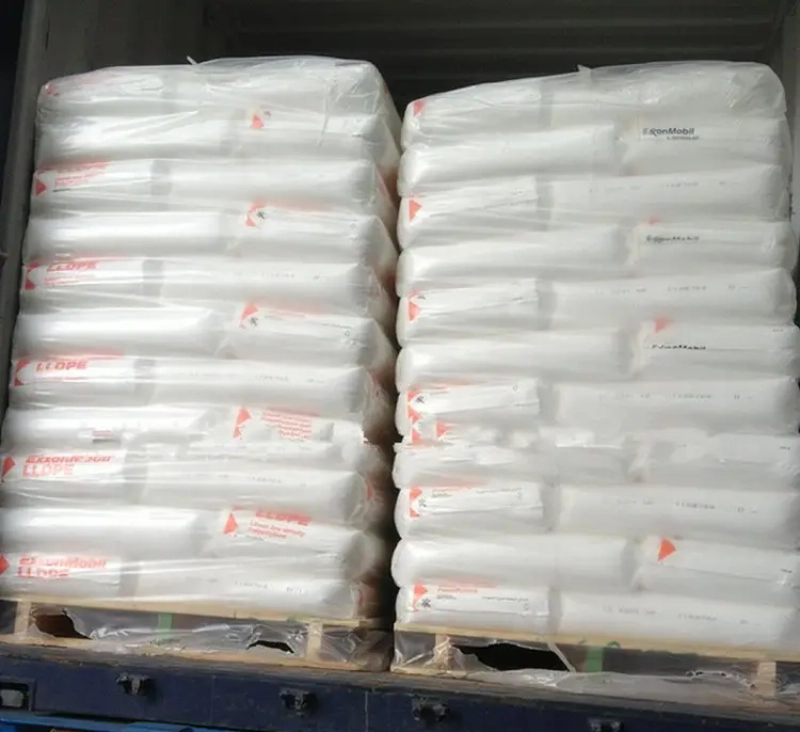
The Result: High-density, stable pallet loads ready for secure global shipping.
Frequently Asked Questions (Chemical & Bulk Industry)
Q: Can this machine handle highly corrosive Sea Salt without rusting?
Yes. We configure the machine specifically for the salt industry using 316L Stainless Steel for all contact parts and apply special anti-corrosion coatings to the frame. We also use sealed IP65/IP67 rated sensors (SICK/Omron) to prevent salt dust ingress.
Q: Our starch bags are very “puffy” (aerated). Will they fit in the master bag?
Standard machines will fail here. However, our system includes a specialized “Double-Deck Shaping Conveyor” that mechanically presses the air out of the bags and flattens them into “bricks” before they reach the grouping unit, ensuring a tight fit and stable stack.
Q: What types of secondary bags can be used?
The system is versatile. It handles Woven Polypropylene (PP) bags (standard for fertilizer/salt), Kraft Paper Laminated bags, and even transparent PE sacks. The sewing system (Newlong) creates a strong, industrial-grade closure.
Q: How many operators are needed to run this line?
The goal is unmanned operation. Typically, you only need 1 operator to monitor the line and refill the empty bag magazine (which holds hundreds of bags) and 1 forklift driver to remove finished pallets. This replaces a manual team of 8-10 people.
Q: Does the system check for broken bags before packing?
Yes. We integrate a “Salt Filtering Conveyor” and a high-speed Checkweigher. If a bag is leaking (losing weight) or broken, the system detects the weight anomaly or the spilled product and automatically rejects that specific bag before it enters the master sack.
Need a consultation on packaging equipment?
CONTACT US → English
 Русский
Leave a Reply