
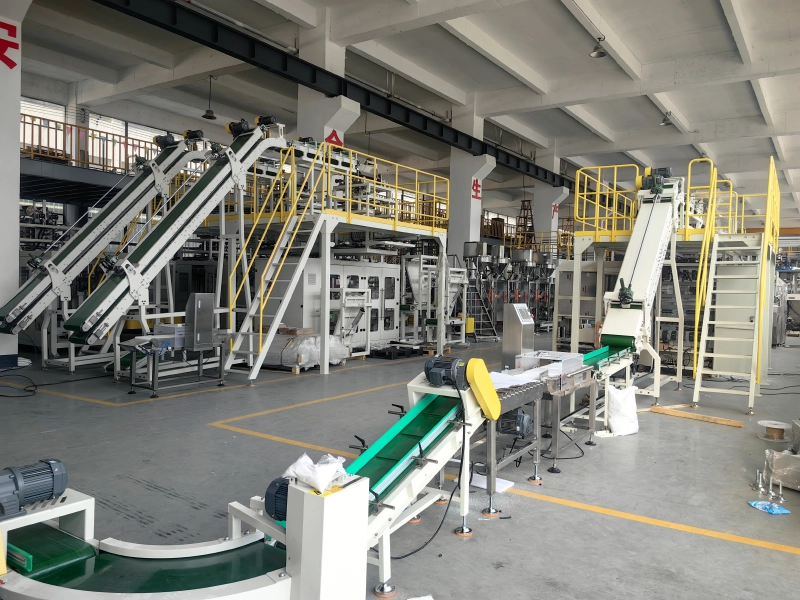
Вторичная Упаковочная Машина с роботом паллетайзером
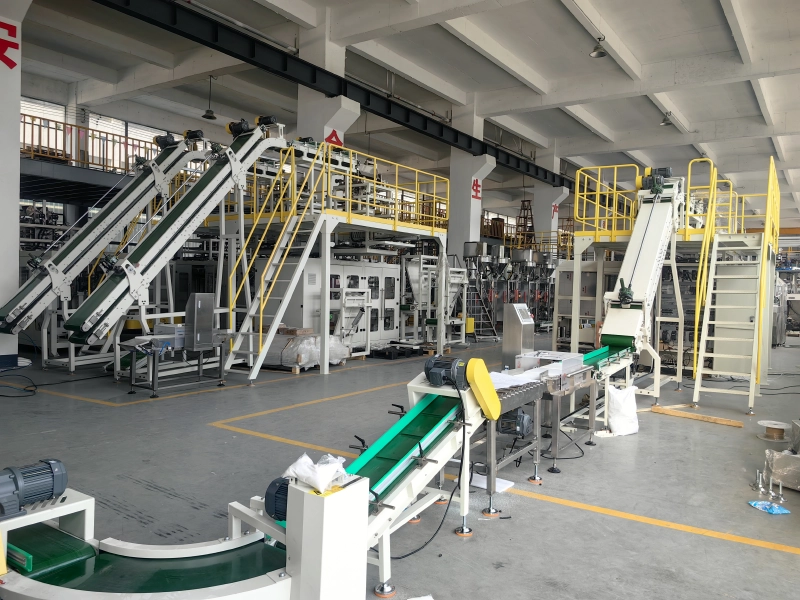
Your salt is pure, but your packaging line is rusting away.
In the salt industry, “standard” equipment is a death sentence. The corrosive chloride dust eats through carbon steel, and the hygroscopic nature of salt turns 1kg bags into rock-hard bricks or “balloons” that refuse to stack. You are paying for manual labor to lift heavy woven bags in harsh conditions, while losing 20% of your truck space to air. It’s time to stop fighting the salt and start mastering it with a 316L-armored automated solution.
The “Hidden Corrosion” of Profit in Salt Processing
If you are managing a salt mine or a processing plant (like Tyretsky or Galit), you know the enemy isn’t the market—it’s the material itself. Salt is aggressive. It destroys machinery and exhausts workers.
Most generic packaging lines fail here. They use standard sensors that get blinded by salt dust, or carbon steel frames that corrode within months. Worse, the manual “bag-in-bag” process—stuffing 1kg consumer packs into 50kg PP woven bags—is a bottleneck. Workers cannot maintain the rhythm needed for high-speed VFFS upstream machines, leading to downtime and inconsistent pallet stacks that collapse during rail transport across Siberia.
This is where the Вторичная Упаковочная Машина (Secondary Packaging Machine) specifically engineered for the salt industry changes the game.
1. From “Air Balloons” to Solid Bricks: The De-aeration Logic
Freshly packed salt contains air. When you manually throw these 1kg bags into a large woven sack, they act like balloons. The resulting master bag is round, unstable, and impossible to stack high.
Our system utilizes a Double-Deck Shaping Conveyor. Before the small bags even reach the grouping station, they are physically compressed between two belts. This forces the air out through the micro-perforations or valve, transforming a “pillow” into a flat, stackable “brick.”
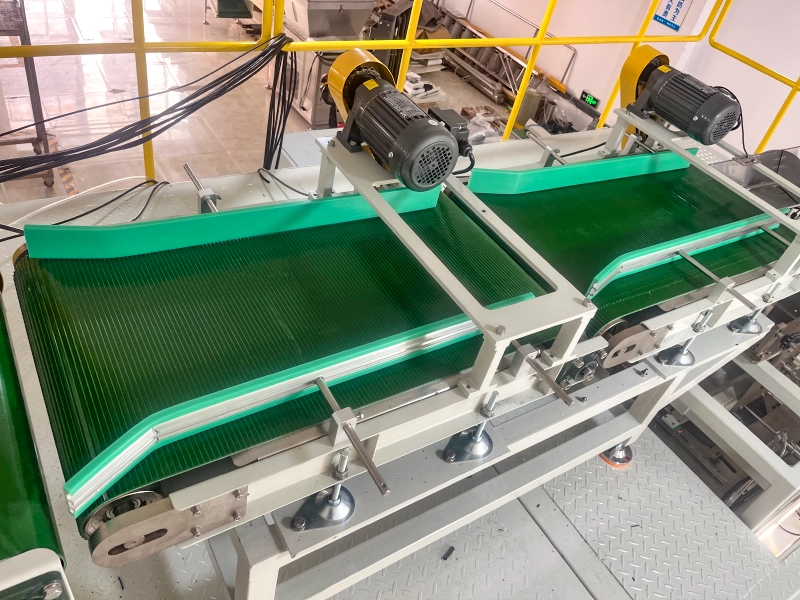
The double-deck shaping mechanism flattens bags before they enter the secondary packaging unit.
2. The 316L Armor & Salt Filtering Conveyor
Leakage is inevitable in salt packaging. A single 1kg bag bursting can contaminate the entire line, causing friction on belts and “gumming up” standard rollers.
We don’t just move the bags; we clean the flow. Our specialized Salt Filtering Conveyor uses diamond-patterned rollers that vibrate the bags as they travel (“shakedown”). Any loose salt from a micro-leak falls through the gaps, preventing it from entering the final woven bag. Furthermore, all contact parts are upgraded to 316L Stainless Steel, offering superior resistance to chloride corrosion compared to standard 304 food-grade steel.
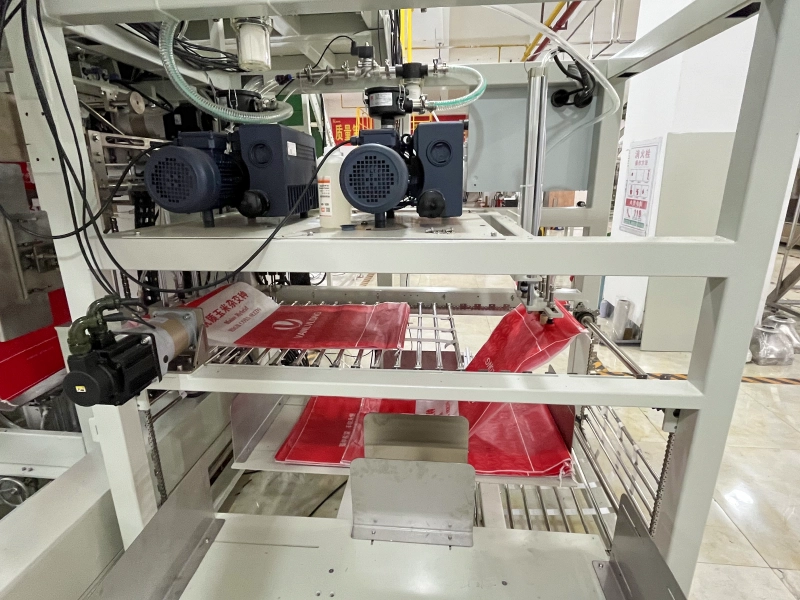
Automatic bag opening mechanism designed to handle woven bags even in dusty salt environments.
3. Robot Palletizing: Stability for Rail Transport
In Russia, salt is often transported by rail over vast distances. Manual stacking results in uneven pallets that shift and collapse (“flowering”) due to the vibrations of the train.
By integrating a secondary packaging machine with a robot palletizer (like KUKA or ABB), we achieve a mechanically interlocked stacking pattern. The robot doesn’t get tired. It places each 50kg woven bag with millimeter precision.
The result? You can upgrade from a loose 750kg pallet to a dense, stable 1.2-ton industrial pallet. This means you are shipping 50% more salt for the same freight cost.
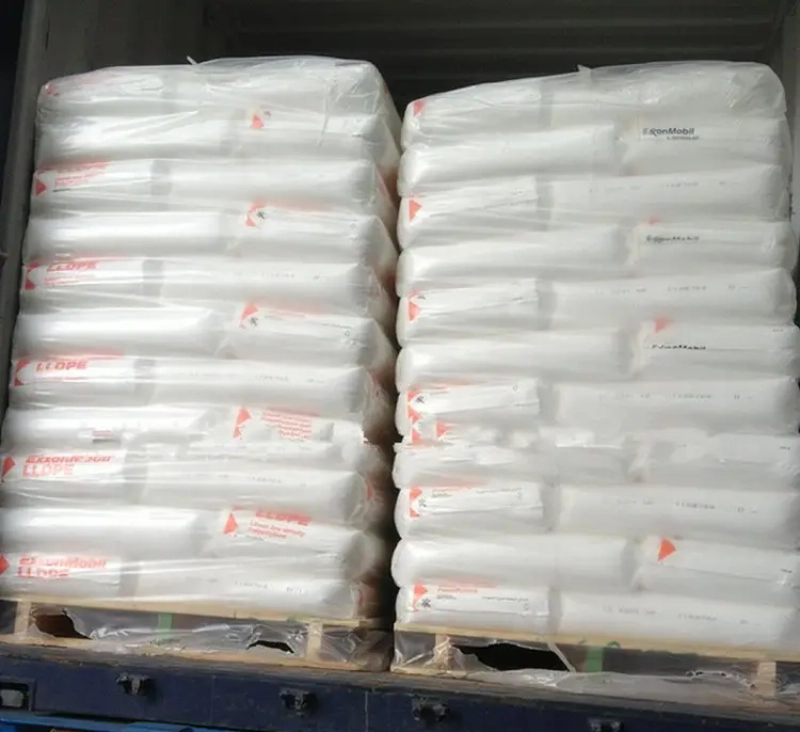
Perfectly stacked pallets ready for container loading, maximizing logistics efficiency.
FAQ: Salt Packaging Automation
1. Can your machine handle the corrosive nature of sea salt and rock salt?
Yes. We customize the metallurgy based on the salinity. For direct contact parts, we use 316L stainless steel. For the frame, we use carbon steel with a specialized anti-corrosion powder coating or epoxy paint designed for marine environments.
2. How does the system handle “caked” salt in the small bags?
Our system includes a conditioning/flattening conveyor. If the salt has hardened into a lump, the double-belt system applies pressure to break the minor caking and flatten the bag before it enters the secondary woven bag, ensuring a proper fit.
3. We use PP woven bags which are slippery. Will the stack collapse?
We solve this in two ways: First, the robot uses an interlocking stacking pattern (brick-laying style). Second, we can integrate an automatic anti-slip sheet dispenser or a glue application system between layers to increase friction for PP bags.
4. What happens if a 1kg bag breaks inside the machine?
The “Salt Filtering Conveyor” allows loose granules to fall through the rollers into a collection tray below, preventing them from entering the final bag. The machine can also be equipped with sensors to detect weight anomalies and reject the specific batch automatically.
5. Can this line handle both 25kg and 50kg secondary bags?
Yes, the BPM BIBPU system is adjustable. Changing between 25kg and 50kg formats requires a changeover of the bag magazine and a recipe selection on the Siemens HMI, which typically takes 15-20 minutes.
Need a consultation on packaging equipment?
CONTACT US → English
 Русский
Leave a Reply