
Why a Southern Russian Bulk-Products Plant Reduced Sack Drift Before Stitching
A factory that handles bulk products does not lose time on filling alone. It loses time when each sack arrives to the sewing point at a slightly different angle, needs a manual touch-up, and slows the next pallet move. This is where the PPLINE bag transfer layout matters: stable handoff, clear visibility, and a line structure built to keep sacks square before stitching.
What the line had to solve on site
The customer scenario is common in bulk products handling: filled sacks leave the bagging point, but the transfer path is not perfectly stable. If the sack twists, rides unevenly, or lands with a slight offset, the sewing head sees extra correction work. Over a shift, that small correction becomes a real throughput problem. It also creates a second issue at the pallet: operators spend more time aligning product, and the forklift rhythm becomes less smooth.
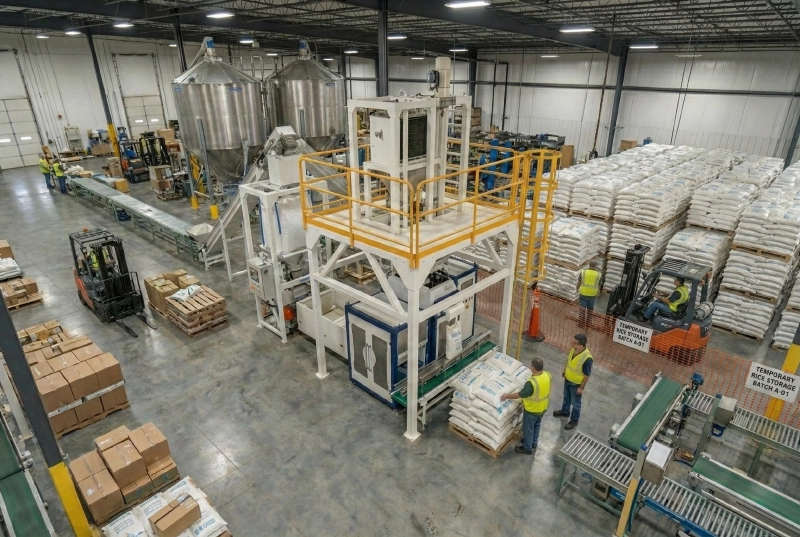
The first image shows why this matters. The plant is not a single machine in isolation. It is a complete working zone with elevated steel structure, connected conveyors, active forklift logistics, and palletized sacks moving through the same floor space. In that environment, the bag transfer point has to be predictable. Otherwise, every downstream action pays for the initial misalignment.
Manual sack straightening before stitching creates delay, adds handling error, and turns a stable filling line into a stop-and-go workflow. For bulk products, the problem is not only speed; it is the consistency of the bag path from discharge to sewing and then to stacking.
Why PPLINE fits this type of bulk-products job
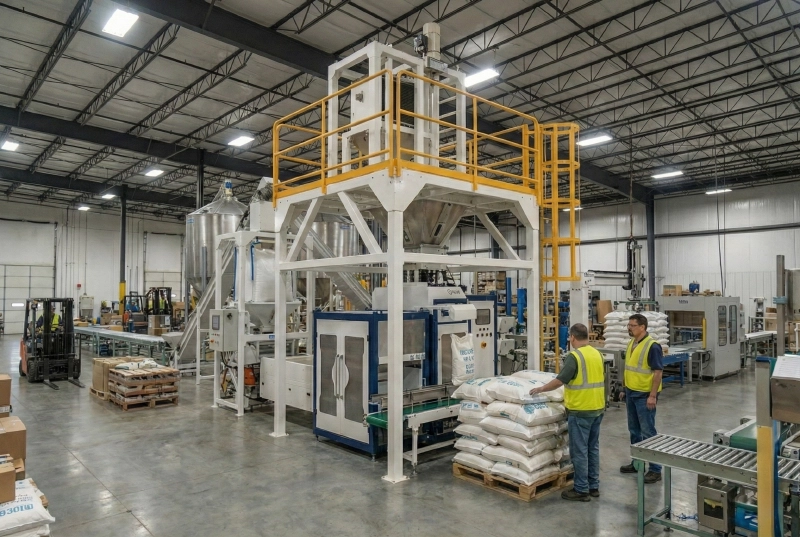
PPLINE fits because the line is designed around controlled transfer instead of loose transfer. The elevated steel frame keeps the working path organized. The enclosed bagging station helps isolate the product flow. The conveyor section gives the operator a clear and repeatable movement path. And the visible safety structure makes the operating zone easier to supervise, which matters when the same floor must support filling, sewing, and pallet handling at once.
The site evidence in the photos is important. You can see the machine sitting in a real factory layout, not in a studio. You can see the silos, conveyors, ladder access, safety cage, and pallet traffic all sharing the same production area. That combination tells you what the line is solving: not just packaging, but packaging that stays organized when the plant is busy.
bpmpack Engineering Insight: When a bulk-products plant asks for better output, the fastest improvement often comes from the transfer stage, not the fill stage. If the sack is controlled before sewing, the sewing head works cleaner, the operator touches the bag less, and the pallet finishes look more uniform. In other words, a stable bag path protects the whole line.
What changed after the layout was improved
Once the bag route is stable, the plant can run with fewer manual corrections. Operators spend less time re-centering sacks. The sewing point receives a better-aligned bag. Forklift movement becomes easier because the pallets are formed with more regular edges and fewer disturbed bags. For a bulk-products producer, that means the line feels calmer even when output stays high.
That is the practical result of the PPLINE approach: it does not try to hide the production zone, it makes the production zone easier to manage. The line structure, the platform access, and the conveyor direction work together so the sack moves through a cleaner path before it reaches the final closure step.
| Before | After PPLINE |
|---|---|
| Bag arrives slightly skewed at the sewing point | Sack transfer stays straighter and easier to close |
| Operators spend time on manual adjustment | Less touch-up is needed at the handoff stage |
| Pallet edges become irregular under pressure | Stacking looks more uniform and easier to move |
| Busy floor traffic slows the workflow | Transfer, sewing, and forklift movement stay more organized |
Need a bulk-products line that keeps sacks controlled before stitching?
If your plant is losing time at the bag handoff, the solution is usually a better transfer layout, not more manual intervention. PPLINE is built for that exact job: keep the sack aligned, keep the operator work simple, and keep the pallet flow steady.
Discuss your line layout English
 Русский