
How a Russian Salt Plant Improved Secondary Packaging Before Sewing with BibPU
For a salt plant that needed a cleaner handoff from filled pouches to woven sack closing, the main issue was not filling alone. The real bottleneck sat at the transfer, compression, and sewing step, where air, loose mouths, and unstable stack geometry made the downstream pack-out inconsistent. BibPU fits that stage by combining controlled bag handling, corrosion-resistant contact parts, and a sewing-ready discharge path.
Why the old handoff created trouble before sewing
The plant was working with a secondary packaging flow that had too many loose transitions: product came off the primary packing stage, then had to be gathered, aligned, compressed, and moved into a reliable sewing zone. On salt, that is where problems show up fast. Bags trap air, stack edges drift, and the sack mouth can arrive at the stitch head in an uneven condition. Once that happens, sewing quality becomes a moving target.
BibPU addresses the problem at the physical level. The line is built around guided transfer, controlled clamping, and compression before closing. That means the bag is not only moved forward; it is shaped into a stitchable form first. The result is a more square mouth, less bulging, and a cleaner closing step for the sewing head.
Loose pouches, trapped air, and uneven sack mouths made the sewing station work harder than it should. The plant needed a way to keep the bag body square and the top edge aligned before the stitch head touched it.
Why BibPU is a better fit for a salt environment
Salt is unforgiving on metal surfaces, so the mechanical layout has to do two jobs at once: maintain packaging quality and resist corrosion. BibPU uses UNS S31603 316L corrosion-resistant stainless steel on all product-contact surfaces, which is a practical match for chloride-heavy material handling. That matters in a salt plant because the contact points around hoppers, guides, and discharge transitions see continuous exposure.
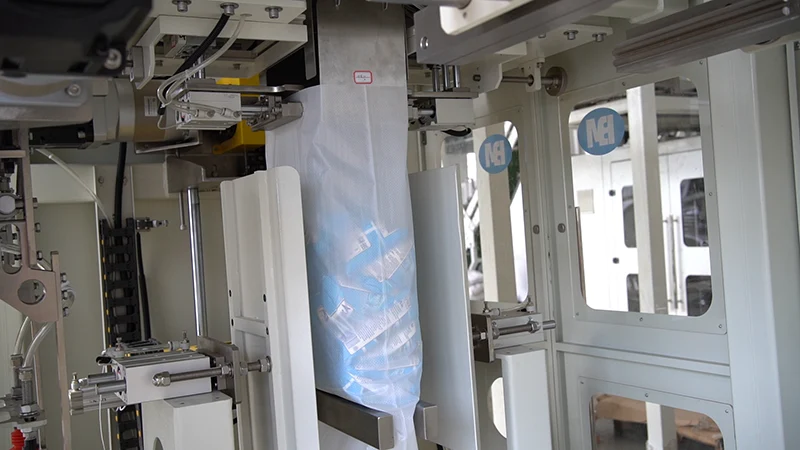
Beyond the material choice, the line architecture is made for stability. The bag flow is guided through conveyor sections, grouping points, and compression zones before it reaches the sewing head. In the selected factory image, the clamped woven sack shows exactly the kind of controlled hold-down the plant needed: the sack is positioned, not just carried. That is the difference between a line that moves product and a line that prepares product for a clean close.
bpmpack Engineering Insight: secondary packaging quality improves when the system solves shape first and stitching second. By combining guided transfer, pneumatic clamping, and pre-sewing compression, BibPU keeps the sack mouth flatter and the bag body more stable, which directly reduces stitch misalignment and bulging at the closing point.
Structure and operating logic behind the result
The line logic is straightforward. Filled primary packs are gathered, controlled, and transferred into a secondary woven sack station. From there, the bag is held by pneumatic clamps, compressed to remove excess air, and presented to the sewing head in a stable orientation. That workflow is important because the stitch quality depends on the mouth geometry being consistent at the moment of closure.
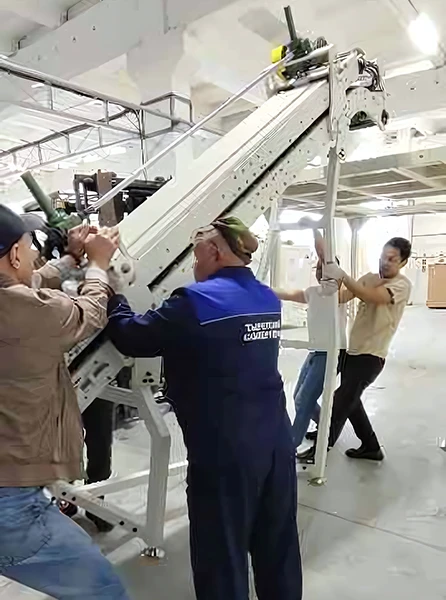
The photos from the project support that logic. The workshop overview shows the broader automated packaging setup, while the clamped-sack image shows the actual transfer condition that prevents sack distortion. Together, they point to a line designed for dependable handling rather than manual correction after the fact. For a salt plant, that is what makes the system practical: less rework, cleaner closing, and a more regular finished pack.
| Stage | What BibPU changes | Result for the plant |
|---|---|---|
| Transfer | Guided movement into the secondary bagging zone | Less bag drift and fewer awkward handoffs |
| Compression | Pneumatic holding and pre-sewing squeeze | Flatter sack mouth and lower trapped air |
| Closing | Stable presentation to the sewing head | Cleaner stitch line and more consistent pack-out |
For operations that pack salt or other free-flowing materials, this matters because every unstable transition adds risk. BibPU reduces that risk by making the secondary packaging stage predictable. The line is not trying to overcomplicate the process; it is removing the points where the pack would otherwise deform.
Need a cleaner secondary packaging handoff before sewing?
If your plant is fighting loose bags, air trapped in the sack, or inconsistent sewing quality, BibPU can be configured around the actual transfer and closing problem. Share your bag format, output target, and material characteristics, and we will map the line around the real bottleneck.
Talk to bpmpack English
 Русский