
How a Russian Salt Line Keeps Secondary Woven Sacks Square Before Sewing with BibPU
At the end of a salt packing line, the bag is already full. The real job starts after filling: remove the bulge, keep the sack mouth aligned, and deliver a steady load to the sewing head without tearing, mis-stitching, or slowing the line.
Why the old handoff breaks down
For a salt plant, the upstream filling step is only half the story. Once the product is inside the woven sack, the bag can swell, lose its shape, and drift out of line during transfer. If the plant depends on manual straightening or a loose conveyor handoff, the stitching station ends up fighting the package instead of closing it.
That is where defects start to multiply. A bulging sack can drag across guides, arrive at the sewing head with an uneven top edge, or trap air that keeps the body too round to feed cleanly. The result is slower takt time, poorer seam consistency, and more operator intervention at the exact point where the line should be stable.
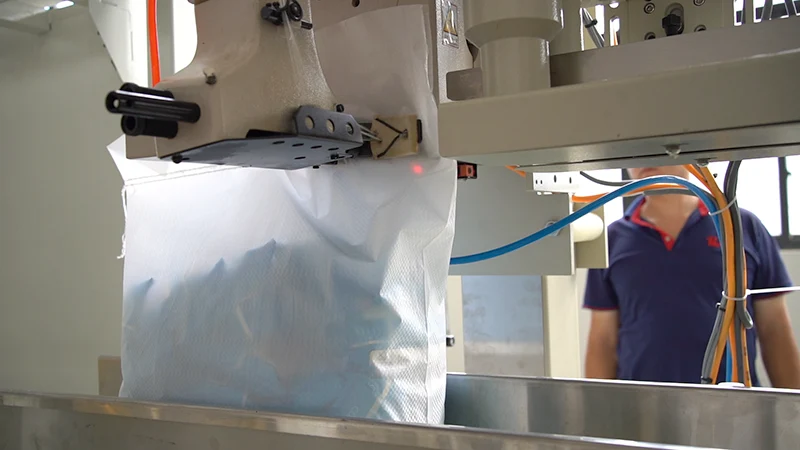
When the bag mouth is not flattened before sewing, the closure station has to compensate for shape, air, and misalignment at the same time. That creates a poor starting point for a heavy-duty stitch head, especially in a salt environment where clean seam formation and reliable bag control matter more than speed alone.
Why BibPU fits this job
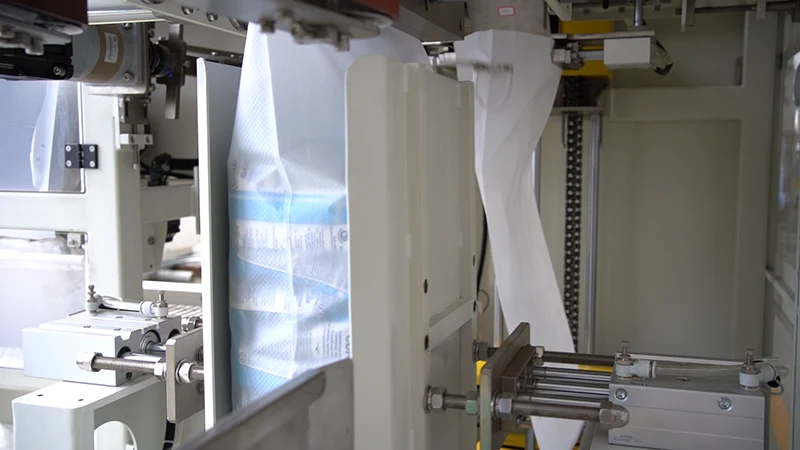
BibPU matches this secondary packaging problem because it is built around controlled bag transfer, compression, and final closure. The support image shows the line using a 150 mm center cylinder to push twin Q235B sprayed side plates inward. That is not decorative structure; it is the mechanism that flattens the filled sack before the mouth reaches the sewing station.
The second image shows the closure stage itself: a Newlong DS-9C industrial sewing head working on the filled woven bag opening. Together, the compression station and the stitching station form a practical pair. One prepares the package shape, the other closes it with a stable feed path. That is the difference between simply moving bags and actually finishing them in a repeatable way.
bpmpack Engineering Insight: The line is not asking the stitcher to solve a shape problem. It solves the shape problem first. The bag is compressed, squared, and centered before sewing, so the closure head receives a calmer mouth, less trapped air, and a more predictable edge to stitch.
Structure and sequence that deliver the result
The visible structure matters because it explains how the line stays controlled in a real plant. The side compression station uses a 150 mm stroke center cylinder to drive the clamping plates. The plates are Q235B with sprayed corrosion protection, which is suitable for an industrial salt environment where the line must remain serviceable and rigid.
After compression, the filled sack is ready for the top transfer and sewing zone. The image evidence shows a dedicated heavy-duty sewing head, which tells us the line is designed for a true secondary packaging finishing step, not a temporary hand-tie or an improvised closure. The result is a cleaner bag body, better seam presentation, and a more consistent final package for palletizing and shipment.
| Line detail | Observed function | Production effect |
|---|---|---|
| Side compression station | 150 mm center cylinder pushes the side plates inward | Flattens the sack body before it reaches sewing |
| Q235B sprayed clamping plates | Rigid mechanical contact keeps the bag under control | Reduces bounce, drift, and shape loss during transfer |
| Newlong DS-9C sewing head | Heavy-duty stitch closure for the filled woven sack | Delivers a more reliable top closure for shipping |
| BibPU line sequence | Compression first, stitching second | Improves stability where secondary packaging usually fails |
Need the same stable pre-sewing control?
BibPU is a strong fit when the bag is already filled but still needs shape control before closure. For a salt plant, that means fewer bulged sacks, cleaner stitching, and a smoother path from filling to shipment.
Talk to bpmpack English
 Русский