
How a Southern Russian Bulk-Product Plant Keeps Woven Sacks Straight Before Sewing
A practical look at how a steel-frame bagging line reduces sack skew, bounce, and rework by holding the transfer path steady from filling to sewing and palletizing.
Why the plant needed a steadier sack handoff
The plant was handling bulk-product bags that arrived at the sewing point with small rotations, soft corners, and inconsistent mouth position. Every time the sack shifted after discharge, the operator had to correct alignment by hand, and that extra motion slowed the station down.
bpmpack matched the line to that problem with a rigid steel frame, a controlled outfeed path, a swing-arm HMI for fast adjustment, and a guided transfer layout that keeps the woven sack square as it moves to the next step.
Bag mouth drift before sewing, sack bounce at discharge, uneven pallet faces, more manual straightening, and extra wear on woven bag corners during floor handling.
Why this ppline setup fits bulk-product bags
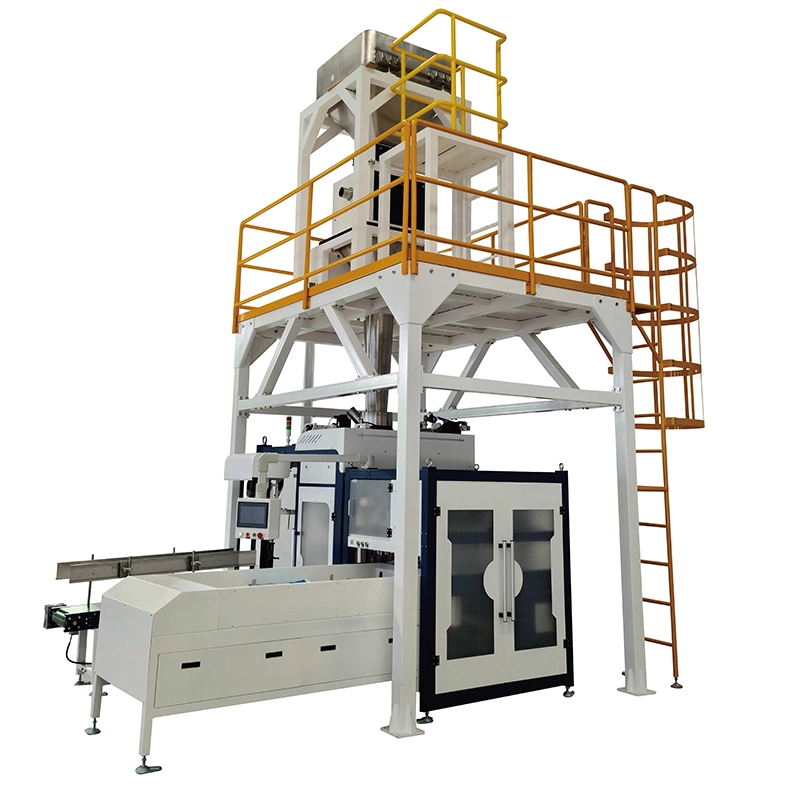
The structure shown in the product photo is built around the kind of transfer control bulk-product bags need. The elevated steel framework supports the machine body, the enclosed cabinet protects the working section, and the outfeed conveyor keeps the sack moving in one clean direction instead of dropping it into a loose handoff.
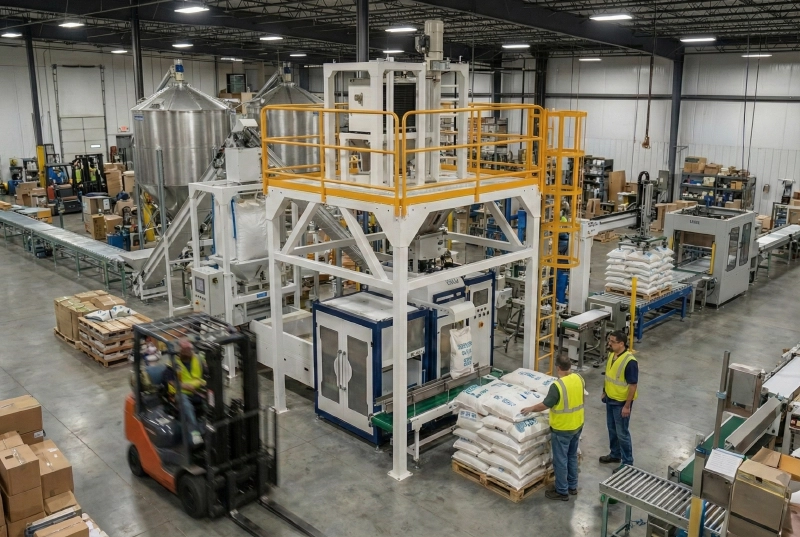
The line layout also leaves room for operators and forklifts to work without crowding the discharge area. That matters when the plant wants fewer touches between filling, sewing, and palletizing, because every avoided touch lowers the chance of a twisted sack face or a damaged seam line.
bpmpack Engineering Insight: when a woven sack must stay square between filling and sewing, the key variable is transfer geometry. A rigid frame, controlled discharge, and clear operator access reduce the small rotations that usually create seam drift and uneven pallet stacking.
Structure, parameters, and the outcome
From the selected images, the core physical cues are easy to read: a QZK-1200 bagging platform, a CY-CJD50K double-station servo scale, a swing-arm HMI touchscreen, an elevated steel tower, safety cage laddering, yellow guard rails, and a guided outfeed belt. Those are not decorative details. They are the parts that keep the sack path stable and the station easy to control.
For a southern Russian bulk-products plant, the result is a cleaner changeover from filling to sewing, fewer corrections at the machine head, and a more consistent pallet face at the end of the line. That means less rework at the station and less damage during the last meter of internal logistics.
| Issue | Line element | Result |
|---|---|---|
| Bag skew before sewing | Swing-arm HMI, rigid tower, guided outfeed | Steadier transfer angle |
| Manual correction at discharge | Enclosed machine cabinet and controlled conveyor | Fewer touchpoints |
| Uneven pallet faces | Clear operator space and forklift-friendly layout | Cleaner stack presentation |
Need a bulk-product line that keeps woven sacks square before sewing?
We can match the platform height, discharge path, control package, and transfer layout to your bag type and throughput so the line works with less manual correction and cleaner downstream handling.
Request a layout review English
 Русский