
How a Southern Grain Warehouse Stabilized Woven-Sack Handoff Between Filling and Sewing
A grain warehouse in southern Russia needed a cleaner way to move filled woven sacks off the bagging station, keep them square for sewing, and hand them over to palletizing without constant rework. The answer was not a single machine upgrade, but a line layout that matched the sack, the conveyor, and the operator’s real workflow.
Why the transfer point was the real bottleneck
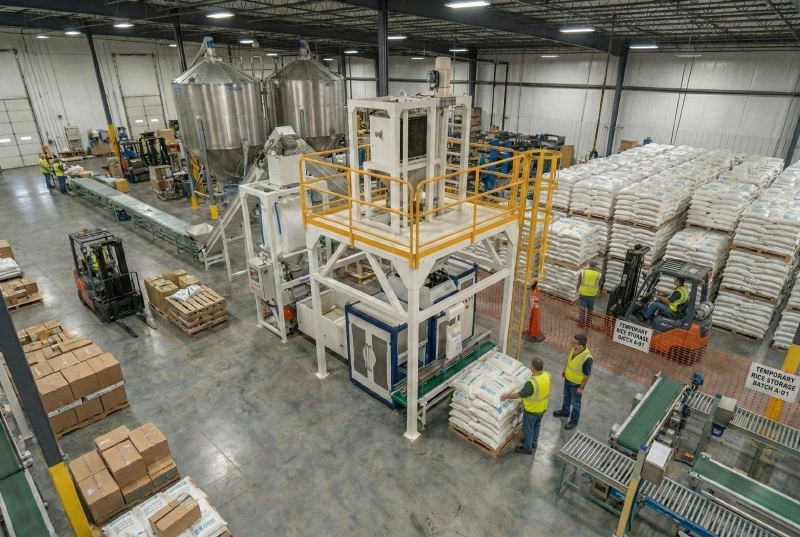
The warehouse did not struggle with filling alone. The hard part started after discharge, when a woven sack still needed to stay flat, align with the next conveyor, and reach the sewing station without twisting. If a bag lands crooked, the operator spends time straightening it. That slows the whole line, increases dust exposure, and makes the pallet stack less predictable.
The installed bagging line was built around that exact handoff. The elevated steel frame gives the station a stable working height, the outfeed conveyor keeps the bag moving in a controlled direction, and the surrounding safety cage and ladder make maintenance and access predictable instead of improvised. In other words, the layout is not just for show; it removes the small interruptions that usually become daily losses.
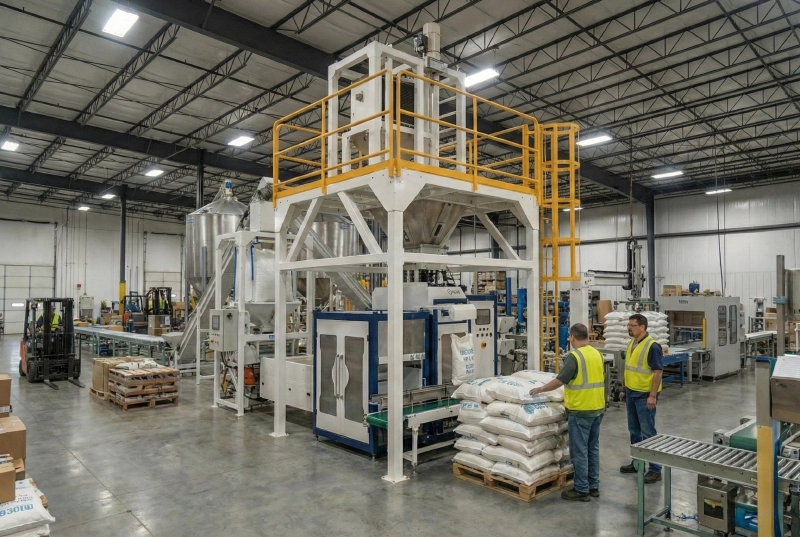
A filled sack that is even slightly off-square can turn sewing into a manual correction step. Once that happens, throughput drops and the line becomes operator-dependent.
What the machine structure solves before the bag reaches the next worker
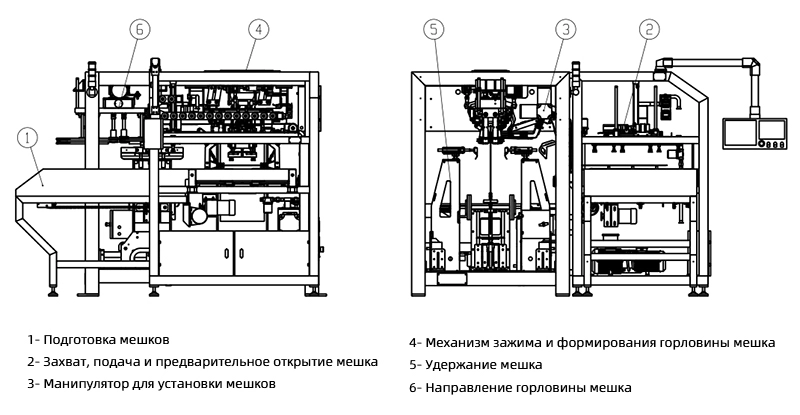
The technical drawing matters because it shows where the control points live. The bag magazine, suction placing arm, bag guide, and swing-arm HMI are not separate features; they work together to keep the bag path repeatable. A bag that is picked, opened, filled, and released in a controlled sequence is far less likely to arrive folded or skewed.
That is the practical value of a QZK-1200-style layout for bulk products. It gives the warehouse a stable transition between filling and sewing, while keeping the operator focused on monitoring instead of fighting bag position. For a site handling dry bulk materials, the biggest gain is usually not a dramatic speed jump on paper. It is the removal of the micro-delays that stack up across a shift.
Operator insight: when the bag guide and suction placement stay consistent, the sewing station sees fewer corrections, the palletizing side receives a more regular load, and the whole line feels calmer.
The details that protect woven sacks during transfer
The close-up internal view is where the article becomes more than a layout story. You can see the vacuum suction cups, the green conveyor, the robotic placing arm, and the height-adjustment handwheel working as one mechanical language. Those details matter because woven sacks are forgiving in volume but not forgiving in handling. If the placement point is too high, too low, or too loose, the bag shape changes before it reaches sewing.
With the right adjustment range and a visible handwheel reference, the line can be tuned to the real sack behavior on site. That helps when material flow changes slightly, when product density varies, or when the bag surface is dusty and less stable in the gripper. The result is a steadier outfeed, fewer manual repositions, and a cleaner bridge to palletizing.
| Pain point | Line feature | Result on site |
|---|---|---|
| Crooked bag after filling | Bag guide and suction placement sequence | More square sacks at sewing |
| Unstable transfer between stations | Controlled outfeed conveyor and elevated frame | Less rehandling by operators |
| Frequent manual correction | Adjustable HMI-controlled workflow | More repeatable daily throughput |
For bulk product plants, that is the real win: the line does not merely fill sacks. It keeps them usable for the next operation, which protects labor time, improves stack quality, and makes the whole packaging room easier to run.
Need a cleaner woven-sack handoff for your bulk packing line?
If your current station is spending too much time straightening sacks before sewing or palletizing, we can help you review the layout, the bag path, and the transfer points around your product and floor plan.
Talk to BPM English
 Русский