
How an Automatic FFS Line for Bulk Products Keeps Bagging, Transfer, and Dispatch Steadier
For plants handling granules, pellets, fertilizer, and other free-flowing materials, most losses happen at the handoff points. A well laid out FFS line reduces those losses with a hopper-fed bagging machine, protected operator access, and a cleaner outfeed path.
Where the old setup usually slows down
In many bulk-product plants, the first bottleneck is not the filling head itself. It is the time lost while operators position bags, keep feed stable, and move finished bags away from the machine. If the access points are too tight, maintenance becomes awkward. If the discharge path crosses forklift lanes, flow becomes stop-start. If the line is built around isolated machines instead of a clear process layout, the workshop spends more time compensating for the layout than producing bags.
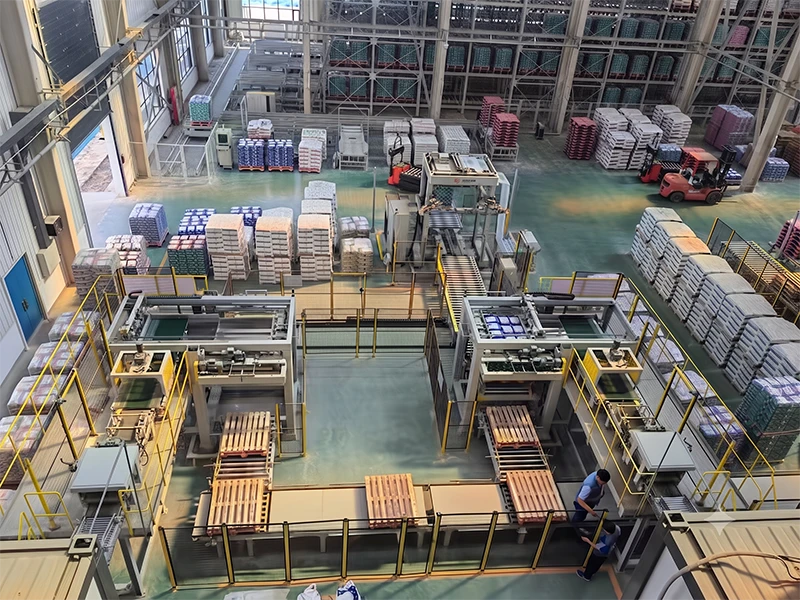
The overhead layout makes that issue easy to see. When conveyors, platforms, palletized materials, and forklift lanes are all visible in one field of view, the difference between a working line and a crowded line becomes obvious. The useful layout is not the one with the most equipment. It is the one that lets each step of the process happen in sequence without forcing operators to fight the floor plan.
It is the transfer between feed, fill, bag takeoff, and dispatch. When those points are poorly connected, throughput drops, cleaning takes longer, and operators spend more effort on handling than on control.
Why this FFS line fits this kind of material
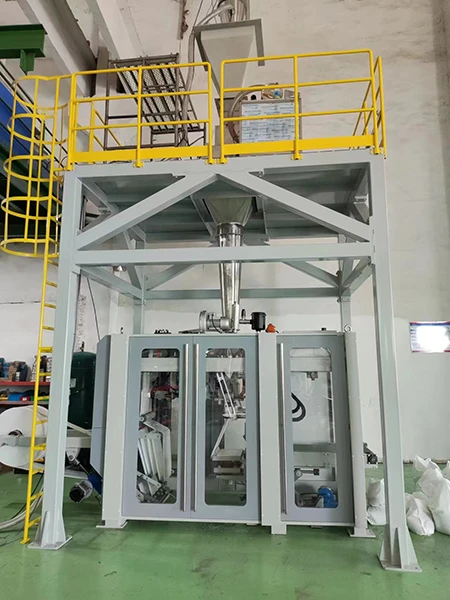
The machine view shows a hopper-fed main unit, an elevated service platform, yellow safety rails, and an enclosed cabinet. Those details matter because bulk materials need a steady feed zone, not a fragile one. The hopper gives the line a practical entry point for free-flowing product. The elevated platform gives technicians a safer way to inspect the upper section without improvising access. The enclosed cabinet helps keep the core machine body protected and visually organized, which is especially valuable in a busy workshop.
Just as important, the line does not stop at filling. The connected conveyor sections visible in the workshop view show that the design is meant to move bags away from the machine in a controlled way. That reduces crowding around the discharge point and keeps the bagging area from becoming the same place where finished product waits, turns, and piles up. For free-flowing bulk products, that kind of separation is often what turns a good machine into a reliable production system.
What the image proves: the line is built as a process system, not a single machine. Hopper feed, protected access, and a clear outfeed route all point to steadier operation for bulk-product packaging.
What the structure tells you before you buy
If your material tends to flow freely but still needs controlled discharge, the first thing to check is whether the feed point is practical. A hopper-fed FFS line is better suited to that job than a loose, open transfer arrangement because the material enters the process in a defined way.
If operator access matters, the next check is whether the machine gives you a real working platform and rail protection. The elevated platform and guard rails shown here are not cosmetic. They are the difference between a line that can be maintained regularly and a line that gets worked around until small issues become downtime.
If dispatch is your bottleneck, look at the floor plan, not just the filling head. The right layout gives finished bags a direct path to downstream handling and leaves forklift movement outside the critical zone. That is why the overhead image is useful proof: it shows how the conveyors, platforms, and pallet lanes can be organized into one repeatable sequence.
| Observed feature | Operational value | Why it matters for bulk products |
|---|---|---|
| Hopper-fed main machine | Stable product entry | Keeps free-flowing material moving into the bagging process in a controlled way |
| Elevated service platform and safety rails | Safer access for inspection | Makes routine maintenance more practical without crowding the production floor |
| Connected conveyors and open lanes | Smoother transfer to dispatch | Reduces congestion around finished bags and helps the line keep moving |
| Enclosed cabinet and defined machine body | Cleaner machine presentation | Helps the workshop stay organized and makes the line easier to supervise |
For bulk-product plants, the final result is not just a faster bagging station. It is a more predictable line. The machine feeds more steadily, operators can reach the equipment more safely, and the workshop has a clearer route for finished bags. That combination is what keeps dispatch steadier when demand rises and the line has to run for longer shifts.
Need an FFS line matched to your bulk product and workshop layout?
Share your material flow, bag weight target, and site layout. We can map the bagging section, the transfer path, and the outfeed arrangement to the way your plant actually runs.
Contact us English
 Русский