
Why a Vertical Packaging Machine for Bulk Products Fits Salt, Grain, and Powder Lines Better
When a plant needs cleaner dosing, steadier sealing, and fewer bagging interruptions, the weak point is usually not the recipe. It is the handoff between hopper, forming shoulder, sealing jaw, and downstream handling. A vertical packaging machine for bulk products is built to keep that chain stable so the line can run with less spill, less film sticking, and less manual correction.
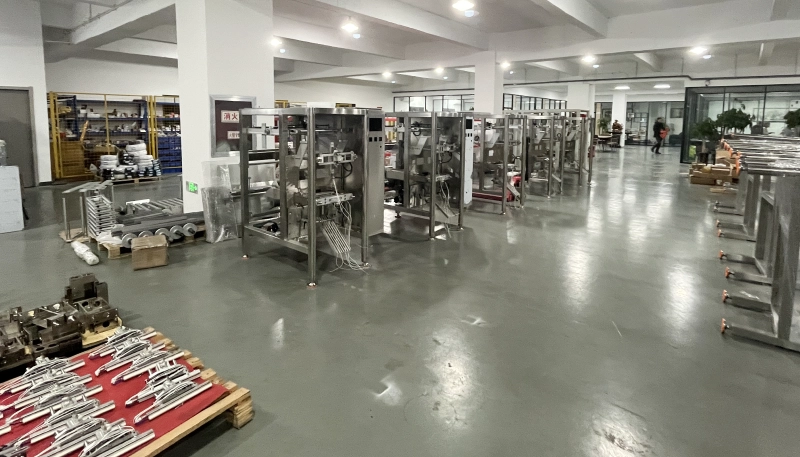
Where the old bagging flow usually starts to fail
Many bulk-product plants still rely on a mixed setup: a hopper that feeds unevenly, a bagging head that needs constant correction, and a sealing section that has to compensate for trapped air or drifting film. That works for short runs, but it becomes expensive when the product is fine, dusty, hygroscopic, or hard to keep level in the feed zone. Salt, rice, resin pellets, and powdered blends all expose the same problem: once the material stops moving consistently, the package stops looking consistent too.
The practical issue is not only appearance. An unstable fill creates unbalanced bags, weak seals, and slow downstream handling. Operators then spend time clearing bridges, re-aligning film, and rechecking heat seal quality. For a plant that wants steady output, the answer is a packaging line that controls the material path instead of reacting to it.
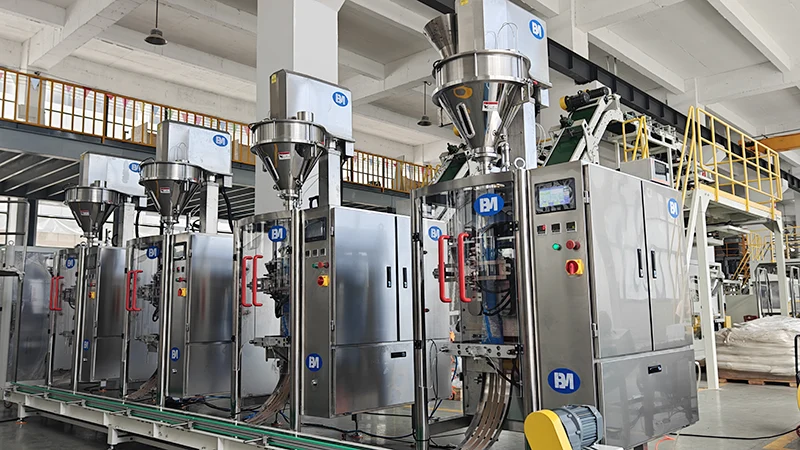
Uneven feed, film sticking, and weak sealing usually come from mismatched machine sections rather than the product itself.
Why this machine layout is a better match for bulk-product packaging
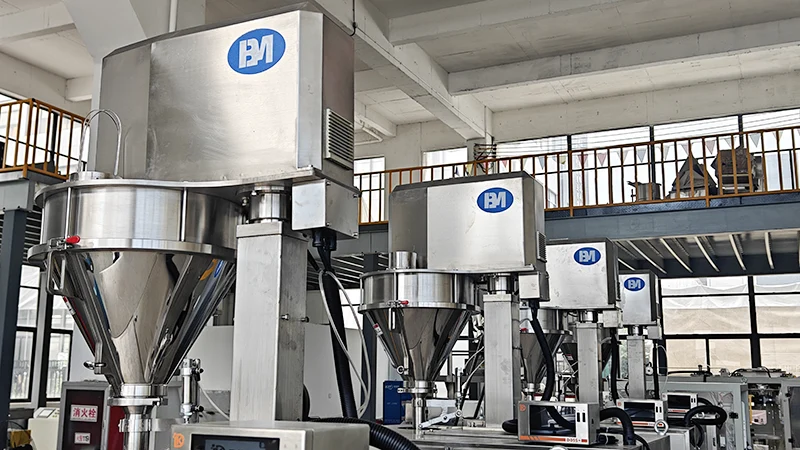
The advantage of this vertical packaging machine is visible in the structure. The stainless hopper row keeps feed organized, the auger dosing zone stabilizes delivery, and the machine frame gives each station a fixed mechanical reference. That matters when the product is heavy, free-flowing, or sensitive to dust control. In the image set, the upper dosing systems and machine columns show that the line is designed as a controlled packaging path, not as a loose collection of accessories.
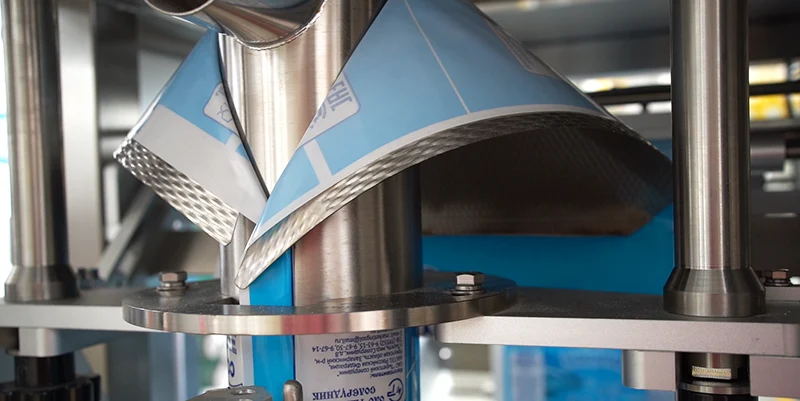
The forming shoulder also matters more than many buyers expect. A dimpled stainless forming shoulder helps reduce film sticking when humidity rises or when the film needs to move smoothly through a long production run. That is the kind of detail that protects throughput. If the film drags, the line slows. If the film tracks poorly, the seal drifts. If the seal drifts, the bag looks acceptable at first but becomes a reject risk later.
Operational note: Steadier output usually comes from smaller mechanical corrections at each stage, not from one large adjustment at the end of the line.
What the sealing and discharge evidence tells you
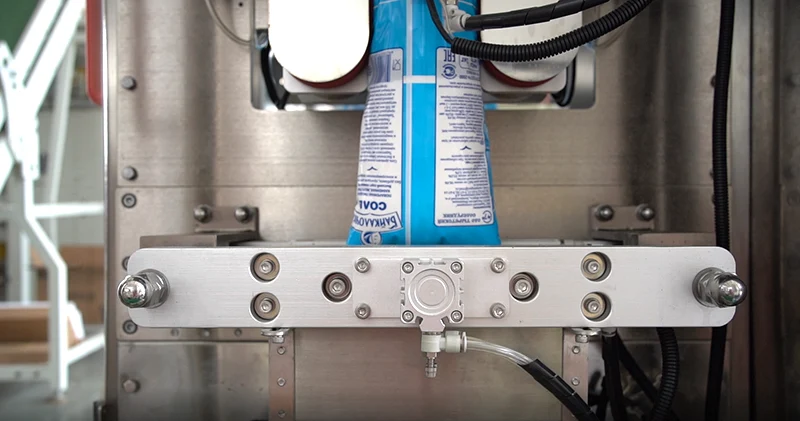
The sealing jaw image gives the clearest proof of why the line performs better on granular and bulk-product bags. Heat sealing is not only about temperature. It is about pressure balance, jaw alignment, and how well the bag is prepared before the seal closes. If the bag still carries too much air, the seal has to fight the package shape. If the jaw is not aligned, the seam quality changes from one cycle to the next. This is why the machine uses a controlled horizontal sealing section rather than a simple clamp-and-release motion.
For bulk-product plants, the final result is straightforward: fewer manual corrections, cleaner bag edges, and more stable output from run to run. That helps not only the primary package but also the downstream handling stage. The line can feed secondary bagging, palletizing, or warehouse dispatch with less rework because the package shape is already under control.
| Line issue | Machine response | Result on the floor |
|---|---|---|
| Uneven hopper feed | Stainless hopper row and auger dosing section | More stable fill cycle |
| Film drag in humid conditions | Dimpled forming shoulder | Smoother film travel |
| Seal drift and weak seam quality | Controlled horizontal sealing jaw | Cleaner, more repeatable seal |
| Manual rework after packing | Consistent machine frame and station alignment | Less correction before dispatch |
What the final result looks like
For buyers packaging salt, grain, resin, or powder, the point of a vertical packaging machine is simple: keep the feed steady, keep the film moving cleanly, and keep the seal repeatable. When those three points are locked in, the whole line becomes easier to plan, easier to supervise, and easier to scale. That is the difference between a line that works in short bursts and a line that supports continuous production.
For plants that need cleaner bagging and steadier output, the machine structure shown here gives a practical path forward: organized dosing, controlled film forming, reliable sealing, and a finish that is ready for dispatch.
Talk to BPM about your bulk-product packaging line English
 Русский