
Cement Packing Equipment for Valve Bags: From Dust Control to Stable Palletized Dispatch
For cement and dry-mix plants moving from manual or semi-automatic filling to automatic valve-bag packaging, VPLINE links bag loading, air-assisted filling, ultrasonic sealing, inspection, negative-pressure shaping, robotic palletizing and stretch-hood protection into one continuous line. The typical reference point is a 25 kg valve bag, subject to material and bag testing.

When a cement plant needs more than a standalone filling machine
A cement, dry-mix mortar, mineral additive or other tested fine-particle plant usually has a clear production scene: material arrives from an upstream silo or process line, is packed into valve bags, checked, palletized and transferred to the finished-goods warehouse or dispatch area. At this point, a search for cement packing equipment is not only a search for a dosing head. The plant needs the packaging, conveying and pallet logistics to work as one automatic line.
The older route—manual bag placement or open-bag filling followed by thread sewing—creates several handoff points. Operators repeatedly handle empty bags, dust can escape while the bag mouth is being closed, and inconsistent residual air can leave bags swollen. A separate checkweigher or palletizer may then be added without solving the gap between stations. The result is more manual coordination, unstable bag presentation and a pallet that is difficult to protect during long-distance transport.
Manual or semi-automatic valve-bag packing may appear flexible, but it leaves dust control, bag-mouth consistency, weight verification, de-aeration and pallet stability dependent on operator timing. These are process risks, not isolated machine defects: a good filling step can still be followed by an underweight bag, an undetected contaminant, a bulging sack or a loose pallet.
Why VPLINE fits automatic cement and dry-mix bagging
VPLINE is designed around a pre-made valve bag rather than roll film. A bag magazine and automatic bagging manipulator pick, open and place the bag onto an expanding valve nozzle. The filling interface uses a main product passage and a return-air passage, allowing air-assisted filling while the bag mouth is held at the nozzle. For a suitable material, bag construction and stable air supply, this enclosed interface supports a lower-dust filling process than an exposed open-bag operation.
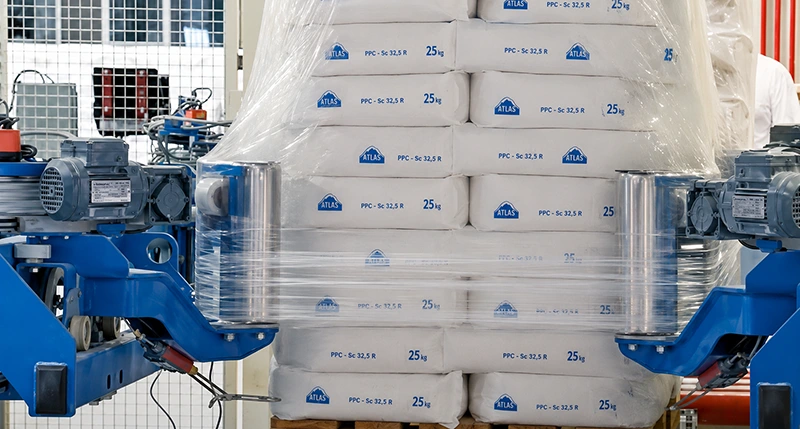
After filling, the line can combine ultrasonic valve-bag sealing, checkweighing and metal detection before palletizing. The ultrasonic unit operates through vibration in the sealing interface; its practical sealing result still depends on the bag’s compatible sealing layer, valve tolerance and powder condition. Negative-pressure shaping removes residual air and improves the bag profile before the robot places bags in an interlocked pallet pattern. The final stretch hood or stretch-film protection creates a more stable handling unit for the finished-goods warehouse and dispatch.
Engineering note: This is a project-configured pneumatic valve-bag packing line, not an instant universal machine. Material flowability, dust behavior, bag permeability, valve dimensions, air quality, ceiling height and required changeover conditions should be confirmed through testing and layout review.
Structure and parameters to verify before specifying the line
The equipment evidence follows the process: bag magazine and gripper at the front, valve nozzle and filling interface at the core, conveyor and inspection hardware after filling, then pallet magazine, palletizing and film protection at the end. The factory image shows enclosed platforms, dust-extraction ducting and integrated conveyors rather than a disconnected filling machine. The palletizing image shows the intended outcome: compact, wrapped 25 kg sacks prepared for storage or transport.
For a new automatic valve bag packaging line, the figures below are source values or planning references, not unconditional production guarantees. Actual performance depends on the product, bag and site. A line review should also confirm compressed-air stability, exhaust routing, pallet dimensions, robot load, pallet pattern, floor space and available headroom.
| Item | Reference for VPLINE planning | Why it matters |
|---|---|---|
| Bag format | Pre-made valve bags; 25 kg shown as a typical reference | Determines nozzle, gripper, sealing and pallet pattern compatibility |
| Filling range | 10–50 kg source range; confirm the project operating point | Material density and bag dimensions affect dosing and cycle time |
| Speed | 5–12 bags/min, depending on material and process conditions | Used to size conveyors, inspection and palletizing capacity |
| Compressed air | 0.5–0.7 MPa reference | Stable pressure supports pneumatic bag handling and air-assisted filling |
| Electrical supply | AC 380 V, 50 Hz, 15 kW for the packaging machine group | Must be checked against the plant utility and line configuration |
| Product-contact material | 304 stainless steel; other structural parts are carbon steel | Supports the specified contact-zone construction and maintenance plan |
Plan the right cement packing equipment around your material
Share the cement or dry-mix material data, target bag weight, valve-bag drawing, desired bags per minute, dust-control requirements, pallet format and plant layout. BPM can then review the filling test, sealing interface, inspection points and palletizing route before preparing a VPLINE line proposal.
Discuss your valve-bag packaging line English
 Русский