
Powder Food Production: How a Zpacker Automatic Paper Bag Packing Machine Controls Dust and Labor
For flour mills and food producers filling 1 kg, 2 kg, and 5 kg paper bags, Zpacker combines premade bag handling, screw dosing, dust removal, sealing, and downstream inspection in one automatic packaging line.
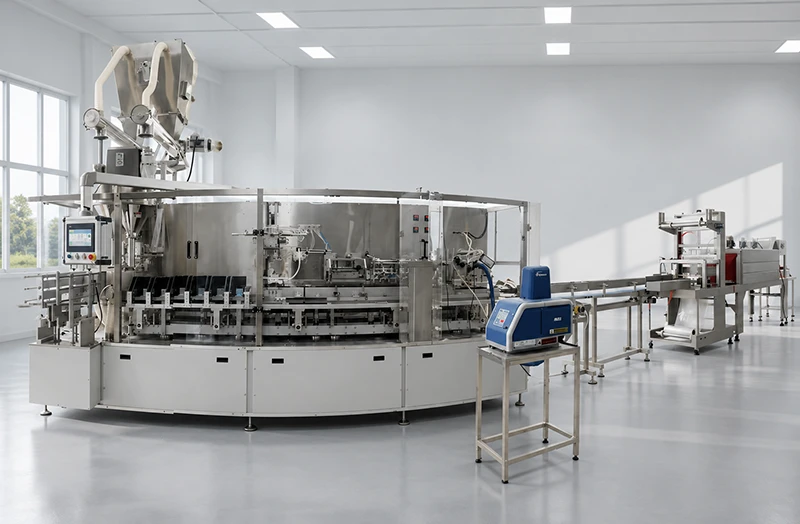
Why flour and powder producers move beyond manual bag filling
A flour mill, bakery supply plant, or other food production site may already have a reliable powder supply system, but manual bag feeding, opening, filling, settling, and closing creates a weak point at the end of the process. Operators must repeat several actions while keeping the bag upright and the target weight stable. This is difficult to maintain when the line must handle common 1 kg, 2 kg, and 5 kg retail flour formats.
The problem is not only labor. Powder can escape around the open bag, remain near the sealing area, or leave the product insufficiently settled. A conventional liquid filler is unsuitable, while a vertical packaging machine usually forms bags from roll film rather than handling a customer’s premade paper or kraft bag. Zpacker is designed for the different sequence required by M-fold square-bottom paper bags and paper-plastic premade bags.
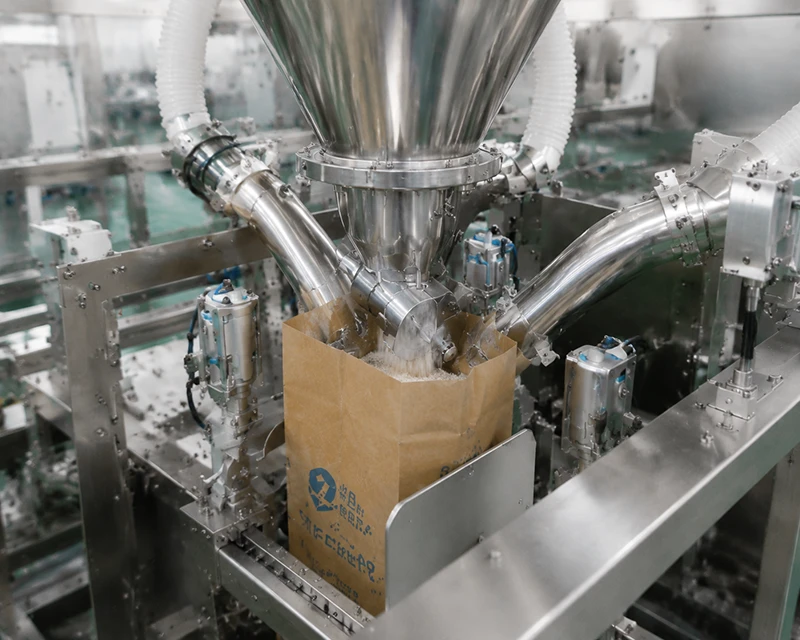
Before comparing nominal speed, confirm powder flowability, dust behavior, bag orientation, bag width and length, M-fold side width, target weights, compressed-air supply, and the available installation area. These inputs determine whether an automatic paper bag packing machine can run the complete process rather than automate only the filling step.
How Zpacker fits the premade paper bag process
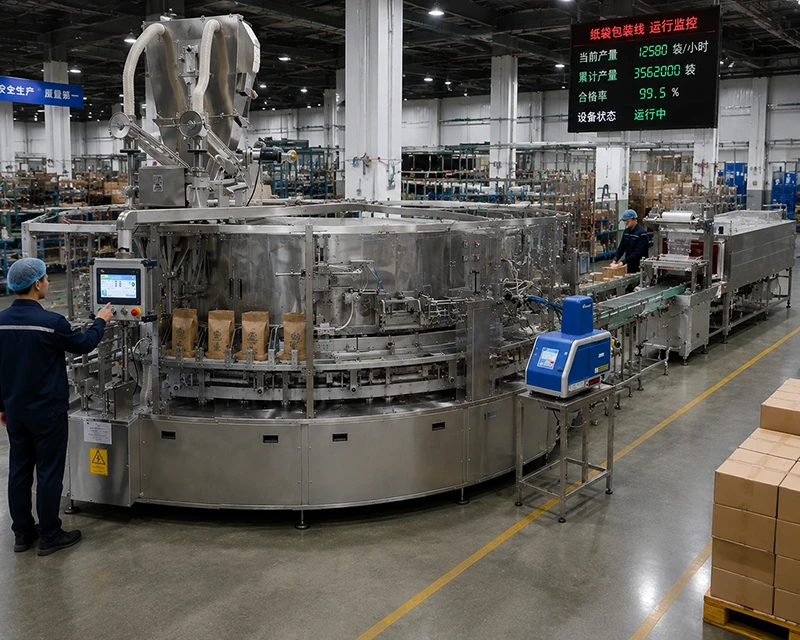
Zpacker uses a belt-fed, dual-station linear arrangement. The bag magazine supplies premade bags; the handling system picks and opens each bag, then positions it for filling. A conical hopper and screw dosing arrangement meter the powder into the open bag. The process is intended for approximately 1–2 kg on one specification range and 2.5–5 kg on another, with the final configuration confirmed by bag samples and material tests.
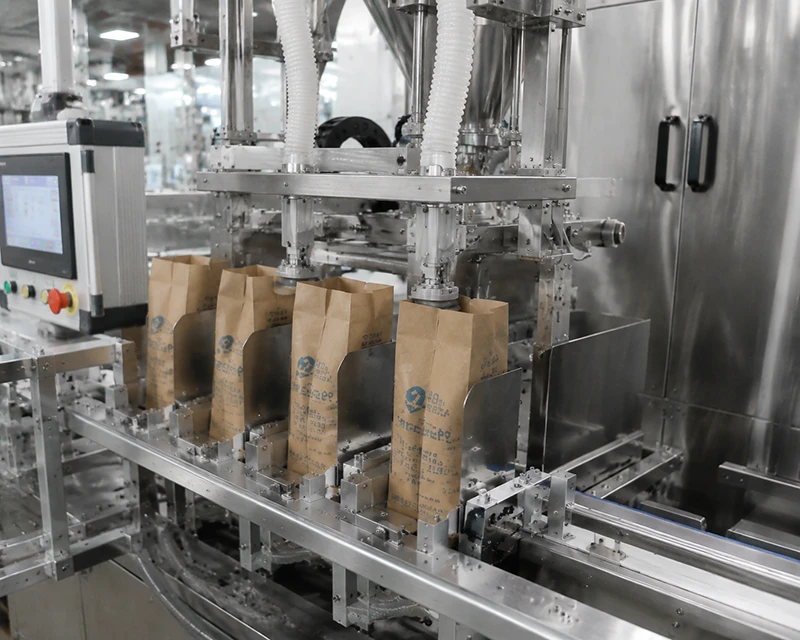
After filling, the bag passes through settling and dust-removal operations before the M-fold is reshaped. The sequence can include edge cutting, edge rolling, hot-melt glue dot or line spraying, and top pressing. This is why the equipment is better described as powder filling equipment than as a generic bag filler: the machine addresses the bag transformation and closing operations as well as dosing.
Engineering note: dust removal and settling should be evaluated together. Removing loose powder near the mouth helps protect the sealing zone, while vibration and settling help create a more stable filled package. The actual result depends on the flour or powder, bag construction, and agreed acceptance conditions.
Reference configuration for a 1–5 kg flour packaging line
The following figures are practical reference points for early project selection, not a substitute for a final technical proposal. A complete automatic packaging line may connect a silo or buffer hopper, screw conveyor, dosing unit, Zpacker bagging machine, conveyor, checkweigher, metal detector, date printer, bag arranging unit, and secondary packaging equipment.
| Selection item | Reference recorded for Zpacker | Why it matters |
|---|---|---|
| Target package | Approximately 1–2 kg or 2.5–5 kg | Determines dosing range and line setup |
| Indicative speed | About 30–35 bags/min for 1–2 kg; 15–20 bags/min for 2.5–5 kg | Must be confirmed against powder and supply conditions |
| Bag reference | W 80–140 mm; L 240–320 mm; M-fold about 60–80 mm | Bag samples and orientation are required before approval |
| Dosing and control | Screw dosing, touchscreen, PLC-based control | Supports repeatable powder filling and operator adjustment |
| Quality and safety path | Dust removal, settling, checkweigher and metal detector options | Extends control beyond the filler into finished-pack inspection |
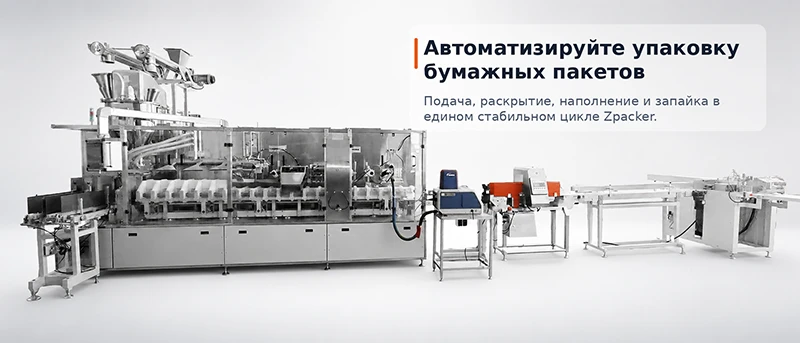
For a food factory or mill, this modular layout provides a clear route from stored flour to grouped finished packs. Secondary packaging can use heat-shrink grouping or manual bagging, with later case packing or palletizing selected according to the logistics plan. The equipment footprint, air pressure, power, and final BOM must be checked for the specific project; published reference data includes about 15.5 kW, 380 V ±10%, 50 Hz, and approximately 0.76 m³/min air consumption.
Confirm the right powder packaging configuration
Send the product, target weight, bag drawings or samples, required output, and available utilities. BPM can then confirm the suitable Zpacker dosing range, bag-handling sequence, dust-removal arrangement, and downstream inspection options for your automatic packaging line.
Discuss your packaging line English
 Русский