
How Flour Is Packed at a Pasta Factory: A 25 kg Powder Bagging Line With Stable Handoff Before Sewing
At a pasta factory, flour packing is not finished when the target weight is reached. The filled bag must remain square, clean at the mouth, and controlled through transfer before sewing or sealing. Mipline links automatic bag handling, bottom-up filling, guided transfer, inspection, and discharge into one powder packaging line.
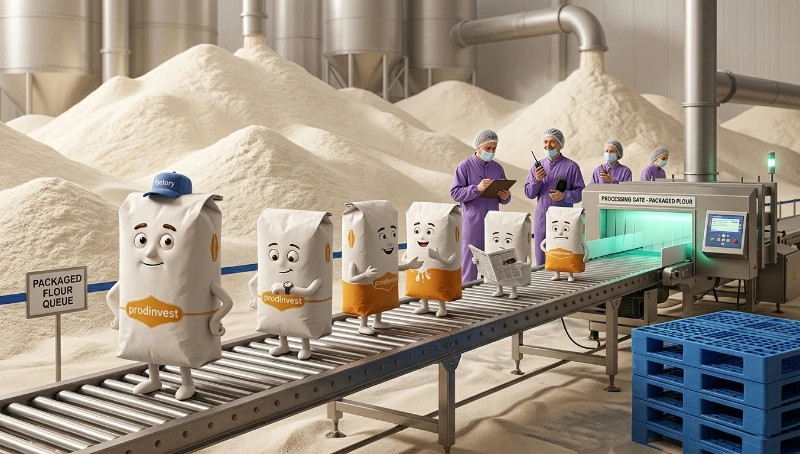
Flour packing starts with a controlled bag, not only a filling head
A pasta factory typically needs to move flour from bulk handling into industrial bags for storage, internal transport, or the next production step. In a basic arrangement, an operator opens an empty bag, holds it under the filler, straightens the filled bag, and guides it toward a sewing head. That method can work at a small scale, but it creates a difficult last meter when a 25 kg bag twists, sags, or arrives with a skewed mouth.
Mipline is configured as an automatic powder bagging line for this complete sequence. A bag magazine and pickup section prepare the bag; a clamp holds it during filling; the bottom-up filling method keeps the fill point close to the product; and downstream transfer sections support a cleaner handoff before sewing or sealing. The exact speed and configuration still depend on flour bulk density, flowability, bag construction, target weight, and the factory layout.
Free-fall filling and un guided conveying may leave flour bags dusty, uneven, or out of square. Operators then spend the last meter manually straightening the bag before the sewing head. The sewing process becomes less stable when the mouth arrives skewed, while dust around the closure area makes housekeeping and sealing more difficult.
Why Mipline fits a flour bagging line at the pasta factory
The solution is to treat bag supply, filling, closure, and transfer as one process. The line can use three-stage screw feeding—fast filling, medium filling, and slow final dosing—together with weighing control. Bottom-up filling is designed to reduce the free-fall distance and keep the fill point close to the flour. Where specified, vacuum extraction or de-aeration can be added before closure. These functions address the source of the problem instead of asking an operator to correct the finished bag manually.
After filling, the bag moves through a controlled path that can include dust removal, trimming, inner-bag heat sealing, pressing, sewing, paper-tape wrapping, or other project-defined closure steps. Turning, settling, shaping, metal detection, checkweighing, reject, and roller discharge can then be integrated according to the required line layout. This is why the equipment should be evaluated as a powder filling and bag sewing line rather than as a standalone automatic powder packing machine.
ENGINEERING VIEW: The critical result is not simply “the bag moved.” The transfer conveyor, bag clamp alignment, and downstream shaping path must deliver a stable bag mouth and a repeatable bag position to the next station. That is the practical difference between conveying and a stable bag handoff before sewing.
Visible machine evidence behind the process
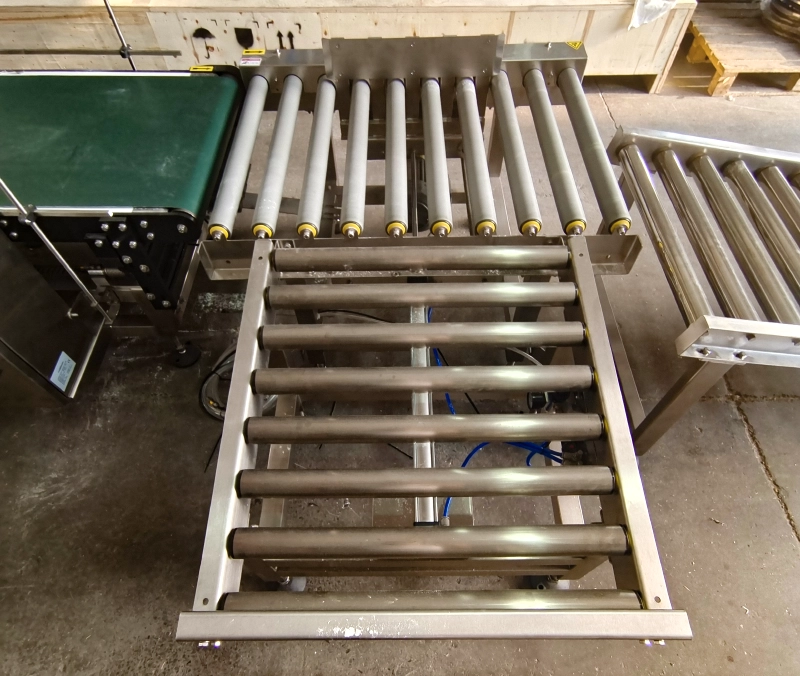
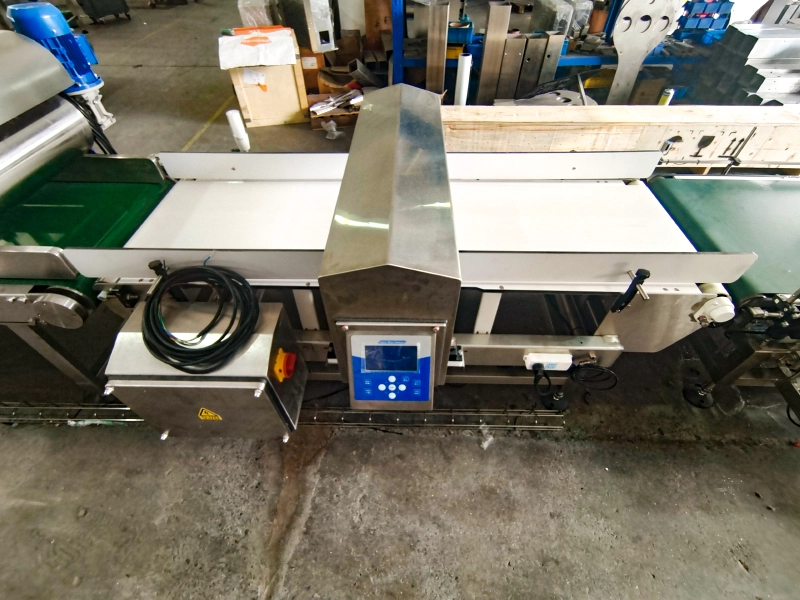
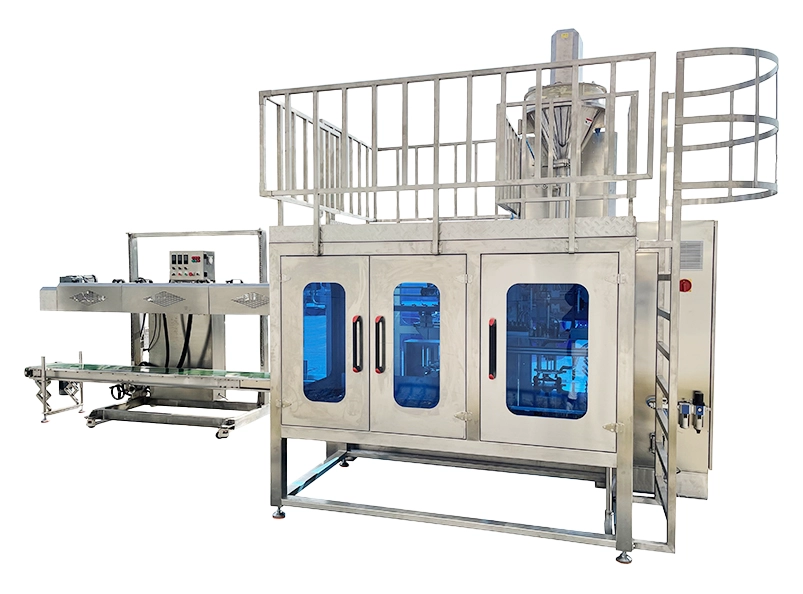
The production images show the structures that make the flour packing sequence controllable: an enclosed stainless steel bagging station, blue inspection windows, a bag magazine conveyor, green transfer belts, roller conveyor sections, and guided transfer equipment. These are not generic factory decorations. They show how operators can supervise the automatic bagging machine for powder while keeping access, guarding, and line connection visible.
A twin-belt transfer conveyor with adjustable side guides helps maintain a more consistent path between stations. Angled roller sections support bag transfer and line integration, while the enclosed station and inspection windows provide a defined area for bag handling and maintenance access. Final specifications must be confirmed against the flour, bag material, closure method, required throughput, and palletizing interface.
| Process point | What the line addresses | What must be confirmed |
|---|---|---|
| Bag supply and clamping | Repeatable bag placement before filling | Bag dimensions, material, mouth construction |
| Bottom-up filling | Shorter product fall and controlled dosing | Flour flowability, density, target weight |
| Transfer before sewing | Cleaner alignment and less manual straightening | Guide layout, closure head, line height |
| Inspection and discharge | Defined checks before storage or palletizing | Checkweigher, detector, reject, downstream layout |
Specify the flour bagging line around the handoff point
For a pasta factory, start with the flour properties, 25 kg bag construction, required closure, target output, inspection needs, and available conveyor space. Mipline can then be configured as dry powder packaging equipment with the bag clamp, transfer conveyor, sealing, shaping, and inspection functions required for a stable route into sewing or final handling.
Discuss Your Flour Packaging Line English
 Русский