
25 kg Powder Bagging Line with Stable Bag Transfer Before Sewing
How a Mipline automatic powder packaging line keeps a filled 25 kg kraft bag square from the gross weigher through the sewing head — and why the last meter before sewing decides your reworked-bag rate.
Where 25 kg powder bags actually twist and collapse
A 25 kg bag of milk powder, flour, starch or whey isolate is not a rigid container. After the gross weigher discharges through the bag spout and the clamp closes, the kraft or woven PP wall has very little shape memory. The filled bag now has to travel through a transfer conveyor, a bag mouth opening station, an inspection zone and finally arrive at the sewing head in a square, flat condition. Any lateral force applied during that travel deforms the bag wall.
In most older powder lines, the last meter before sewing is a flat belt with no side guidance. The bag arrives with its mouth skewed 5–15° off-axis. Operators stand at the sewing head and manually straighten each bag. At 600 bags per hour that is constant intervention — and it is exactly where the sewing needle breaks, the thread loop misses the seam, and the rework bin fills.
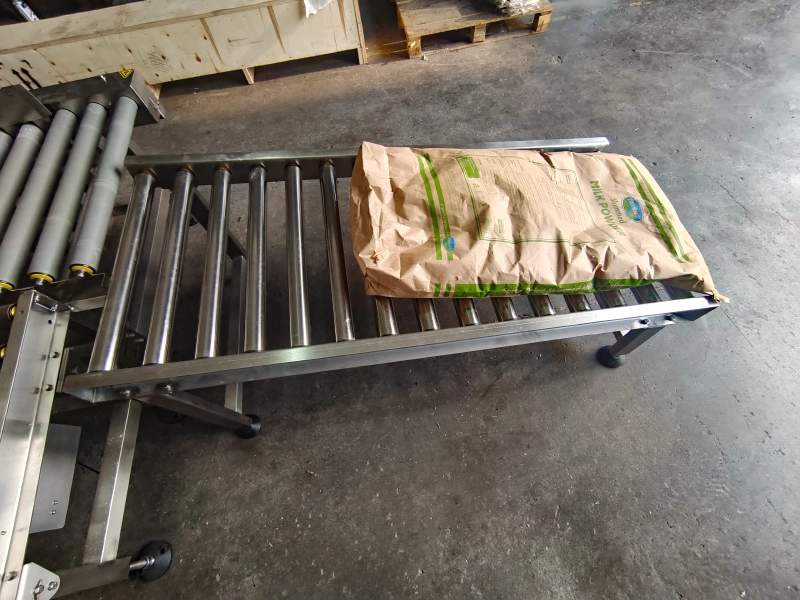
The sewing head is the last station in the line. Once the bag arrives misaligned, no upstream correction is possible. The result is rejected bags, jammed needles, and operators getting their hands close to moving needles. It is both a quality problem and a safety problem.
How Mipline keeps the bag square from filling to sewing
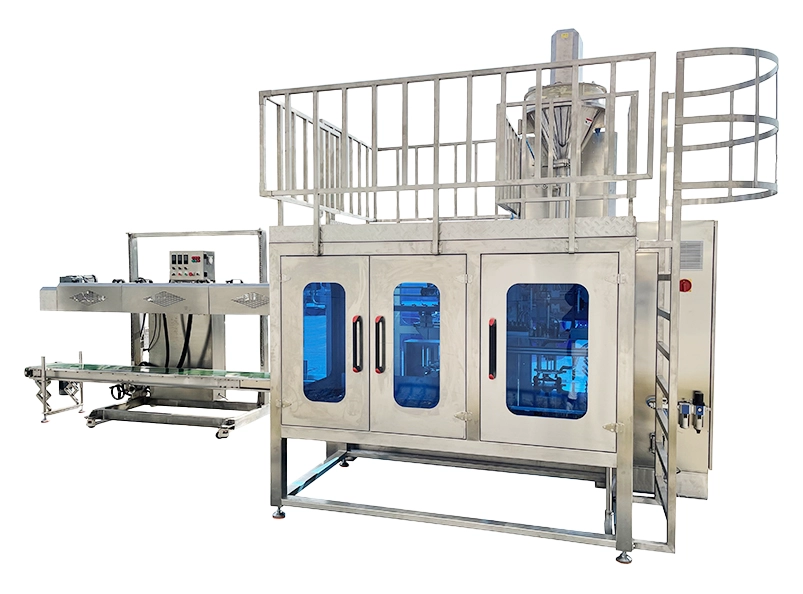
Mipline starts the alignment job at the upstream end. The bagging station is a fully enclosed stainless-steel cabinet with three blue inspection windows, a top maintenance platform with safety railing, and a bag magazine conveyor that feeds empty bags into the clamp. Because the empty bag is already square when it leaves the magazine, the upstream reference is correct from the first step.
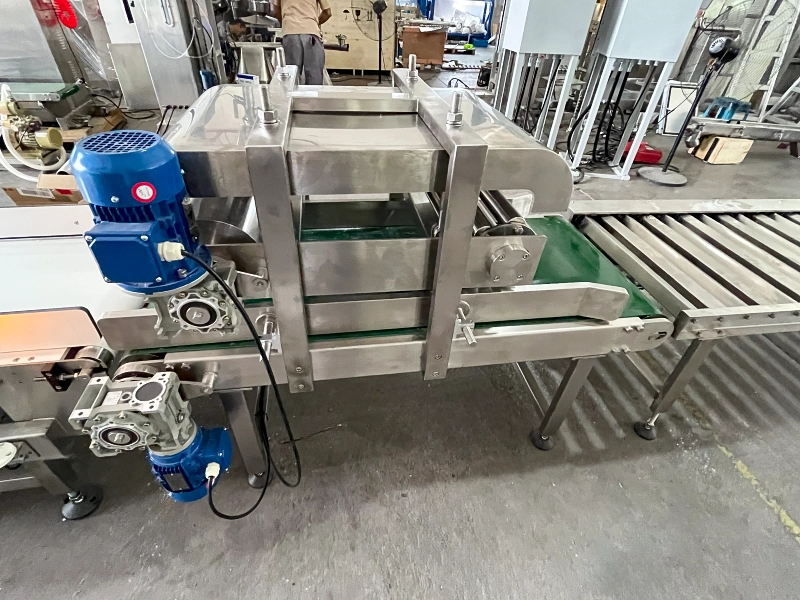
From the clamp to the sewing head, the bag rides a guided transfer path. A twin-belt transfer conveyor with adjustable side guides carries the filled bag away from the filling nozzle. An angled roller section aligns the bag walls against a fixed guide rail. A separate roller conveyor with vacuum grippers holds the kraft paper wall flat while the bag mouth is shaped for sewing. Every transition has a physical reference — there is no free-flight zone where the bag can drift.
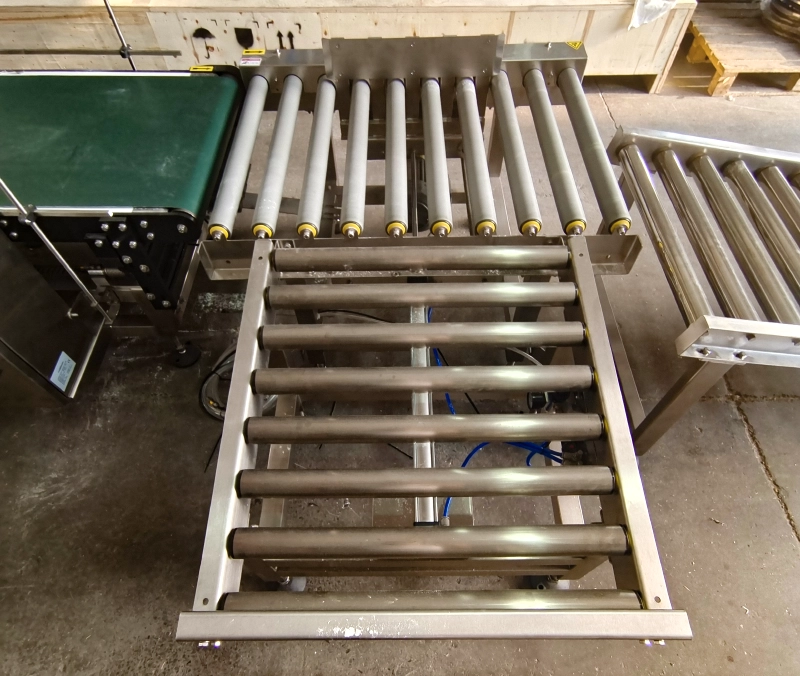
Field note: On a 600-bag-per-hour milk powder line, Mipline measures bag-mouth skew at the sewing head. Lines with an unguided transfer average 8–12° of skew and 4–6% reworked bags; Mipline holds skew under 2° and reworked bags under 1%.
Engineering evidence: how the line is specified for 25 kg powder
These numbers are not nominal — they are the working envelope the line is built around. The 304 stainless contact parts let the line handle milk powder, whey, food starch and other dairy or flour products without contamination risk. The 600 mm conveyor width is sized for the standard 25 kg kraft bag footprint.
The PLC and HMI are sized so the line can be reconfigured for a different bag size — 20 kg, 25 kg, 50 kg — by changing the recipe, not the mechanical layout. That is the difference between a packaging line that ships product and a packaging line that ships product at the rate your sales team promised.
| Parameter | Mipline specification |
|---|---|
| Throughput | Up to 600 bags / hour (25 kg) |
| Bag type | Kraft paper, woven PP, PE-lined |
| Bag weight range | 20 – 25 kg |
| Contact parts | SUS 304 stainless steel |
| Conveyor width | 600 mm |
| Air supply | 0.6 MPa, ~200 L/min |
| Power supply | 380 V / 50 Hz / 3-phase |
| Operator per shift | 1 (line monitoring) |
| PLC / HMI | Siemens S7-1200 + 7″ HMI |
| Sewing head | Newlong NP-7A or equivalent |
| Frame material | Q235 carbon steel + stainless cladding |
Send us your bag size, your powder, and your target bags-per-hour
We will spec a Mipline configuration for your 25 kg powder line — including the bag handoff before the sewing station, the sealing head, and the upstream gross-weigher interface.
Request a Line Spec English
 Русский