
Automatic Valve Bag Cement Packaging Line: 25 kg Robotic Bagging, Ultrasonic Sealing, and Robotic Palletizing in One Cell
A 25 kg cement valve bag packaging line ties a wheeled bag magazine, twin-arm robotic bagger, air-assisted filling nozzle, ultrasonic sealing, checkweighing, metal detection, negative pressure bag shaping, and robotic palletizing into one continuous cell. For a regional cement producer running 5–12 bags per minute, this is what stops dust at the spout, keeps bag weights on target, and ships a stable pallet out the door.
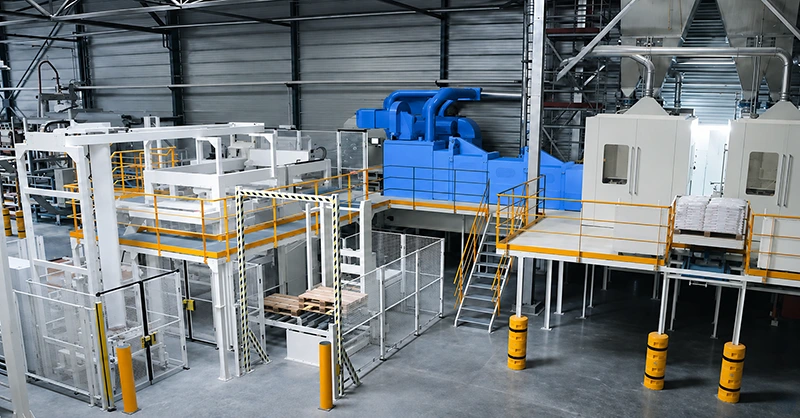
Why cement plants replace manual valve bagging with a fully automatic cell
Cement valve bags have always been a tough packing job. The old way runs like this: an operator picks up a 25 kg valve bag from a stack, opens the valve by hand, holds it against the packer spout while cement is blown in, slides the bag onto a sewing head or ultrasonic sealer, lifts the sealed bag onto a pallet, and repeats. Two operators per spout, one operator sewing, two operators palletizing. The cycle lives and dies by hand speed, and that hand speed is the bottleneck that decides whether the cement mill can ship a full truckload before the silo runs empty.
When a regional cement producer near Moscow Oblast scaled up to a third packing bay, they kept running into the same four problems. Dust leaked at the spout during each cycle. Bag weights drifted because the operator could not hold the bag still for the full fill time. Seals were inconsistent, with a small share of bags going out un-sealed. Pallet stacks leaned or slumped on the truck because every bag arrived at the pallet with a different amount of trapped air. The fix was not a bigger silo or a faster truck. The fix was a packaging line where each station is engineered for cement and the stations are wired together end-to-end.
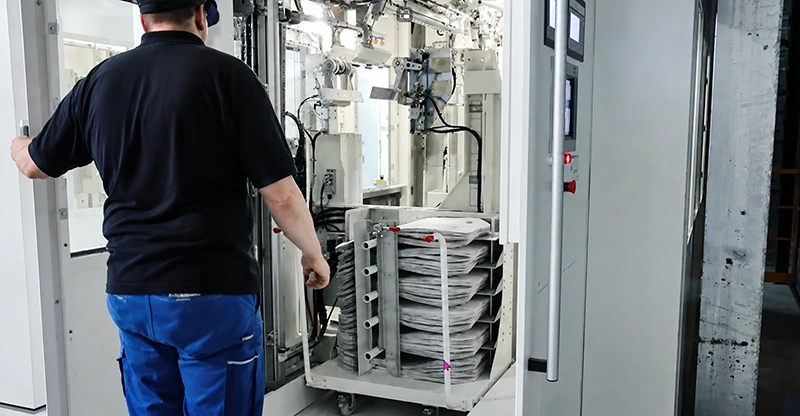
Dust leaks at the filling nozzle, bags that inflate like balloons, seals that fail in transit, and pallet stacks that lean on the truck. Any one of them can shut down a cement mill’s shipping window.
How the line stops dust, rework, and stack collapse at the spout
The filling station is where a cement valve bag line is won or lost. Our valve bag filler uses an inflatable spout that opens inside the valve of the bag. A large-bore feed channel delivers cement into the bag while a smaller return-air channel pulls displaced air back out through the same spout. The bag seals against the outside of the spout, so the cement stays inside the closed loop during fill. Material contact parts are 304 stainless steel; the rest of the frame is welded carbon steel, which is enough for cement duty and keeps the cell weight manageable.
Once the bag is filled, the seal is the next critical station. We use a 20–40 kHz ultrasonic weld head on the valve area to generate frictional heat at the inner film layer and close the valve. Ultrasonic sealing does not introduce a heated element into the bag, so there is no scorch risk on coated woven polypropylene valve bags. Right after the seal, the bag runs through a checkweigher and a metal detector, so any bag that misses the target weight or carries tramp metal is rejected before it ever touches a pallet. That is the quality gate.
Engineering note: Negative pressure bag shaping is the station that makes the rest of the pallet stable. After sealing, each bag is run through a vacuum chamber that pulls residual air out of the woven body. A flat bag stacks. A balloon does not. A flat bag is also what lets the palletizer place three bags per layer in the one-flat, two-tall pattern without skewing the stack, which is what makes a 25 kg cement pallet survive a long-haul truck without leaning.
Key stations and engineering parameters for a 25 kg cement valve bag line
The numbers below are the typical configuration we ship for a 25 kg OPC or composite cement job. Cement is abrasive and dusty, so the line is built around dust containment, gentle bag handling, and stable pallets. A project-specific layout review is required before any cycle rate or bag weight range is committed in writing.
| Station | Function | Typical spec for cement |
|---|---|---|
| Mobile bag magazine | Holds empty 25 kg valve bags and feeds the bagger | Welded steel frame on casters, ~150–200 bags per load, side guide rails and pneumatic clamps |
| Twin-arm robotic bagger | Picks, opens, and seats the valve onto the spout | Dual pneumatic grippers, 304 stainless contact, dual-station layout so one arm can serve two fillers |
| Air-assisted valve filler | Inflatable spout, large feed channel, return-air channel | 304 stainless contact, 0.5–0.7 MPa clean dry air, 5–12 bags/min |
| Ultrasonic sealer | Closes the valve area without a heated plate | 20–40 kHz weld head, suited to coated woven PP valve bags |
| Checkweigher + metal detector | Quality gate before palletizing | ±1–2‰ target weight window, ferrou and non-ferrous detection, reject conveyor |
| Negative pressure shaping | Removes trapped air from the woven body | Vacuum plenum, sealed chamber, knife-edge seals on the bag sides |
| Robotic palletizer | Builds the interlocked stack and applies hood film | Three-bag layer pattern, layer sheet dispenser, cold-applied stretch hood |
| Line power and footprint | AC 380 V, 50 Hz, ~15 kW for the packer section | Roughly 15–20 m long, 4–6 m wide, ≥4.5 m clear ceiling for the palletizer |
Talk to a cement packaging line engineer
Send us your cement grade, target bag weight, current throughput, bag type, silo layout, and the ceiling height of your packing hall. We will map the line stations, confirm the cycle rate, and quote a configuration that fits your building, not a generic catalog page.
Request a cement line layout English
 Русский