
Sifted Sand and Crushed Stone Valve-Bag Packing Line for a Northern Aggregate Plant
A Kandalaksha-based aggregate producer moved from manual 25 kg bagging to a closed-loop VPLINE valve-bag line, cutting airborne dust at the fill point, stabilising pallet stacks for long-distance haulage, and stitching filling, ultrasonic sealing, checkweighing, metal detection, robotic palletizing and stretch-hood wrapping onto one floor.
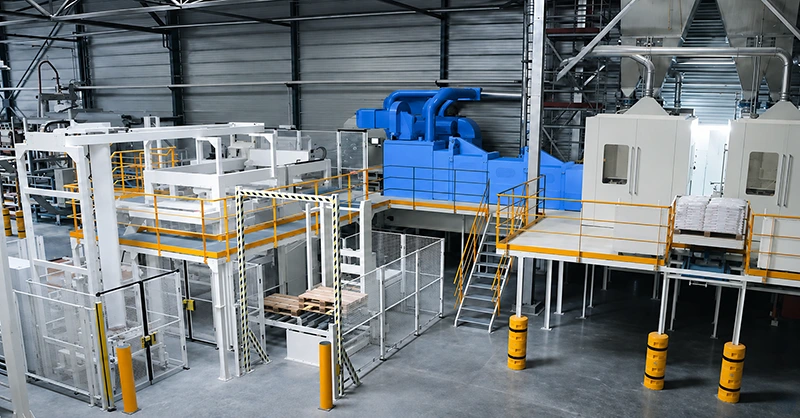
From shovels and open-mouth bags to a closed 25 kg valve-bag line
Kandalaksha sits above the Arctic Circle, and aggregate shipments leave the plant in palletised 25 kg units destined for construction sites across northwestern Russia. Until recently, sifted sand and graded crushed stone were filled by hand into open-mouth paper or woven polypropylene sacks. Two operators held each bag under a gravity spout while a third sewed or tied the mouth, and the finished pallets were moved with a hand pallet truck to a separate stretch-wrap station at the loading bay.
That layout produced three chronic problems. Visible dust escaped at the spout every time a bag was repositioned, net weight drifted between 24.6 kg and 26.1 kg from one operator to the next, and pallet stacks leaned or toppled in winter when cold bags stiffened and slipped on wooden pallets. Reject rates above 4% were absorbed into margin because remote-site customers accept a 0.5 kg shortfall but reject damaged or dirty bags, and damaged pallets mean re-bagging the entire stack at the warehouse before delivery.
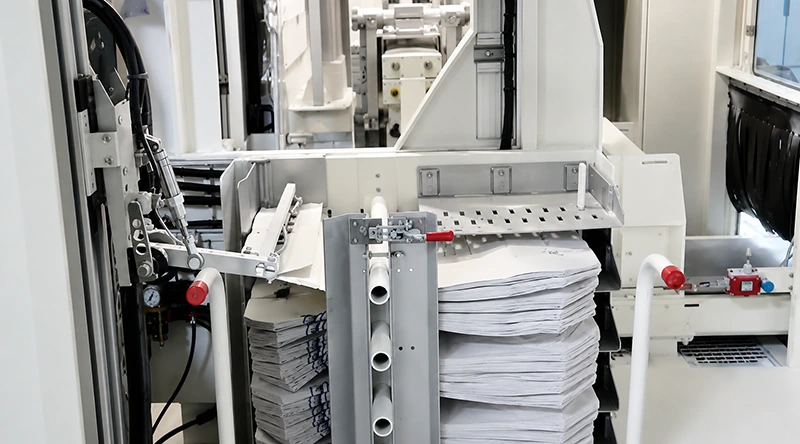
Airborne dust at the fill point, weight drift of more than 1.5 kg between bags, and pallet stacks that fail on the first leg of a 1,200 km winter haul.
Air conveying, ultrasonic sealing and negative-pressure shaping, applied to dry aggregate
VPLINE replaces the gravity spout with an inflatable valve-bag nozzle. The nozzle expands inside the bag mouth, then a regulated air stream carries the sand or crushed-stone fraction into the bag through a large-diameter feed channel while a smaller return channel bleeds displaced air back to the dust collector. With the bag sealed against the nozzle collar, the fill interface is enclosed from the first gram to the last, which is the single most effective dust control measure available on a dry-fill valve-bag line and removes the need for an operator to hold the bag against the spout.
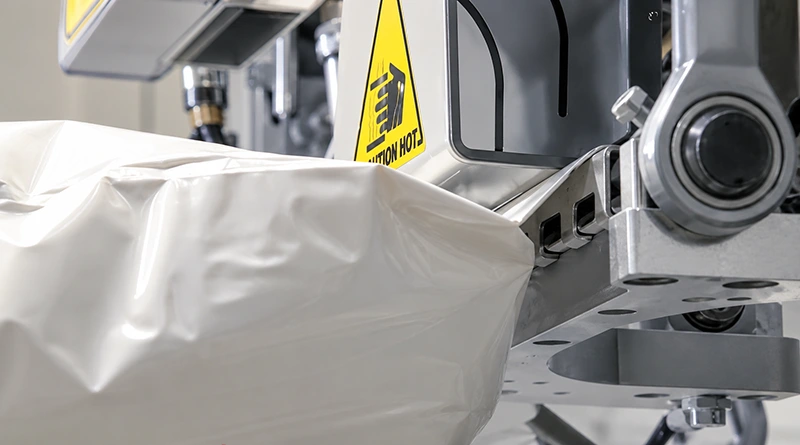
Once the target weight is reached, the valve mouth is closed by a 20–40 kHz ultrasonic weld head. The horn vibrates against the inner valve layer, generating frictional heat that fuses coated woven polypropylene or kraft-paper valve laminations without external heating elements or hot bars. After sealing, the bag passes through a negative-pressure shaping station that evacuates residual air from the bulk, so the bag arrives at the palletizer with a flat, brick-like profile instead of a pillow that can roll off the stack when the winter wind hits it on the loading dock.
VPLINE Field Note For sifted sand and graded crushed stone in 25 kg valve bags, the line is normally specified at 5–10 bags per minute, weighed to ±1–2‰ against an in-line checkweigher, and scanned by a metal-detection gate before the robotic palletizer builds a five-layer interlock pattern. Throughput, accuracy and stack height are project values, not catalogue promises, and must be confirmed against the actual material bulk density, valve-bag tolerance and compressed-air stability on site.
Why a single integrated line beats three standalone machines
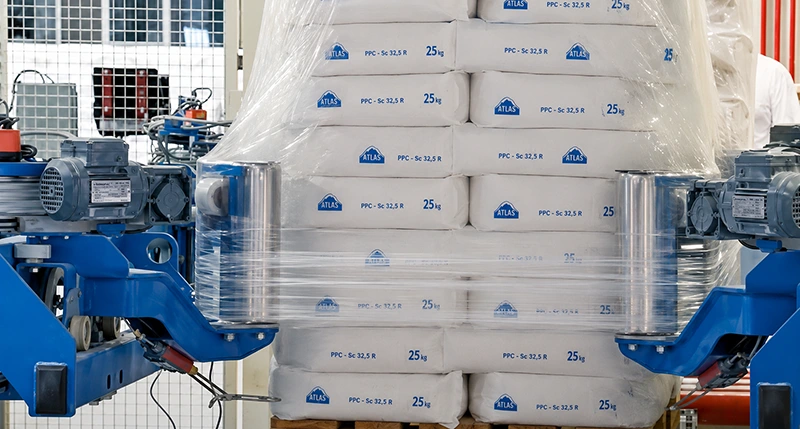
Buyers often price three standalone units: a valve-bag filler, a checkweigher and a robot palletizer. The Kandalaksha evaluation showed that approach leaves the bag open between stations, exposes the unsealed valve to conveyor vibration, and forces the operator to hand-correct every stack before stretch-wrapping. An integrated VPLINE line keeps the bag clamped from fill through seal, runs checkweighing and metal detection in the same travel, and ends with a stretch-hood wrapper that locks the stack as a single unit for winter transport across northwestern Russia.
The footprint also matters. VPLINE is planned around an approximately 15–20 m straight run, 4–6 m wide and at least 4.5 m clear height under the gantry, so the line fits inside an existing aggregate hall without civil work. Material-contact parts are 304 stainless steel, the rest is carbon steel with a white industrial coating, and the electrical pack is rated AC 380 V, 50 Hz, 15 kW for the filler section, fed from a 0.5–0.7 MPa compressed-air network that the plant already runs for its dust-collection system.
| Parameter | Specification |
|---|---|
| Target product | Sifted sand, graded crushed stone, dry mineral aggregate |
| Bag type | 25 kg valve bag (coated woven PP or kraft-paper lamination) |
| Throughput | 5–10 bags/min, project-confirmed against material bulk density |
| Weighing accuracy | ±1–2‰ against in-line checkweigher |
| Fill interface | Inflatable valve nozzle with feed and return air channels |
| Sealing | 20–40 kHz ultrasonic valve weld head |
| Bag shaping | Negative-pressure flattening station |
| Quality gates | Checkweigher and metal-detection gate in series |
| End-of-line | Robotic palletizer with stretch-hood wrapper |
| Contact parts | 304 stainless steel |
| Frame and structure | Carbon steel, white industrial coating |
| Power supply | AC 380 V, 50 Hz, about 15 kW for the filler section |
| Air supply | 0.5–0.7 MPa, project-confirmed consumption |
| Footprint | About 15–20 m × 4–6 m, at least 4.5 m clear height |
| Operating crew | One operator on bag-magazine refill and end-of-line pallet take-off |
Specifying a VPLINE line for sifted sand and crushed stone
Before the line is configured, BPM confirms the bulk density of the sifted sand and the largest grading of crushed stone that will pass the valve mouth, the tolerance of the valve bag drawing from the converter, the static pressure stability of the 0.5–0.7 MPa air network over an eight-hour shift, the clear height under the hall truss and the pallet size the customer wants to ship. With those five numbers, BPM returns a VPLINE layout with cycle time, stack pattern, air-consumption figure and the recommended stretch-hood film grade for the local winter.
Send the same five numbers through the contact form below and the BPM engineering team will return a full VPLINE proposal for the Kandalaksha plant, including the bag-magazine capacity, robot payload, pallet-stack height and a reference list of similar aggregate and dry-mix projects already running on this configuration.
Send us your sand, gravel and aggregate bag specification
Share the bulk density, valve-bag drawing, target throughput and hall dimensions, and BPM will return a VPLINE layout with cycle time, stack pattern and air-consumption figures for your site.
Request a VPLINE Quote English
 Русский