
Granulated Sugar in 1–5 kg Paper Bags: How Zpacker Adapts to a Free-Flowing, Hygroscopic Powder
Granulated sugar pours like a liquid but absorbs moisture like salt. A line tuned for flour will over-feed, under-compact and let fine dust drift past any extraction not designed for sugar crystals. Here is how a Zpacker premade paper bag line is re-confirmed for a 1–5 kg sugar line — and which site inputs must be locked before the order is approved.
Why Granulated Sugar Breaks a Manual Filling Bench
Retail granulated sugar is sold in 1 kg, 2 kg and 5 kg paper bags in many markets. Workers on a manual bench scoop sugar into pre-opened paper bags, weigh it on a bench scale, then carry each bag to a sewing or stitching station. The flow looks simple. In production it has three repeating problems: weight drift between bags as scooping fatigues, fine sugar crystals shaken loose during scooping and transfer that drift into the air, and bag shape damage when a partly filled 5 kg bag has to be moved by hand into the next station.
The price of that drift shows up downstream. Underweight bags trigger retailer rejections at goods-in; overweight bags silently waste product. Sugar that escapes the bag leaves a sticky film on the floor, the conveyor and any metal surface, and that film pulls in moisture from the room. Caked sugar then transfers onto the next bag’s outside surface and the next pallet. A premade paper bag line removes most of those failure points — but only if the dosing, dust extraction and sealing are matched to sugar specifically, not just borrowed from a flour configuration.
Granulated sugar pours like a liquid but absorbs moisture like salt. A line tuned for flour will over-feed, under-compact and let fine dust drift past any extraction not designed for it. Zpacker’s screw dosing, M-fold paper bag handling and dust removal must be re-confirmed — not assumed — for sugar.
How Zpacker’s Screw Dosing, M-Fold Bag Handling and Dust Removal Map to a Sugar Line
Sugar flows differently from flour. At the dosing station, Zpacker’s twin-screw volumetric feeder is sized for the bulk density of the powder on site. Granulated sugar runs near 0.80–0.85 g/cm³ — finer and heavier than most flour grades — so the screw pitch, screw speed profile and discharge clearance are re-confirmed against an actual sample, not a generic flour setting. The dosing accuracy quoted on the technical specification is approximately ±0.5% of the target weight. On a 2 kg sugar bag that holds each bag within about ±10 g of the label weight, which keeps a retailer audit clean.
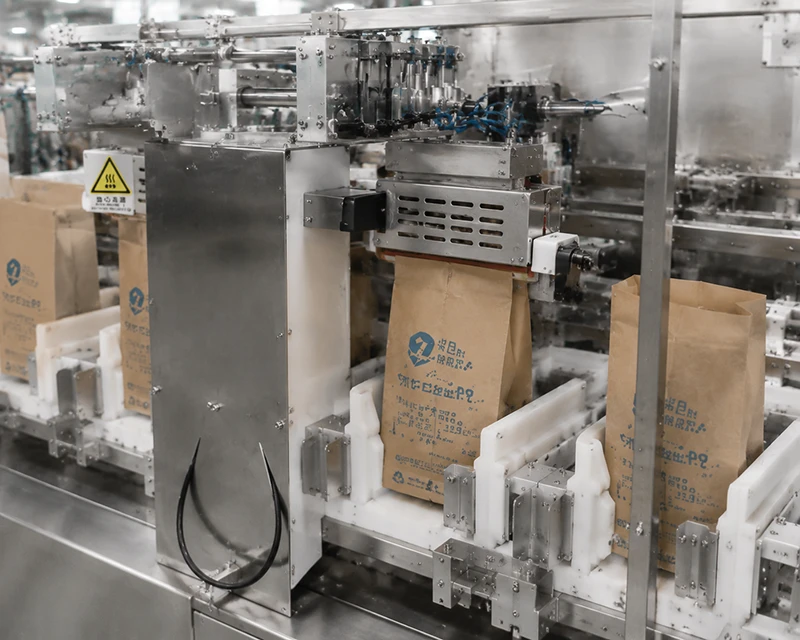
At the bag station, Zpacker takes a flat M-fold paper bag from the magazine, opens it into a standing pouch, then — after dosing — folds the M-side back in, trims the edge, applies hot-melt glue in a dot or line pattern and presses the top closed. Sugar granules are heavier and rounder than flour, so they settle cleanly without compaction. The hot-melt seal closes on a clean, dry paper surface because the dust extraction at the fill point pulls the airborne fine fraction down to the filter before it can land on the glue line. Without that extraction, sugar dust mixes with melted glue and the seal peels.
Speed and bag format: Zpacker configurations on the technical sheet cover 1–2 kg in one build and 2.5–5 kg in another. For a sugar line, the 1–2 kg build typically runs at about 30–35 bags per minute; the 2.5–5 kg build runs at about 15–20 bags per minute. Final acceptance speed is confirmed on the customer’s actual sugar sample, not a generic spec.
What a 1–5 kg Sugar Line Looks Like End to End
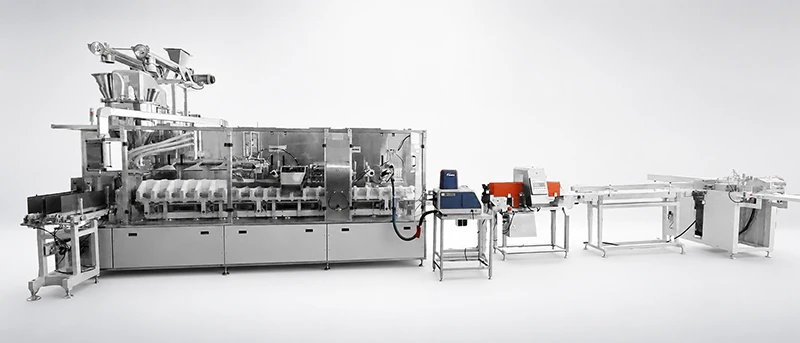
A premade paper bag line for sugar is more than the bagging machine. Zpacker connects upstream and downstream stations that a buyer sometimes forgets to budget. Upstream, a buffer hopper and screw conveyor feed the dosing station from a sugar silo or refiner bag-dump station. The control panel runs on a 10.4-inch touchscreen with PLC logic and the safety interlocks stop the line if air pressure drops below the set point or if a bag is missing at the open station.
Downstream, sugar hits three stations a flour line can sometimes skip. A checkweigher catches the occasional underweight bag before it ships; a metal detector protects the brand from metal fines that come off the refiner screens; and a date coder prints the batch code on the flat M-fold panel. After that, sugar bags are typically grouped with a shrink wrapper or case packer because retail sugar is sold in multi-packs in most modern grocery channels.
| Station | Equipment | Purpose on a sugar line |
|---|---|---|
| Upstream feeding | Buffer hopper + screw conveyor | Steady pressure to the dosing station |
| Dosing | Twin-screw volumetric feeder | Target weight to about ±0.5% |
| Bag handling | M-fold paper bag magazine + opener | Picks a flat bag, opens it to a standing pouch |
| Fill-point dust removal | Local extraction + filter | Keeps the glue line clean, controls airborne fine sugar |
| Sealing | Hot-melt dot/line spray + press | Closes the M-fold without heat-sealing the paper |
| Checkweighing | Checkweigher | Rejects bags outside ±0.5% tolerance |
| Metal detection | Tunnel metal detector | Catches fines from the refiner screens |
| Coding | Inkjet or laser date coder | Batch / lot / date on the flat M-fold panel |
| Secondary packing | Shrink wrapper or case packer | Multi-pack format for retail |
Three inputs to lock in writing: Before a sugar line is approved, three inputs must be confirmed in writing: the actual sugar sample (not a spec sheet), the retail bag drawing with M-fold dimension against a physical bag, and the downstream connection point — shrink wrapper or case packer — because sugar’s weight and surface need a slightly different gripper profile than flour.
Send Us Your Sugar Sample and Bag Drawing
A Zpacker 1–5 kg sugar line is configured against your real sugar, your real bag and your real downstream connection. Send us the sample, the bag drawing with M-fold dimension and your target bags per minute — we will return a confirmed specification, a layout sketch and a project quote.
Request a Sugar Line Quote English
 Русский