
Granule Bagging Line: Steady 25 kg Woven Sack Flow
A heavy-bag granule bagging line replaces loose sack presentation, weighing gaps, and unstable handoffs with one continuous flow from hopper to pallet-ready stack.
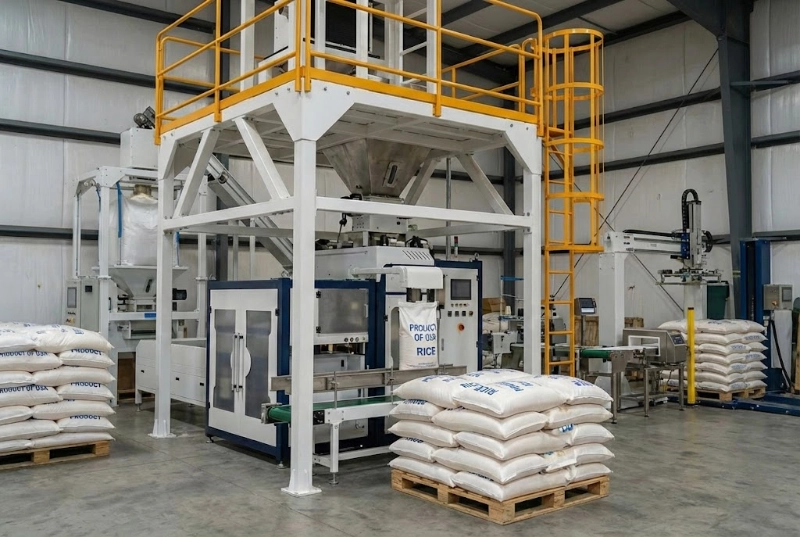
Where woven-sack warehouses lose rhythm
A 25 kg woven sack of grain, feed, plastic pellets, or fertilizer is heavy long before it is full. Manual sack presentation, separate weighing, and ad-hoc transfer between the filling and pallet stations slow the line. A granule bagging line solves that by combining bag pickup, gross weighing, fill, and guided outfeed into one controlled sequence. Once the stations are connected, operators stop rushing the same bag from point to point, and the workshop gets a predictable rhythm instead of stop-and-go.
For buyers comparing a heavy-bag packaging line or an automatic bagging line for free-flowing granules, the practical question is the same: can the line keep a 25 kg sack square from gross weigher to pallet stack? On most factory floors, that is exactly where output drops. The granule bagging line answers with a closed-loop bagging station, tracked roller transfer, and an outfeed that hands each sack to the next station in the same orientation.
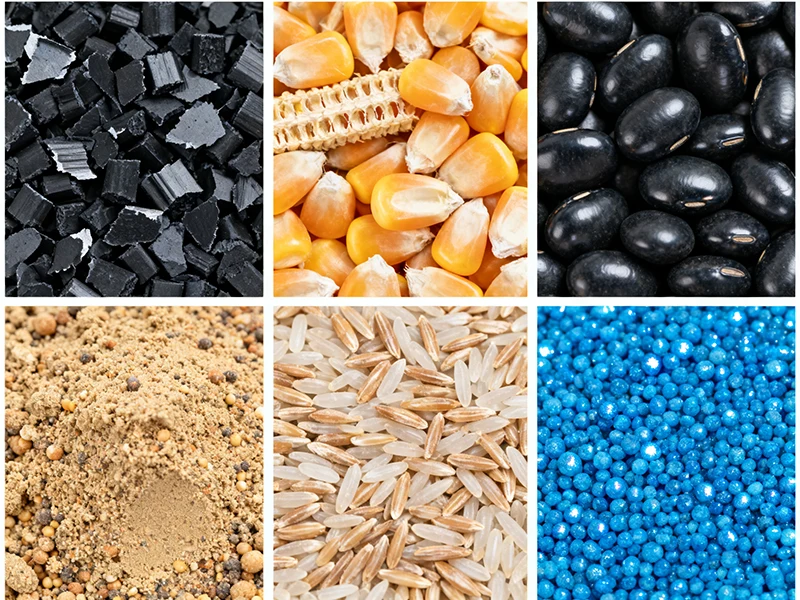
Loose sack presentation, weighing gaps, and unstable handoffs between filling and palletizing are the most common reasons a granule bagging line loses its target output. The fix is connecting bag pickup, weighing, fill, transfer, and outfeed into one controlled flow rather than a string of separate steps.
Why this granule bagging line fits the heavy bag better
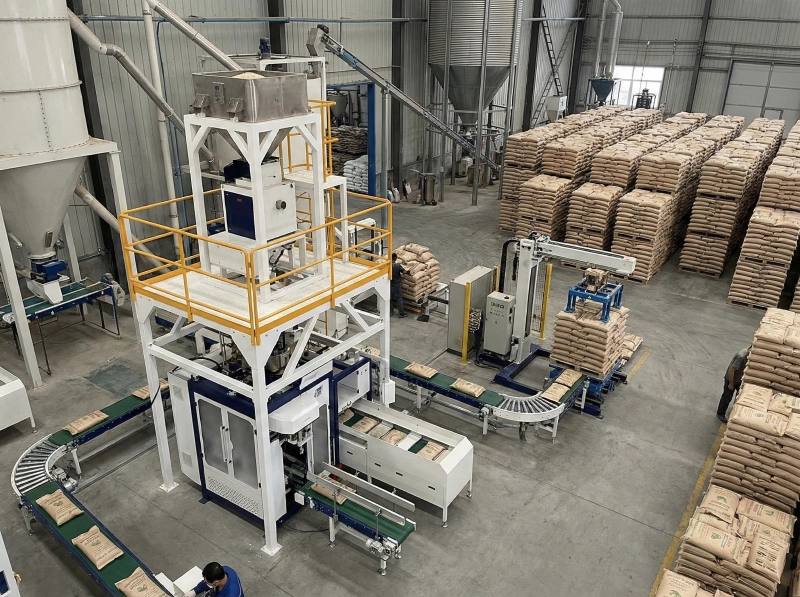
The closed-loop design starts at the bag magazine. A robotic placing arm with vacuum suction cups opens the woven sack and seats it on the filling spout, so the bag mouth stays aligned with the dosing point. Below the fill station, a tracked roller section and a twin-belt conveyor carry the filled sack toward the checkweigher or sewing head without tipping the bag. That is the structural reason a granule bagging line can keep a 25 kg sack square at 700–800 bags per hour.
For a 10–50 kg project, the heavy-bag granule bagging line runs at a standard 700–800 bags per hour and can climb toward 1200 bags per hour in a high-speed configuration. Typical accuracy sits at ±0.2%, the PLC stack uses Inovance for standard builds or Siemens for higher-demand lines, and air consumption stays around 1200–2000 NL/min at 0.5–0.7 MPa. Those numbers come straight from the project reference data BPMpack applies to the bagging line for granules.
Engineering note. A granule bagging line is more than a single filler. The bag magazine, robotic placer, gross weigher, enclosed filling cabinet, guided roller transfer, and outfeed conveyor are engineered as one production object. That is why the bag orientation is preserved end to end and the warehouse pallet stack stays square instead of leaning.
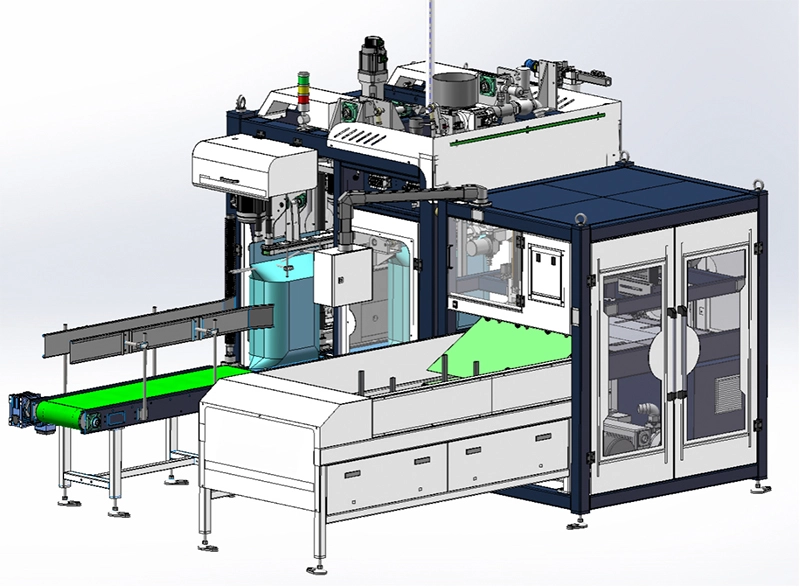
What the structural and on-site evidence confirms
The CAD layout for the QZK-1200 granule bagging line shows the bag magazine, large-bag gripper, accumulation belt, and discharge conveyor arranged as one serviceable assembly. That is the same arrangement BPMpack installs on a feed, seed, fertilizer, or pellet floor, which is why buyers comparing an automatic bagging line or a free-flowing-granule filler see the same line structure across projects.
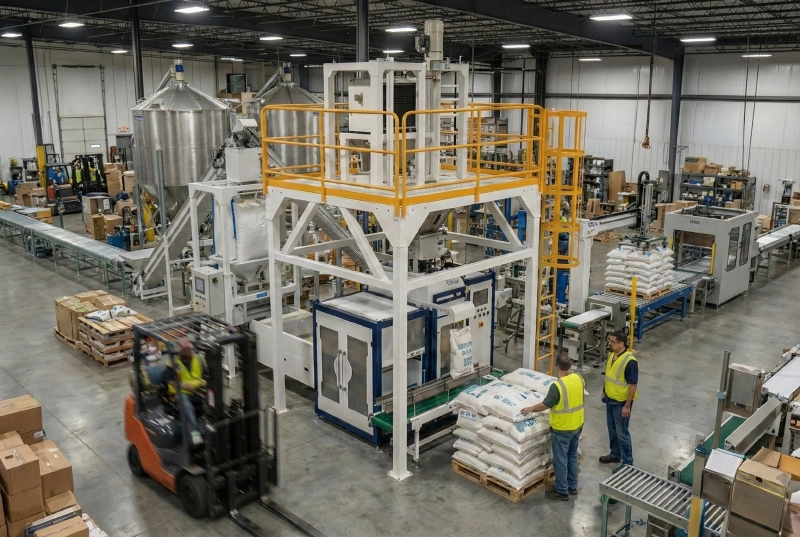
On the operational side, the granule bagging line runs in a real plant with forklift traffic and pallet handling. Operators in safety gear stack sacks onto wooden pallets at the discharge end, while the line keeps feeding the next sack in the same orientation. A 3D render adds the next step: a six-axis robotic palletizer takes the granule bagging line output and stacks it into a forklift-ready pallet without breaking the packing rhythm.
| Line module | Function in the granule bagging line |
|---|---|
| Bag magazine and robotic placer | Auto-pick and open woven sacks for the granule bagging line |
| Gross weigher and enclosed fill station | 10–50 kg fill at ±0.2% accuracy |
| Guided roller and twin-belt transfer | Keep 25 kg sacks square through the granule bagging line |
| Checkweigher and reject conveyor | Filter under- and over-weight sacks out of the line |
| Outfeed conveyor and robotic palletizer | Hand off to forklift-ready pallet stacks |
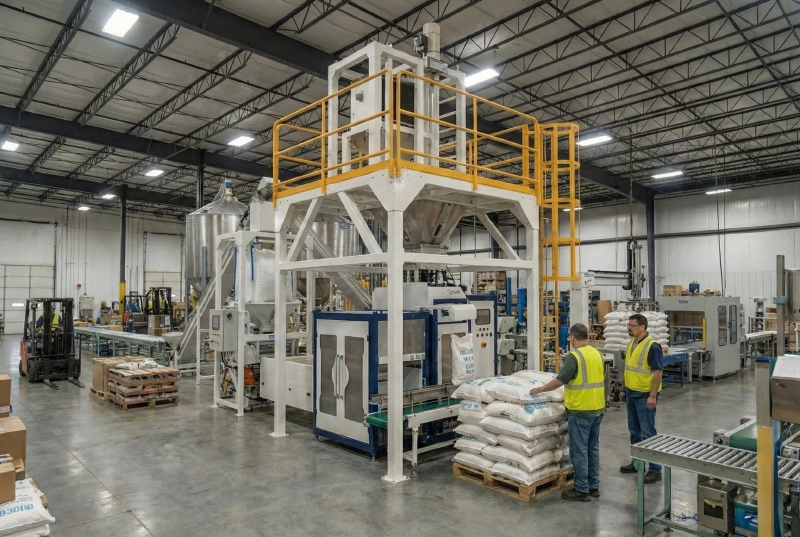
Specifying a granule bagging line for your floor
For a 10–50 kg project on grain, feed, seed, fertilizer, plastic pellets, or mineral granules, BPMpack builds the granule bagging line around your bag type, weight range, throughput target, and factory CAD layout. Send the project details and we will return a line layout, a module list, and an indicative price for review.
Request a packaging line proposal English
 Русский