
Flour Bag Packaging Machine for 1–5 kg Kraft Paper Bags
Flour millers who move 1 kg, 2 kg and 5 kg retail packs from silo to shelf hit the same wall: somebody has to hold the kraft bag under the spout while it fills. A flour bag packaging machine takes that hand out of the cycle — bag pickup, auger dosing, dust extraction, closing and checkweighing run as one sequence on pre-made paper bags, at a repeatable geometry instead of a pedal rhythm.
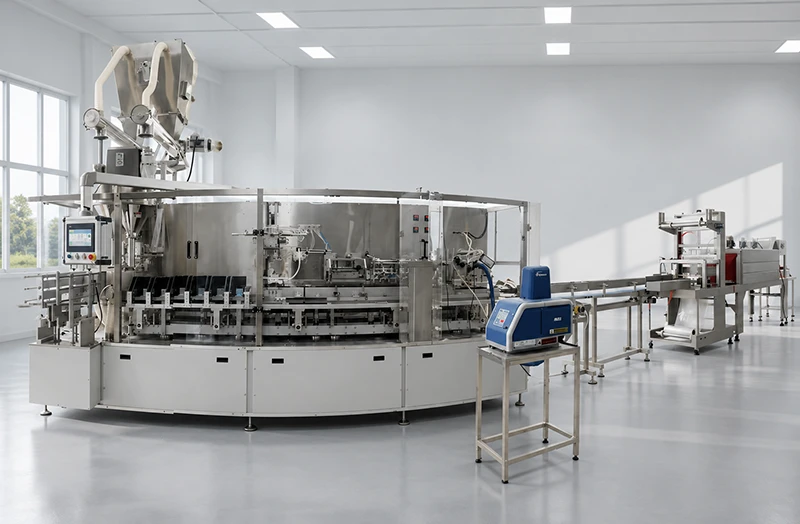
Where a flour line loses money today
Picture a mill that already sells bulk flour from its silos and now wants 1–5 kg kraft packs on the same site. The usual first step is a semi-automatic auger filler: an operator stands at the spout, holds an open flat or side-gusset bag underneath, presses a pedal, watches the weight display and pulls the bag away at target. It works — for the first hour. By mid-shift the flour dust has settled on the frame, the operator is holding bags at an angle to keep them upright, and the display is being read by a tired eye. That is usually the point where a flour bag packaging machine starts to look less like a capital cost and more like a repair to the process.
The losses are quiet, and they compound. A pack that leaves ten grams heavy is a giveaway multiplied by the day’s output; a pack pulled off the spout early has to be reweighed, opened and topped up. Dust escaping the bag mouth settles across the closing station, so glue grabs unevenly and the bags arrive on the pallet soft-cornered. And the whole line stops for lunch, for shift change, and for the one operator who has learned how this particular pedal behaves.
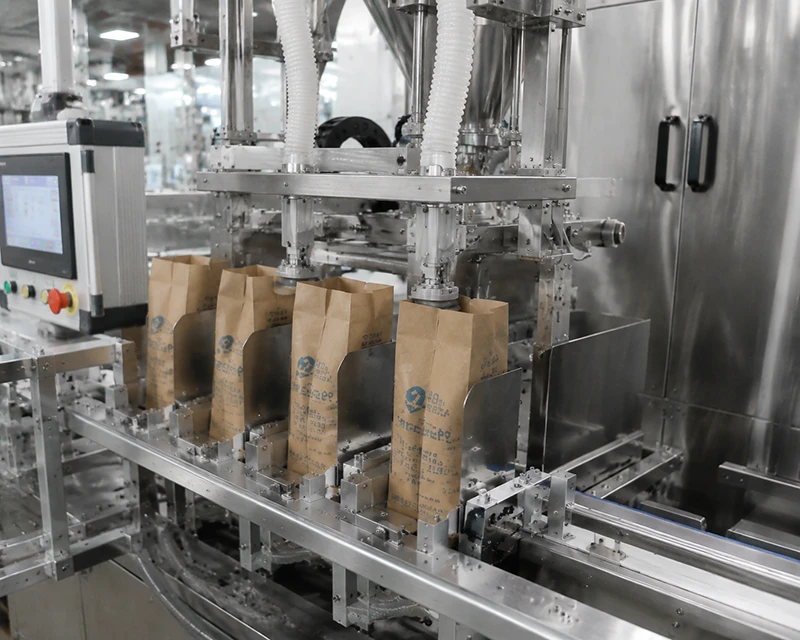
Holding a kraft bag under a dosing spout couples the fill weight to grip strength and reaction time. It puts the operator’s face in the dust plume, and it leaves the closing station dependent on how straight the bag mouth happened to be released.
What the machine does instead of the second operator
A flour bag packaging machine works from a magazine of pre-made kraft paper bags or side-gusset M-fold bags. A pickup takes the front bag, clamps open the mouth, and the clamp keeps the bag square through dosing, settling and closing — the job the hand was doing, done with repeatable geometry. Dosing runs on an auger screw sized to the flour’s bulk density, so 1 kg, 2 kg and 5 kg targets are stored recipes on the touchscreen rather than a pedal rhythm. Servo-driven motions carry the bag from station to station without the jolt that shakes flour back out of the mouth.
Dust is handled at the point where it is created. A shroud around the filling station pulls the displaced air away from the bag mouth, so less flour settles on the clamp, the closing jaw and the floor. The operator supervises instead of lifting: a PLC controller runs the sequence, the touchscreen shows the active recipe and any alarm, and the stainless steel frame survives a wash-down routine that painted mild steel will not. On a 1–5 kg retail line, that single change is what usually pays back first.
Field note Ask how the closing station is fed before you discuss adhesives. If the bag mouth arrives crooked, the best glue line in the plant still produces a soft pack — clamp geometry, not adhesive choice, decides the seal.
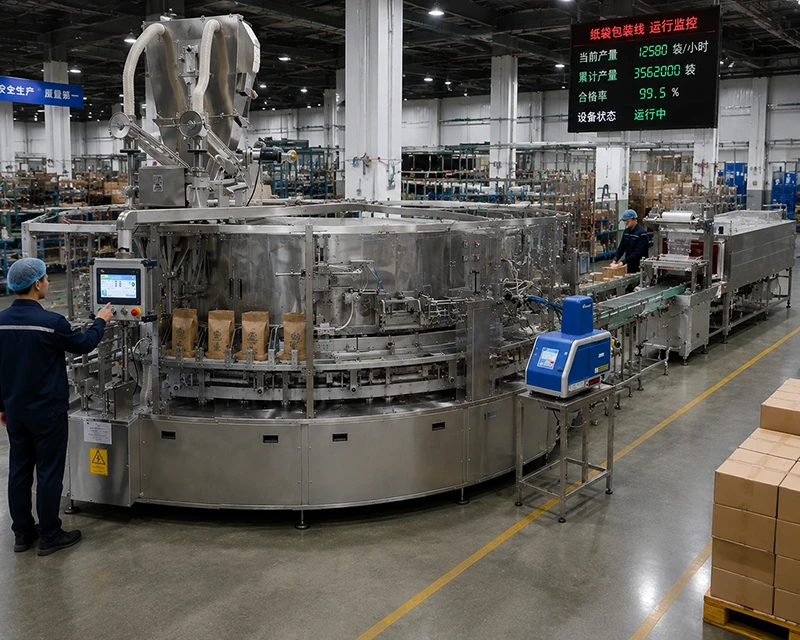
What to specify before the bag is approved
Running 1 kg retail packs and 5 kg wholesale packs on the same flour bag packaging machine means the specification has to be written outward from the bag, not inward from a catalogue. Four items decide whether the line actually runs: the bag format and its tolerance (kraft grammage, flat or side-gusset, glued or stitched block), the fill range with its target accuracy, the extraction capacity matched to the filling rate, and how the closing station is fed — glue, hot-melt or sewing. Everything downstream, including the pallet pattern, follows from those four.
Each of them has a matching design decision on our side. Bag format is answered by an adjustable magazine and clamp set that runs kraft and M-fold paper bags inside one format family. Fill range is answered by auger screws and a dosing programme per weight, with a checkweigher handshake closing the loop. Dust is answered by the extraction shroud and its ducting, sized together with the filling station rather than bolted on after commissioning. Closing is answered by a gluing or sealing station that receives the bag from the clamp, still square. Checkweigher, metal detector, date printer, shrink packer and palletizer then connect as downstream stations, and the layout is drawn against your floor before the first weld.
| Bag and duty requirement | How the line answers it |
|---|---|
| Pre-made kraft paper bag, flat or side-gusset | Adjustable magazine and clamp set running pre-made paper bags — no roll film |
| 1 kg, 2 kg and 5 kg target weights on one line | Auger dosing screw with stored recipes selected on the touchscreen |
| Flour dust at the open bag mouth | Extraction shroud and ducting sized with the filling station |
| Repeatable closing geometry | Bag held in clamp through dosing and closing; glue, hot-melt or sewing |
| Weight compliance for retail | Checkweigher handshake and reject signal from the PLC controller |
| Supervision instead of lifting | PLC controller, servo drives, one operator at the control screen |
| Food-plant hygiene routine | Stainless steel frame and washable surfaces around the filling station |
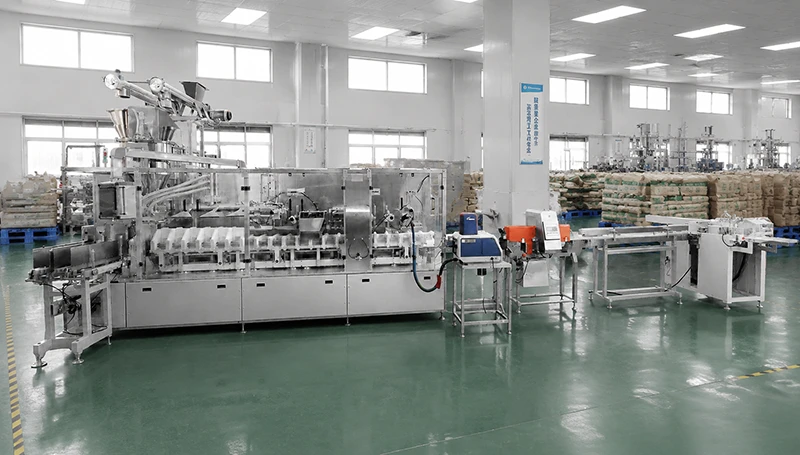
Start from the bag you already buy
Send us that bag — grammage, flat or side-gusset, and the 1 kg, 2 kg or 5 kg target you want in it — plus your packs per shift and the flour you run. We answer with the dosing, extraction and closing layout for that bag, drawn against your floor.
Send bag samples and target weight English
 Русский