
Premade Paper Bag Packaging Machine: Flat-Bottom M-Fold
Retail flour leaves a mill in a paper bag, not in a hopper. Between the flat kraft bag sitting in the magazine and the sealed 1–5 kg pack on the pallet there are six hand motions — open, dose, settle, fold, glue, press — and most plants still spread them across three operators. A premade paper bag packaging machine keeps all six inside one frame.
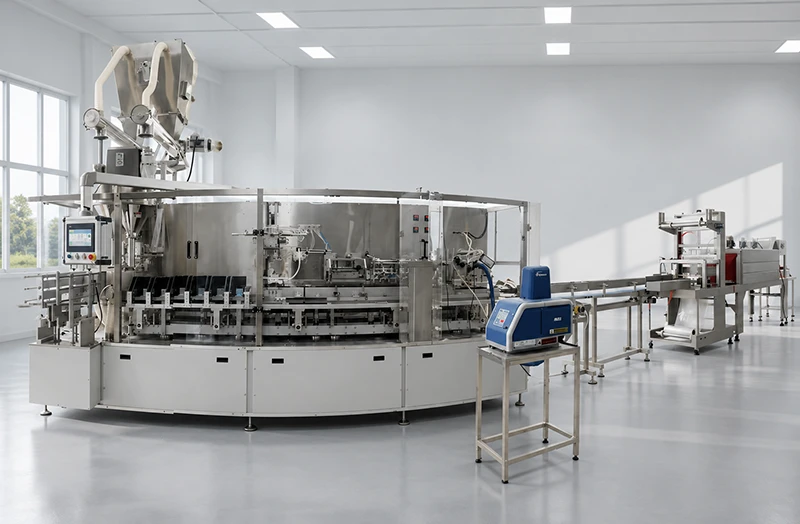
Where the flat bag becomes a filled flour bag
Walk the retail side of a flour mill or a bakery plant in Russia and the format list is short: 1 kg, 2 kg and 5 kg. The bag is normally a flat-bottom kraft bag with an M gusset, printed with the buyer’s artwork long before it reaches the packing hall. In the manual version of the line, an operator pulls a bag off the stack, snaps it open against the filler spout, holds it through the dosing cycle, then folds the gusset back, trims the top edge, rolls it down and glues it shut.
Each motion looks small. Together they set the rhythm of the whole packing hall, and they are the reason a semi-automatic spout filler and a premade paper bag packaging machine are not the same purchase. A flat M-fold bag has a front, a back and a direction; opened by hand it hangs slack under the load, the fold-back line drifts from bag to bag, and the glue bead lands wherever the operator’s wrist happens to be. Output falls when a new shift takes over the table, not when the machine is slow. For the dosing side of this 1–5 kg format, our flour bag packaging machine breakdown covers weighing and spout filling; what changes here is that the unit also owns the bag.
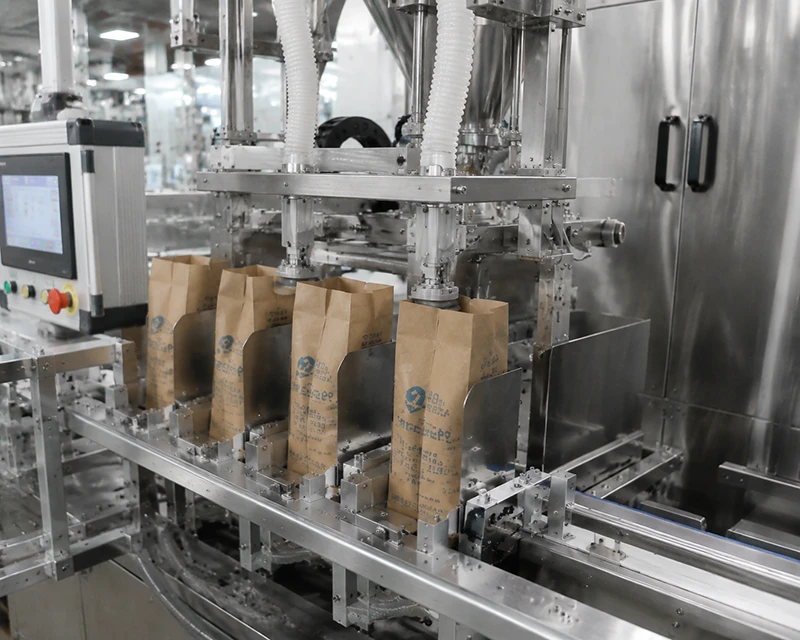
Flour that escapes at the filling spout settles on the M gusset, on the cut edge and on the inner faces of the bag mouth. Hot melt sprayed onto that film grips powder instead of paper, and the press bar then closes a bag whose two faces were never clean. The pack looks sealed at the plant and opens in the retail crate.
Why the seal fails long before the glue is sprayed
That is why the extraction on a premade paper bag packaging machine sits at the filling position and repeats at several vibration-and-dedusting stations downstream, before the gusset is folded back. Extraction at the spout catches the airborne fraction; the vibration stations let the column of flour settle and push residual air out through the fold area, so the M edge is folded and trimmed on a bag that has stopped shifting inside.
The closing sequence is glue, not heat. Paper will not heat-seal to itself, so the head sprays hot melt as a dot or a line onto the rolled top and a press bar closes it; a temperature fault on the glue unit raises an alarm instead of quietly producing open packs. Paper-plastic laminate runs on the same frame, but the bond between paper layer and film has to be checked against a supplied bag sample before the order is fixed. Interlocks follow the same logic: no bag, no opening, no filling and no sealing, and low air pressure, an opened guard, a main-motor or inverter fault, or a glue-temperature fault stops the cycle.
What to send instead of photos: one physical bag. Bag width 80–140 mm, bag length 240–320 mm, M gusset about 60–80 mm, fill weight, flour type and target speed — those numbers decide whether a premade paper bag packaging machine is quoted in the 1–2 kg size or the 2.5–5 kg size.
Reference speed, and what sits on either side of the frame
Two frame sizes cover the retail range. The 1–2 kg frame is quoted at roughly 30–35 bags per minute and the 2.5–5 kg frame at roughly 15–20; project notes on individual materials record about 40–50 bags per minute at 1 kg, 30–35 at 2 kg and 16–20 at 5 kg. Flour flow, feed height, bag quality and the number of downstream stations move those figures, so a premade paper bag packaging machine is specified against a bag test rather than promised from a catalogue. Metering accuracy is held at about ±0.5%, driven by the twin-screw dosing head above the filling position.
The frame is only the middle of the line. Upstream, a screw elevator or silo outlet feeds a horizontal screw and the twin-screw weigher; downstream, filled bags pass a checkweigher and metal detector with a reject, a date coder, an aligning conveyor, and then either shrink-wrapped multipacks or manual outer bagging. Contact parts and exposed stainless are 304, the frame is coated carbon steel, the control panel is a 10.4-inch touchscreen, and the machine draws 15.5 kW at 380 V ±10%, 50 Hz, weighs around 3,000 kg and needs about 0.76 m³/min of air at 0.6–0.8 MPa. Two bag magazines and two filling positions run as one line: the station that runs out of bags stops and alarms while the loaded station keeps working. Against a vertical roll-film machine the choice is really about packaging material — a VFFS forms the bag from film and cannot produce the printed flat-bottom kraft bag the retail chain already buys, which is the whole reason a premade paper bag packaging machine exists as its own category.
| Retail format | Reference output | Bag format |
|---|---|---|
| 1 kg | about 40–50 bags/min | M-fold flat-bottom kraft bag |
| 2 kg | about 30–35 bags/min | M-fold flat-bottom kraft bag |
| 2.5–5 kg | about 15–20 bags/min | M-fold flat-bottom bag, gusset about 70 mm in reference samples |
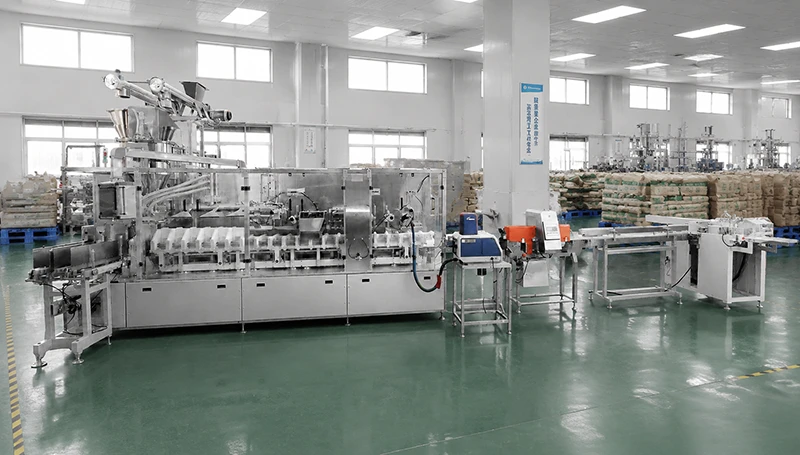
Run your own bag through the line
Send a bag sample, the fill weight and the target output. BPMpack sizes the premade paper bag packaging machine, the dosing head and the downstream stations around that bag, and the acceptance figures stay tied to the sample that was tested.
Request a bag-sample proposal English
 Русский