
Powder Filling and Bag Sewing Line: Keeping 25 kg Bags Square Before Sewing
A powder filling and bag sewing line is rarely limited by the filler. It is limited by the last two metres, where an aerated 25 kg bag has to stay square long enough for the sewing head to close a straight mouth. Mipline builds that stretch as a controlled handoff instead of a conveyor gap.
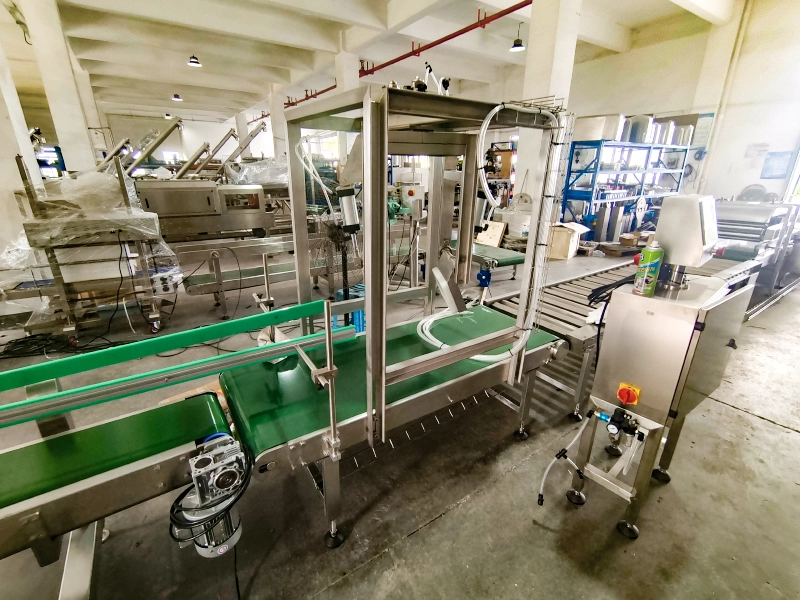
Where a powder filling and bag sewing line loses output
Start with three plants that look nothing alike: a dairy filling spray-dried skimmed milk into 25 kg kraft bags, a flour mill running woven bags, a starch line on paper-laminated sacks. The filler holds weight inside a few grams. Output still drops, because the loss shows up downstream — a bag arriving at the sewing head with a skewed mouth, an operator pulling it straight by hand, a seam cut open and re-closed. That is where a powder filling and bag sewing line earns or loses its rated speed.
The usual answer is more people. Two operators stand at the last metre: one squares the bag after filling, the other steers the mouth into the sewing head. It works on a good shift and fails on a bad one. Seam quality then depends on who is standing there, and the filler keeps producing bags faster than the back end can dress them.
A 25 kg bag of aerated powder is at its least stable the moment it leaves the filling spout. If the conveyor under it only carries weight, the bag leans, the mouth closes unevenly, and the sewing head inherits a problem it cannot solve. Bag settling is slower than the machine cycle, and the gap is paid for at the seam.
Why the bag moves on a powder filling and bag sewing line
On a Mipline powder filling and bag sewing line the bag mouth is clamped before dosing starts, and the fill runs inside that clamped bag. The bag is held by both faces rather than resting on the belt, so the powder column builds vertically and the mouth stays at a fixed height. From the clamp, the bag is carried on green belt and twin-belt sections with adjustable side guides set to the bag width, then onto roller sections for the run to the closing station. No unsupported drop, no rolling on a bare roller bed.
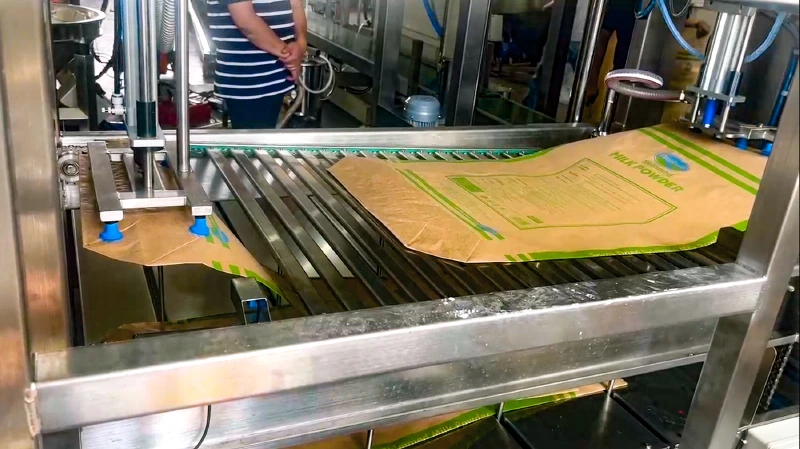
The visible hardware matches that sequence. Flat bags come off a magazine conveyor into a fully enclosed stainless steel station with blue inspection windows; vacuum grippers lift the top bag and open it at the clamp; control is a touch HMI with an emergency stop on the housing. Operators can watch the bag through the windows while adjusting guides, so alignment is set against the real bag, not a drawing.
What we ask before quoting: a filled bag sample, not just a powder spec. The guide spacing, transfer length and handoff height on a powder filling and bag sewing line are set by bag face width, fill weight and how much the powder settles in the first seconds after dosing.
What to check on a powder filling and bag sewing line before you approve the layout
Buyers usually arrive with a checklist: bag pickup, mouth control, dust, transfer stability, maintenance access. Each item has to end somewhere concrete on the machine, otherwise it stays a promise. The table maps the common evaluation points to what is actually visible on the Mipline build.
| Evaluation point | Visible evidence on the Mipline line | What it removes from the shift |
|---|---|---|
| Bag pickup | Flat bag magazine conveyor feeding an enclosed stainless station through a guarded infeed | Hands out of the bag path at the start of every cycle |
| Mouth control | Clamp station holding both bag faces through filling | A mouth that reaches the sewing head at the same height and width each time |
| Dust and aeration | Filling inside the clamped bag, station enclosed behind blue inspection windows | Powder cloud around the mouth and product settling after the seam |
| Transfer stability | Green belt, twin-belt and roller sections with adjustable side guides | Bag drift and twist on the run between filling and closing |
| Access and safety | Top maintenance platform with railing, touch HMI, emergency stop on the housing | Guide adjustments made without opening the process or stopping the line for long |
| Handoff | Guided handoff before sewing or sealing, bag square to the sewing head | Manual straightening at the last metre and re-closed seams |
The two items that decide throughput are the transfer length and the position of the sewing handoff. A short transfer on a 25 kg dairy or flour bag leaves the powder still moving when the head closes. A longer, guided run on belt and roller sections lets the bag settle upright, so the seam is closed on a stable column. If the line also carries a checkweigher or metal detector, the same setting decides whether the bag is still square when it crosses that station — the sequence is covered in our automatic bagging machine for powder walk-through.
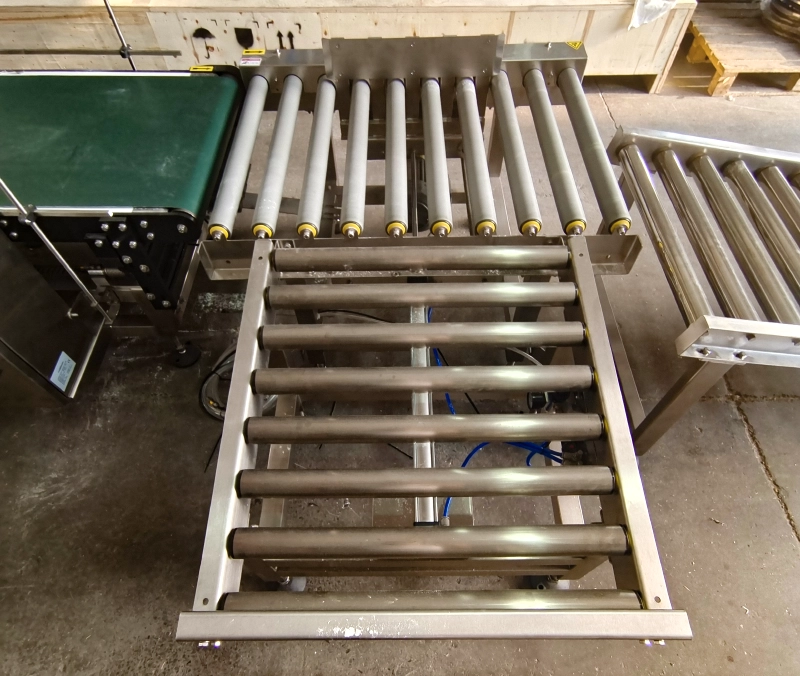
The result on a working line is unglamorous and useful: the sewing head receives the same square bag every cycle, the operator who used to straighten bags is released, and the seam closes on the first pass. If your current line still needs a person at the last metre, the transfer section — not the filler — is the place to start. Our starch powder packaging line case shows the same fix applied to a paper-laminated bag.
Send your bag and powder spec
Tell us bag type (kraft paper or woven), fill weight, powder bulk density and target bags per minute. We return a powder filling and bag sewing line layout with transfer length, guide settings and the sewing handoff position marked on the drawing.
Request the line layout English
 Русский