
Polypropylene Granules Bagging Line: 25 kg Bags
A polypropylene granules bagging line is judged at the palletizer, not at the dosing screw. PP resin flows like dry sand, keeps the air it swallowed on the way down, and leaves an open mouth the moment the sack is lifted, so the station that forms, fills, cools and closes the bag in one pass decides how many 25 kg sacks arrive square. FFSline builds that sack from PE or PP roll film on the machine, weighs the granules into it, cools both seams with air and hands the bag downstream already closed.
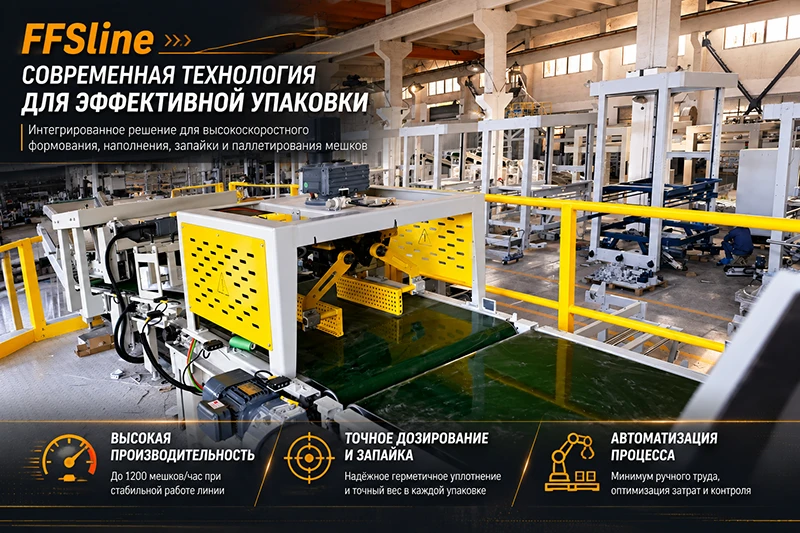
From the silo to a closed 25 kg sack on one frame
Picture a compounding plant with three resin grades and one packing hall. The line takes PP granules from a buffer hopper, doses them in a multi-head or linear weigher, drops them through the filling tube into a bag formed around that tube from roll film, and closes the bag with a horizontal and a vertical seam. There is no bag magazine, no pre-made sack to unstack, and no sewing head waiting at the end of the conveyor. Film arrives on one pallet; the bag is created about a metre before it is filled, which is also why a grade change costs minutes instead of a bag order.
The scheme this replaces is still common in resin warehouses: flat-stacked woven or kraft sacks, a semi-automatic filler, a sewing machine and a pallet built by hand. It looks cheap on paper and costs on the floor. Granules leak at every transfer point, a sewn mouth admits humid air, the sack cannot be printed on all faces, and the empty bags need storage, handling and a truck of their own. Replacing the pre-made sack with roll film strips out that logistics layer and turns the bag into a process step rather than a purchased item.
Never at the dosing screw. A 25 kg PP sack fails in the one to three metres between the sealer and the palletizer: the seam is still hot, the film relaxes under load, the bag leans and the bottom corner splits on the belt edge.
Why a Polypropylene Granules Bagging Line Fits PP Resin
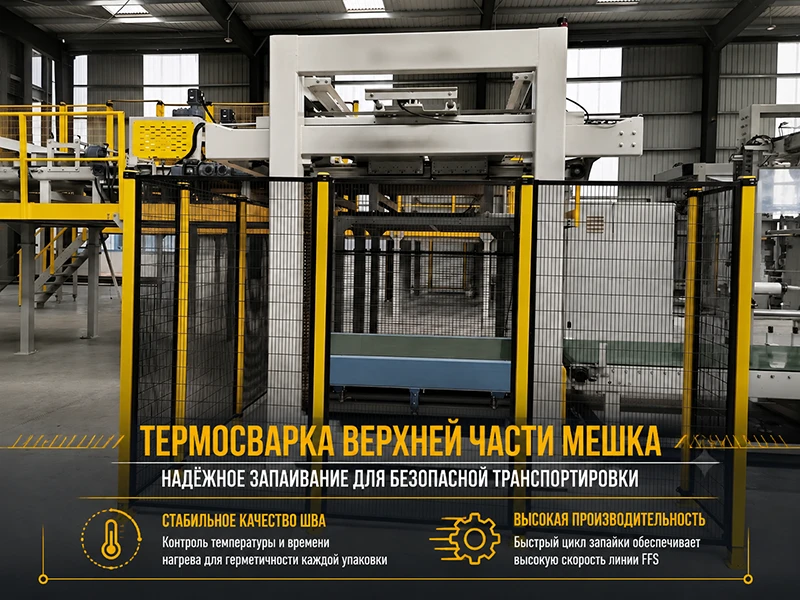
PP granules are free-flowing, slightly abrasive on film and heavy enough to load a seam the moment they settle. Fill a sack too fast and the material traps air: the bag bulges, the seam carries the weight, and the pallet goes soft by the second layer. A polypropylene granules bagging line answers that in three places. The weigher doses to ±0.1–0.2%, so bag weight is repeatable before a seal is made. The forming tube and the film guides keep the bag square while it fills. And the sealing station runs an Italian-made heating wire with pneumatic cooling on the bag bottom and at the bag mouth, so the seam is set rather than merely pressed.
That cooling step separates a bag that rides a pallet from a bag that comes back as a claim. A hot seam dropped straight onto a conveyor keeps relaxing under 25 kg of resin; a cooled seam keeps its geometry and lets the bag stand upright on the palletizer infeed. The same station is where the film saving shows up: PE or PP roll film runs more than 30% below paper, woven or paper-plastic composite sacks, and the roll is recyclable, so the saving repeats every shift instead of once at purchase. Output on the reference layout reaches 1,200 bags per hour, with 1,500–2,000 bags per hour available when the palletizer receives bags at high level.
Specify before you order. Three numbers decide the machine: bag weight, film width and seam type. FFSline covers 10–50 kg bags on 200–1200 mm film with a horizontal plus vertical seam, and the electrical cabinet is built onto the frame, so the line fits roughly 5.5 × 5 × 6 m with no separate control room. Optional metal detection and checkweighing with rejection sit inside the same line rather than in a second one.
The structure behind the seal
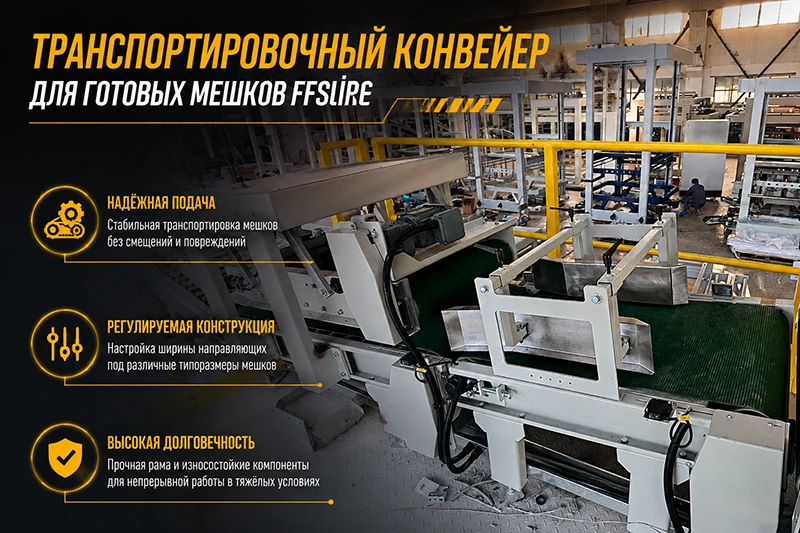
The photographs show two stations of a production polypropylene granules bagging line: the upper heat-sealing unit with its guard fencing and receiving conveyor, and the outfeed conveyor that carries the closed sack away. Guards are not decoration at this speed — a 25 kg granules bag leaves the sealer fast enough to damage anything it meets, and the maintenance points behind the fencing are reached from a platform rather than from a ladder.
Downstream, the transfer conveyor uses adjustable side guides to stop a filled sack from drifting on the belt, so the palletizer receives a bag with a straight leading edge and a flat bottom. From there the robotic palletizer stacks layer by layer, the wrapper secures the finished pallet, and one operator at the HMI supervises the run instead of four people handling sacks by hand. Nitrogen flushing, explosion-proof electricals and remote diagnostics are specified where the resin grade or the site asks for them, and a metal detector with a checkweigher and reject arm closes the quality loop before the pallet is built.
| Parameter | FFSline configuration for PP resin |
|---|---|
| Bag weight range | 10–50 kg, 25 kg standard for polypropylene granules |
| Dosing accuracy | ±0.1–0.2% bag to bag |
| Capacity | up to 1,200 bags/h; 1,500–2,000 bags/h with high-level palletizing |
| Packaging material | PE or PP roll film, 200–1200 mm web width |
| Sealing | horizontal and vertical seam, Italian heating wire, pneumatic cooling at bag bottom and mouth |
| Footprint | approx. 5.5 × 5 × 6 m with the electrical cabinet integrated on the frame |
| Quality control | optional metal detector and checkweigher with reject |
| Options | nitrogen flushing, explosion-proof electricals, remote diagnostics |
Size the line around your resin, not around a catalogue bag
Send BPM your bag weight, film grade and target output. We will configure the polypropylene granules bagging line, the weigher, the sealer and the palletizer as one continuous run and quote it as a single unit.
Send your bag weight and output target English
 Русский