
What a Siberian Salt Plant Solved at the Last Meter of Secondary Packaging
For salt producers, the most expensive problems are often not in the filler itself. They show up at the last meter: when the bag leaves the primary packer, loses shape, picks up air, and reaches the sewing head too loosely to build a dense, stable pallet. That is where a well-built secondary packaging line changes the economics of the whole plant.

If the bags arrive uneven, inflated, or contaminated with fine salt dust, the line can still be fast and still fail. The result is weak bag geometry, unstable stack height, and a pallet that wastes space long before it reaches the truck.
1. The transfer zone decides whether the line stays clean or starts leaking value
On a modern salt line, the transfer zone is not a passive bridge between primary filling and secondary packing. It is the place where bag flow is buffered, aligned, checked, and prepared for compression. If the upstream buffer runs dry, the whole line begins to stutter. If the buffer runs too loose, bags float with trapped air and the downstream seam takes unnecessary stress.
That is why the upstream hardware matters so much. In a salt plant, the dosing area must stay stable even under corrosive and dusty conditions. With 316L contact surfaces, a protected control cabinet, and a layout that keeps the feed pool full, the line stops behaving like a chain of separate machines and starts acting like one coordinated system.

BPM Engineering Insight: The gain is never just “more bags per minute.” The real gain comes from reducing giveaway, keeping the transfer zone stable, and protecting the line from chloride-driven wear. That is how a plant moves from short-term throughput thinking to a real 18-20 month payback model.
2. Why compression before sewing changes the pallet, not just the seam
When a woven secondary sack is filled, it is usually still too soft. Air pockets make the bag look full, but they reduce stack density. The bag may survive the sewing step, yet the pallet becomes taller, looser, and more likely to shift during transport. In salt logistics, that is where the hidden cost lives: the plant pays to move air instead of product.
Compression before sewing solves this in a mechanical way. Side clamping, controlled push plates, and a guided discharge path force the bag body into a flatter shape before the needle head closes the top. The seam is easier to keep consistent, but the bigger win is downstream: better pallet geometry, higher cube utilization, and fewer complaints about bag slippage in storage or transit.
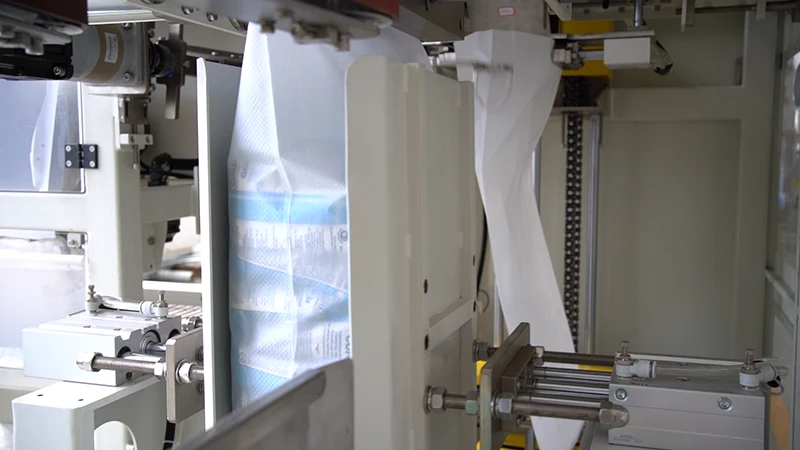
3. The sewing head only performs well when the upstream flow is already disciplined
Many buyers look at the sewing head as the last decisive component. In reality, it is the final proof that the whole upstream layout is working. If the bag is overinflated, misaligned, or arriving with irregular tension, the sewing head cannot “fix” the process. It can only close what the line has already prepared.
That is why a salt plant needs a full system view. The target is not a neat stitch alone. The target is a stable 20 kg to 50 kg secondary pack that can run at production speed, stay within control tolerance, and maintain the shape required for safe stacking. On the BPMPack side, that means the line is designed around flow discipline, not isolated machine promises.

| What the plant needs | What the line provides |
|---|---|
| Stable transfer after primary filling | Buffered flow, full feed pool, and a controlled handoff into the secondary unit |
| Resistance to salt corrosion | 316L contact parts, protected electrical enclosure, and corrosion-aware construction |
| Dense pallets and lower freight waste | Compressed bag geometry, better stacking, and a practical path toward 1.2 t pallets instead of loose 750 kg loads |
Frequently asked questions from salt plants
Why not just increase the filler speed and leave the rest unchanged?
Because speed only helps when the upstream and downstream motions are already synchronized. If the bag is still soft at the sewing head, more speed only multiplies the same instability. The better approach is to keep the transfer zone full, compress the bag body, and let the sewing head close a prepared package.
Can a cheaper 304 machine survive a salt environment?
Not for long in a chloride-rich plant. Salt attacks weak points first: seams, crevices, and unprotected surfaces. That is why a serious salt line uses 316L contact materials, proper passivation, and a protected cabinet design. The objective is not just to run today; it is to keep the line productive year after year.
If your salt line still loses control between primary filling and palletizing, BPM can review the layout, bag format, and target pallet density with your team.
Request a Line Review English
 Русский