
Why the Bag Clamp Station Decides the Rhythm of a Salt Packaging Line
At a southern Russian salt producer, the problem was not the filling head alone. The line only became unstable when the bag clamp station, the transfer conveyor, and the palletizing crew stopped speaking the same mechanical language. Once the bag mouth starts to move, every downstream action has to compensate for a mistake that should have been prevented earlier.
Pain point: If the sack is not held flat and centered before discharge, the operator corrects the bag, the conveyor absorbs the wobble, and the palletizing zone loses rhythm.
The QZK-1200 line is built to reduce that chain reaction. Its job is not only to move product, but to keep the transition zone calm enough that the next step can happen without extra handling.
The bag clamp station is where rhythm is protected
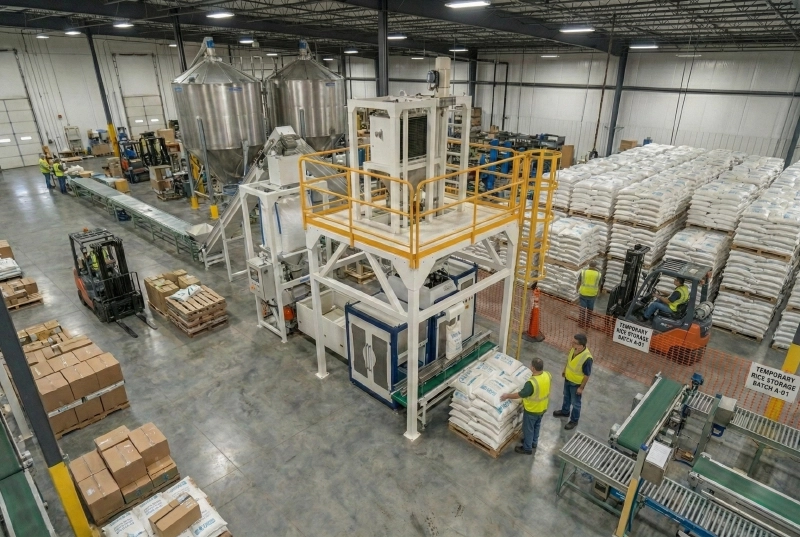
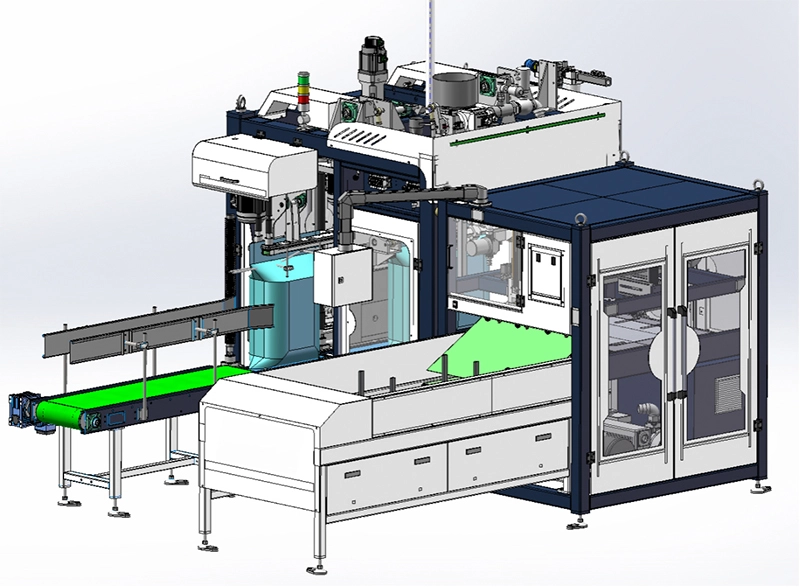
The most important thing about a bag clamp station is not how dramatic it looks from the outside. It is whether the bag arrives in a repeatable position, is held securely, and leaves the machine with a predictable orientation. The close-up internal image of the bagging unit makes that visible: vacuum suction cups, a robotic placing arm, a green conveyor, and the woven bag all work together in a narrow window where mistakes are expensive.
| Station | What it controls | Why it matters on a salt line |
|---|---|---|
| Bag clamp / mouth alignment | Bag position before discharge | Reduces skew, wrinkling, and manual correction |
| Vacuum pickup and placing | How the sack enters the transfer zone | Keeps the bag centered and repeatable |
| Enclosed frame and access ladder | Operator access and service safety | Speeds checks without exposing the line to disorder |
| Outbound conveyor | Transfer from machine to logistics area | Prevents congestion before palletizing |
Why alignment matters more than raw speed
Many line owners ask for more throughput first, but speed only helps when the transfer zone is stable. If the bag leaves the machine crooked, the faster conveyor simply moves the problem downstream. In the running line photo, the operators, forklifts, and transport path are all visible at the same time. That is exactly the reality most plants face: the machine is never isolated from the rest of the warehouse.
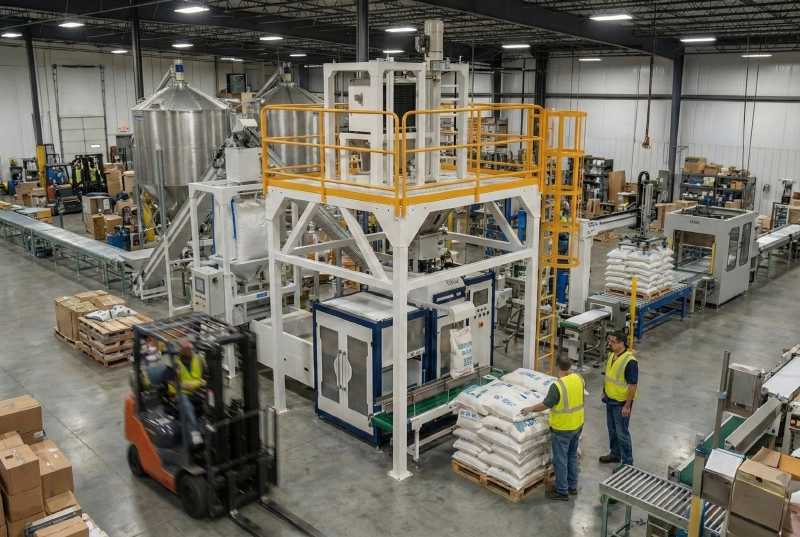
For a salt producer, that synchronization is especially important because salt packaging usually runs in a high-usage environment: frequent output, repetitive bag handling, and constant pallet movement. The line cannot depend on improvised corrections every few minutes. It needs a frame, a transfer path, and a discharge point that keep performing the same way on every shift.
What the machine architecture tells you
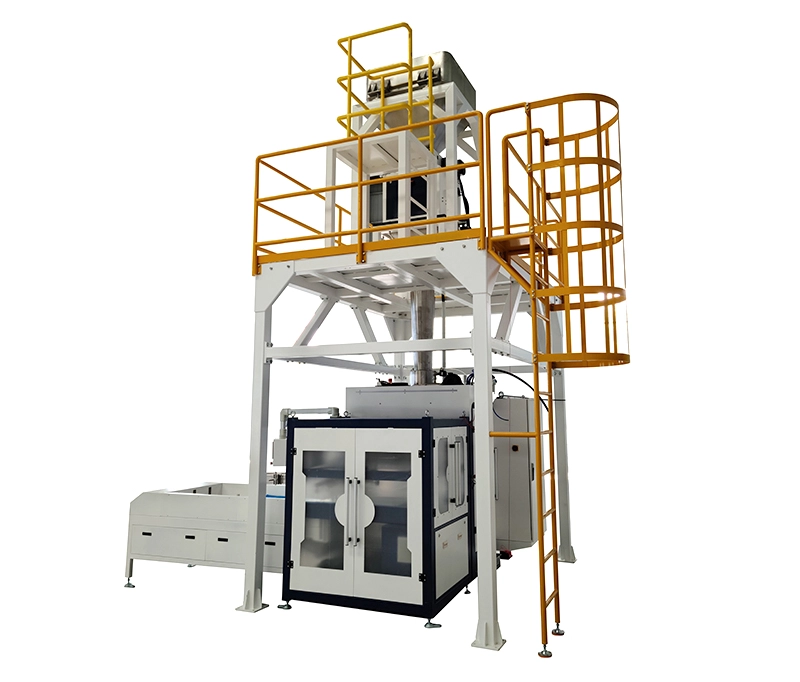
The front view of the QZK-1200 shows the elements that make this possible: an elevated steel framework, a safety cage ladder, and an enclosed cabinet. These are not decorative features. They create access, keep the machine protected, and support a more disciplined workflow around the bagging tower. When maintenance is easier to reach and the operator path is clear, restart time goes down and the entire line recovers faster after interruption.
Expert note: If a salt line is losing time between filling and palletizing, the first question should not be “Can we run faster?” It should be “Is the bag being held, centered, and transferred cleanly enough to let the next station do its job?” That is where the QZK-1200 architecture earns its value.
What to specify before you plan an upgrade
- Bag handling stability: define how the sack is held at the mouth, not just the target output rate.
- Transfer visibility: make sure the operator can see the discharge path and react quickly when a bag drifts.
- Maintenance access: prioritize access to the frame, cabinet, and service points so downtime stays short.
- Logistics handoff: design the conveyor and forklift zone together, because pallet removal is part of the line rhythm.
That is the lesson from this southern Russian salt project: the last meters matter. A line becomes reliable when the bag clamp station, the transfer conveyor, and the warehouse flow are built as one system, not as three separate jobs.
 English
 Русский