
Why a Salt Producer Should Treat Bag Orientation and Labeling as One Flow
For a southern Russian salt producer, the hard part was never the filling step alone. The real problem was what happened after the bag left the sealer: the bag needed to stay stable, readable, and ready for palletizing without a second round of manual handling. That is exactly the zone where bpmpack ppline earns its place.
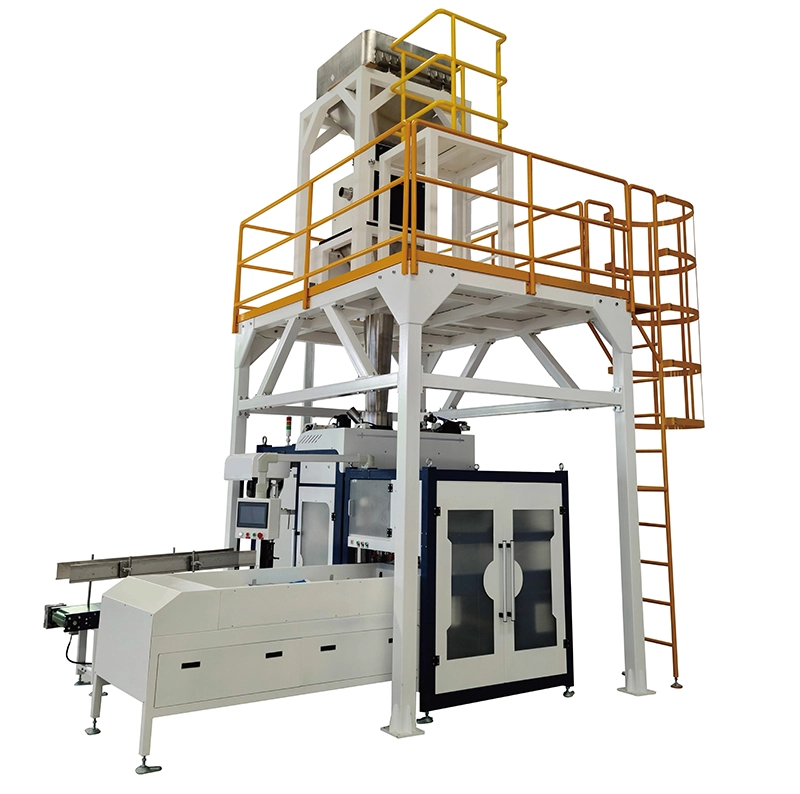
On dense mineral products like salt, the bag may leave the sewing or sealing head correctly but still arrive at the palletizer with a poor orientation, a shifted label, or a shape that needs to be corrected by hand. Once that happens, line speed drops, bag quality becomes inconsistent, and the whole packaging room starts depending on operators to fix what the machine should have controlled.
The first meter after sealing decides whether the line stays stable
ppline is built around a simple idea: pre-made heavy bags should not be treated as isolated stations. The bagging machine, outfeed conveyor, turner, inspection point, and palletizing handoff all belong to the same flow. In project examples, the line family covers common heavy-bag ranges such as 5-50 kg and 7-30 kg, with speeds from around 700 bags/hour up to 900+ bags/hour depending on the configuration and material behavior.
That is why the outfeed section matters so much. If the bag leaves the unit with the wrong posture, the next station has to fight the bag instead of moving it. A clean transfer zone keeps the bag body supported, keeps the printing and label face in the expected position, and makes it easier for the downstream conveyor to send the bag into the palletizing rhythm without interruption.
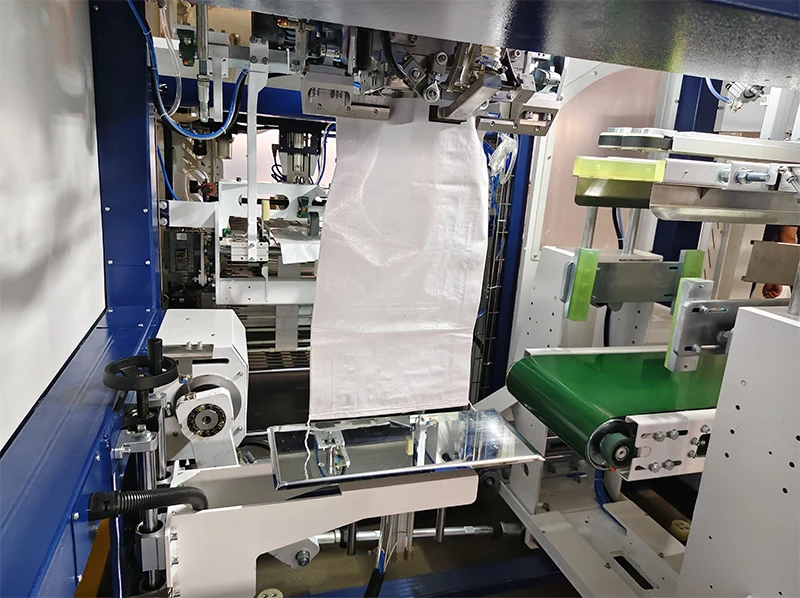
BPM Engineering Insight: On salt projects, the value of automation is not only in filling accuracy. It is in keeping the bag geometry, label position, and downstream transfer behavior consistent enough that the palletizer can run at a fixed pace without manual correction. That is what turns a packaging machine into a line.
Labeling only works when the bag path is controlled
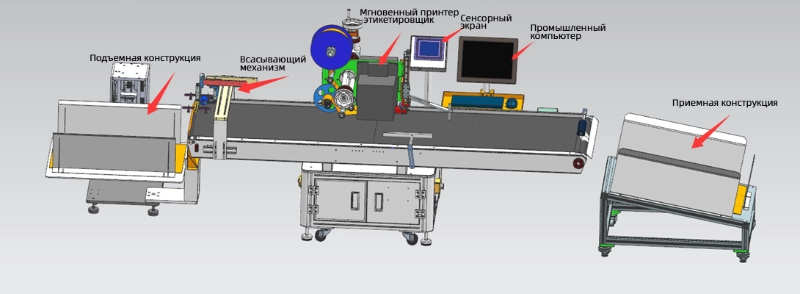
A labeler can look impressive on paper and still underperform if the bag is drifting, rotating, or stretching after sealing. For that reason, ppline treats bag orientation and labeling as one control problem. The bag path must be predictable so the label hits the same surface every time, and the bag must reach the inspection point in a posture that the operator can trust.
This matters even more when the customer wants the line to handle multiple bag types, such as woven bags, kraft paper bags, or composite bags. The packaging room then needs one common downstream logic instead of a separate manual workaround for each bag format. The product brief for ppline is clear on this point: the family is meant to connect packaging, checking, transfer, and palletizing preparation in one line discussion, not as disconnected add-ons.
Why the frame, control cabinet, and service access still matter in a salt plant
Salt is unforgiving to weak design choices. Dust, abrasion, and a busy transport area quickly expose machines that are difficult to service or too open to the environment. In a real project, the structure has to support maintenance access, safe walkways, and a stable interface for the operator panel. Depending on the configuration, ppline uses a carbon-steel painted structure with 304 stainless steel on contact parts, plus familiar controls such as PLC and HMI-based operation.
The benefit is not abstract. It means faster start-up, fewer complaints about access, and less time spent chasing alignment issues. When the operator can see the bag path, understand the alarm, and reach the adjustment points without breaking the line flow, the packaging room becomes easier to run every shift.
When the line reaches palletizing, the bag must already be “ready”
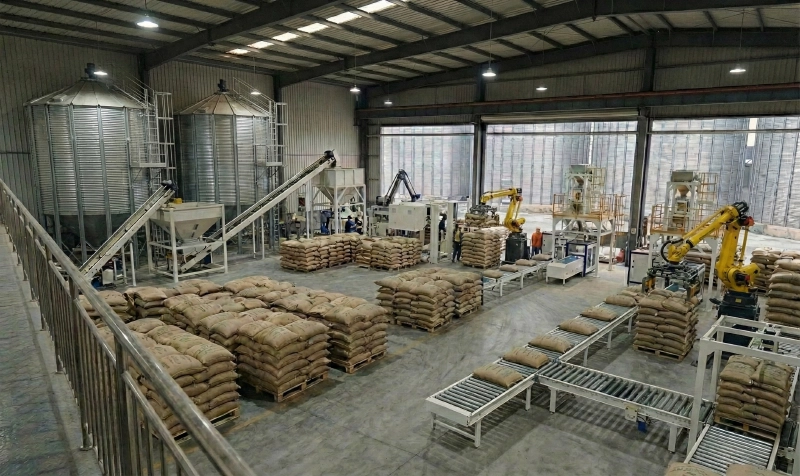
That is the logic behind a good secondary packaging line. The output bag should already be oriented, read, and spaced correctly so the palletizer is not forced to rework the product. In the best projects, the downstream conveyor, inspection point, and robot handoff are planned together from day one. This is especially important when the customer wants higher throughput or a compact plant layout where every meter of floor space has to do useful work.
For a salt producer, that coordination can eliminate one of the most common hidden costs: the labor required to straighten, flip, and re-stack bags before they reach the pallet. Once that manual loop disappears, line rhythm becomes easier to predict, and the shipment area stops acting like a bottleneck.
| Decision point | What ppline solves |
|---|---|
| Bag posture after sealing | Controlled outfeed and transfer logic keep the bag stable before the next station takes over. |
| Label placement and readability | The bag path is coordinated with labeling so the same face is presented consistently. |
| Palletizer handoff | The bag arrives in a predictable orientation, which reduces manual correction and keeps throughput steady. |
Frequently asked questions for salt packaging projects
Can ppline handle salt bags?
Yes. Salt is a typical mineral-granular application for this line family, provided the bag size, sealing method, and downstream arrangement are defined correctly in the project brief.
What should be fixed before asking for a quotation?
Bag weight range, target output, bag material, label position, available floor space, and whether the line ends at a conveyor, a checkweigher, or a robotic palletizer. The more precise the inputs, the easier it is to choose the right downstream modules.
If your packaging room still depends on manual bag straightening between sealing and palletizing, the problem is usually not the filler alone. It is the missing line logic after it.
Request Storage Advice English
 Русский