
Automatic Powder Packaging Line: 25 kg Powder Bagging
An automatic powder packaging line replaces manual bag opening, manual clamping, and free-fall filling with a controlled sequence from bag pickup to a sealed 25 kg bag. The result is a cleaner fill point, fewer reworked bags, and a stable handoff before sewing or heat sealing on a dairy powder, flour, or starch line.
Why plants upgrade to an automatic powder packaging line
For a dairy powder, flour, starch, or food-grade powder plant packing 25 kg kraft or woven bags, the manual work is rarely just at the start of the line. Operators open bags by hand, hold them under the fill head, straighten the bag at the sewing machine, and then lift the finished bag onto a pallet. Each of those steps is where powder escapes, bag mouths skew, and operators slow the line down to a stop. Replacing those manual steps with a controlled machine sequence is the reason most plants move to an automatic powder packaging line in the first place.
The change is not just about replacing hands with a robot arm. The line is engineered as one continuous flow: bag supply from the magazine, vacuum pickup, bag opening, clamping under the fill head, bottom-up filling, de-aeration, sealing, and guided transfer toward sewing or heat sealing. Once those stations are linked, the bag stops being touched by an operator between the magazine and the discharge conveyor, and that is when rework rates start to fall.
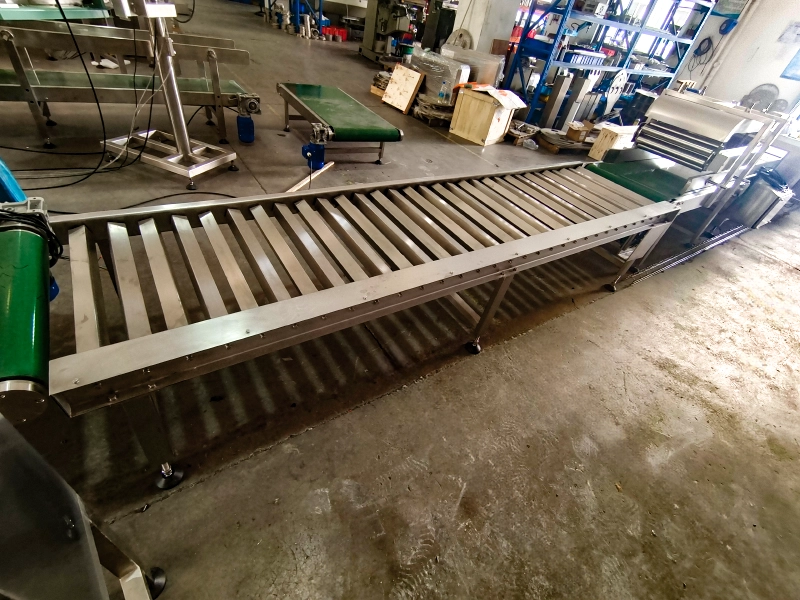
Bags arrive skewed, the sewing head misses on the first stitch, and operators re-stitch the same bag two or three times. Each re-stitch is lost throughput, lost bag, and lost seal integrity before the bag ever reaches the warehouse.
What an automatic powder packaging line does at each station
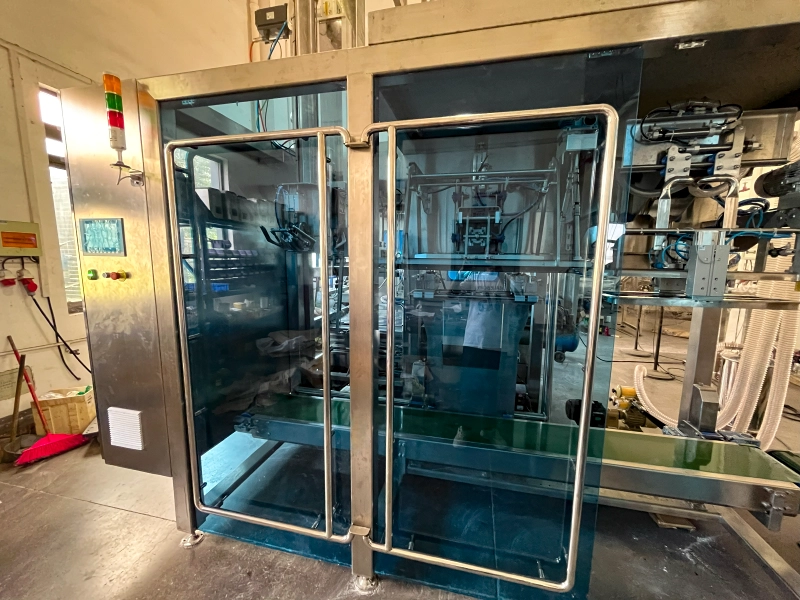
At the front of the line, a stainless steel bag magazine holds the next 50 to 80 empty bags. A vacuum pickup head takes one bag at a time, opens it with a pair of grippers, and slides it onto the clamp assembly under the filling nozzle. The clamp holds the bag mouth against a dust collar while the fill head lowers into the bag. On a Mipline system this section is fully enclosed in stainless steel with blue inspection windows, so an operator can watch the bag opening and clamp cycle without opening the door.
Filling happens in three screw stages: a fast feed brings the bag up to about 80% of target weight, a medium feed covers the next 15%, and a slow trim dose lands the bag inside the accuracy window. The bag is lifted by a platform that follows the fill level, so the dust never has the full free-fall distance to escape. This bottom-up filling principle is what separates an automatic powder packaging line from a manual or top-fill setup, and it is the same principle that keeps the bag mouth clean enough for the next station to seal.
Field note: Bottom-up filling is not a marketing term. It is a mechanical layout choice that keeps the fill point close to the rising powder surface, which is what reduces the visible dust cloud at the bag mouth on most 25 kg powder lines we ship.
How to specify your line before you buy
Four project inputs drive almost every layout decision on an automatic powder packaging line: bag type and weight, target throughput, accuracy window, and the closure method. Bag type decides whether the line uses a kraft paper bag with sewing, a paper-plastic composite with heat sealing, or a coated woven bag with hot-melt tape. Each closure method adds or removes stations downstream of the bag clamp, and the settling conveyor length depends on which closure you pick.
Throughput and accuracy decide the dosing stage and the checkweigher window. Reference configurations for 25 kg powder bags sit between 1.5 and 3 bags per minute, depending on bulk density, screw sizing, and the dust extraction setup. Higher throughput is possible, but it usually means a larger screw, a higher vacuum rate at de-aeration, and a wider settling conveyor after the closure station. Accuracy on a single-pass weigh is usually quoted at ±0.1% to ±0.2%, with a final trim cycle to land the bag inside the checkweigher window before discharge.
| Project input | What it changes on the line | Typical range |
|---|---|---|
| Bag type | Closure station, dust collar, magazine geometry | 25 kg kraft / paper-plastic / coated woven |
| Target weight | Weighing range, screw sizing, checkweigher window | 5–25 kg or 25–50 kg |
| Throughput | Screw speed, settling conveyor length, reject path | 1.5–3 bags/min at 25 kg |
| Bag opening success | Vacuum pickup timing, magazine geometry, gripper set | 99%+ project-verified |
| Bottom-up filling lift | Platform stroke, fill head height, dust extraction | 25 kg bag lift 1,200–1,500 mm |
| Closure method | Sewing, heat sealing, hot-melt tape, paper-tape wrap | Set by bag construction |
Request a project proposal for your 25 kg bagging line
Send us your powder name, bulk density, bag type, target weight, throughput, and the closure you need. We will return a layout, an indicative price range, and the project inputs we still need to confirm before engineering.
Request a Project Proposal English
 Русский