
How a BIBPU Secondary Bag-in-Bag Machine Keeps Repacking Cleaner and Woven Sack Output Steadier
When bulk bags or small retail packs need to be collected, repacked, and closed again, the problem is rarely the final stitch only. The real issue is how to keep the bags aligned, the air out, the opening stable, and the discharge steady enough for daily shipping. This BIBPU line is built for that exact handoff.
What usually goes wrong in secondary packaging
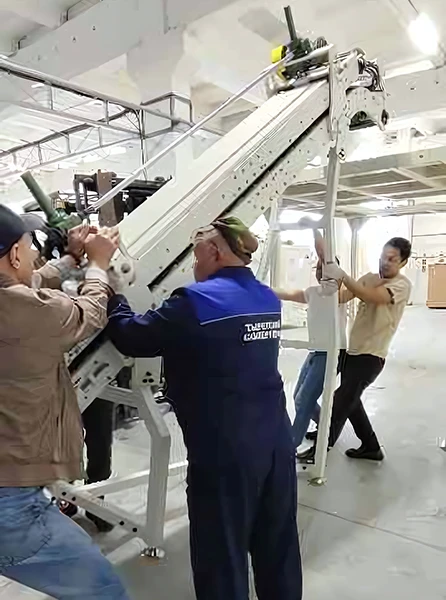
In a manual or semi-manual repacking room, operators normally have to move finished bags, open a larger woven sack, hold the mouth by hand, drop products in one by one, flatten the load, and then send it to sewing. That process is slow, noisy, and sensitive to operator skill. If the bag mouth drifts, the fill becomes uneven. If too much air remains inside, the stack becomes unstable. If the discharge point is not controlled, the next station waits, and throughput falls.
The BIBPU concept is designed to remove that instability. The line shown here combines automatic bag handling, guided transfer, compression, and final closing in one flow. Instead of treating secondary packaging as a loose manual step, it turns it into a controlled machine sequence.
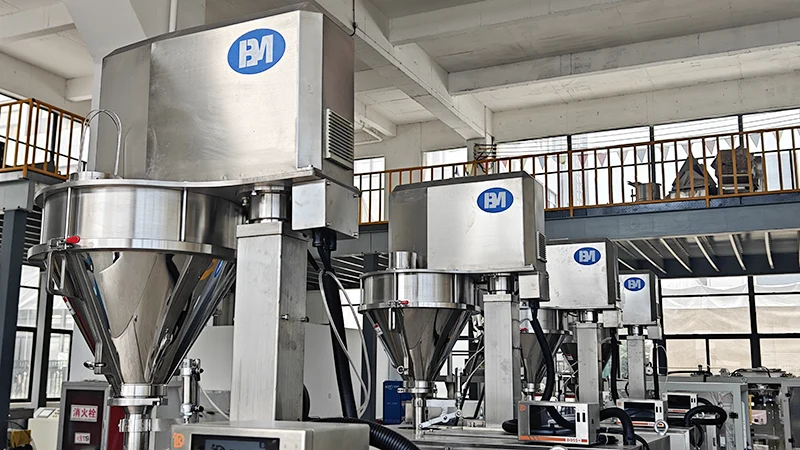
Loose hand-fed repacking creates three direct costs: more labor per ton, more rework from bad alignment or poor deaeration, and more damage risk when sacks bulge or the mouth is not held square before stitching.
Why this machine fits the job
BIBPU works because every key motion has a mechanical reason. The bag handling area uses stable clamps and guided transfer so the sack opening stays square. The filling and settling section keeps the load centered instead of letting bags fall into a random pile. The compressing section pushes out trapped air before the closing station, which helps the finished sack sit flatter on pallets and in transport.
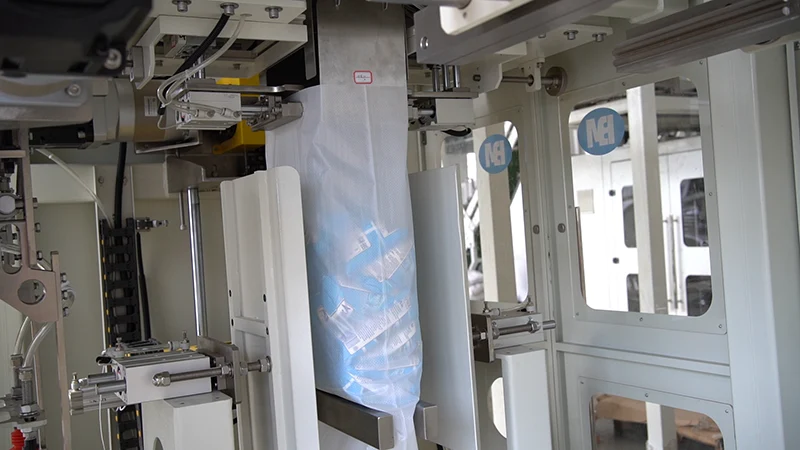
The product-side evidence is visible in the image set: the secondary woven PP bag is held by pneumatic clamps while the small bags drop in from above, then the loaded sack is compressed by side plates before sewing. At the closing end, the Newlong sewing head gives a dependable industrial stitch for a filled woven sack. This is not a generic packaging line; it is a sequence built around secondary bag-in-bag work.
Practical takeaway: if the upstream bags are already packed, the secondary machine must protect their shape, control the mouth, and keep the final sack tight. That is exactly where a guided clamp-and-close design performs better than a free-hand repacking table.
Structure, parameters, and evidence from the machine photos
The photo set shows the important hardware decisions behind the line. The contact-side components use corrosion-resistant stainless steel where needed, which helps in dusty or corrosive environments. The control cabinet uses an IP65-rated layout with an HMI and safety devices, so operators can monitor the sequence without opening the machine. The sealing and compression stations rely on fixed guides, pneumatic motion, and thermal control instead of improvised manual adjustment.
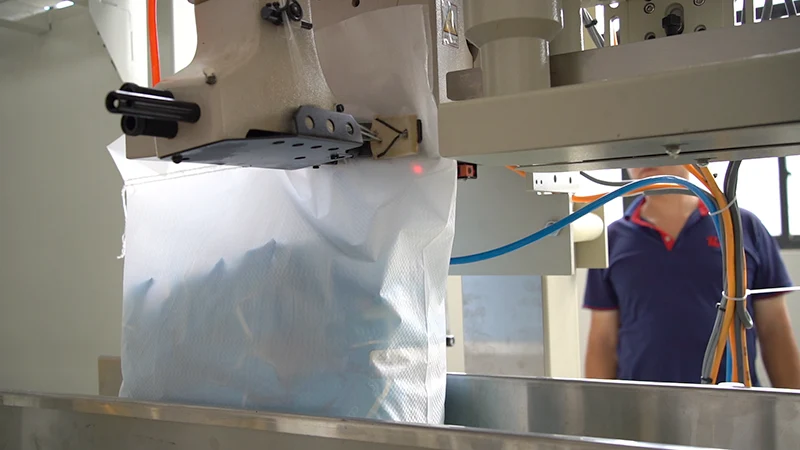
For the closing station, the evidence is even more direct: the woven sack mouth is guided to the sewing head, then stitched with industrial consistency. In the compression stage, the 150 mm side-cylinder motion shown in the index is enough to flatten the filled sack before sewing. That matters because a flatter sack is easier to stack, easier to load, and less likely to deform during dispatch.
| Problem on the floor | BIBPU response | Photo evidence |
|---|---|---|
| Manual repacking is slow and inconsistent | Automatic bag handling and guided transfer | Workshop line overview and transfer sections |
| Sacks bulge before closing | Pneumatic compression and deaeration before stitch | Loaded woven sack compression and foam guide details |
| Final stitch quality varies by operator | Industrial sewing head with controlled feed | Newlong DS-9C sewing station |
Final result: steadier repacking, flatter sacks, easier dispatch
For plants that need to collect, repack, and ship bagged products in a woven outer sack, BIBPU gives the line a cleaner flow. The mouth is controlled, the load is settled, the air is reduced, and the closing station is no longer dependent on hand skill alone. That is what makes the output steadier from shift to shift.
Request a BIBPU line layout English
 Русский