
How BIBPU Keeps Salt Bags Straight Before Sewing
A Russian salt producer needs every filled bag to arrive at the sewing head flat, aligned, and ready for a clean seam. That is where the secondary packaging line matters most: it has to control transfer, buffer the bag shape, and keep the workflow stable from discharge to closing.
From production floor pressure to a stable handoff
In a salt plant, the problem is rarely the bag itself. The real issue starts after primary filling, when the product still has to move through transfer, alignment, opening control, and sewing without twisting or collapsing. If the handoff is rough, the bag mouth shifts, air remains trapped, and the closing point becomes inconsistent.
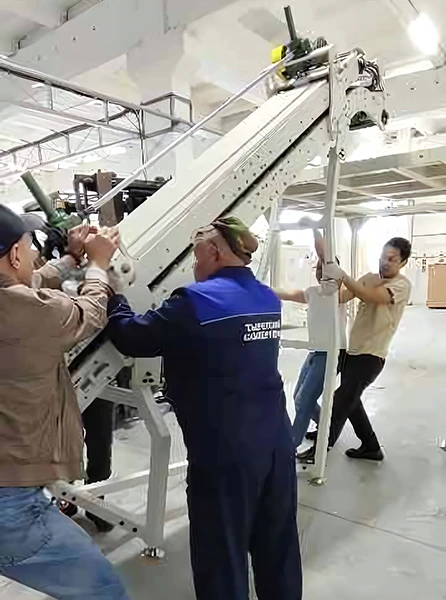
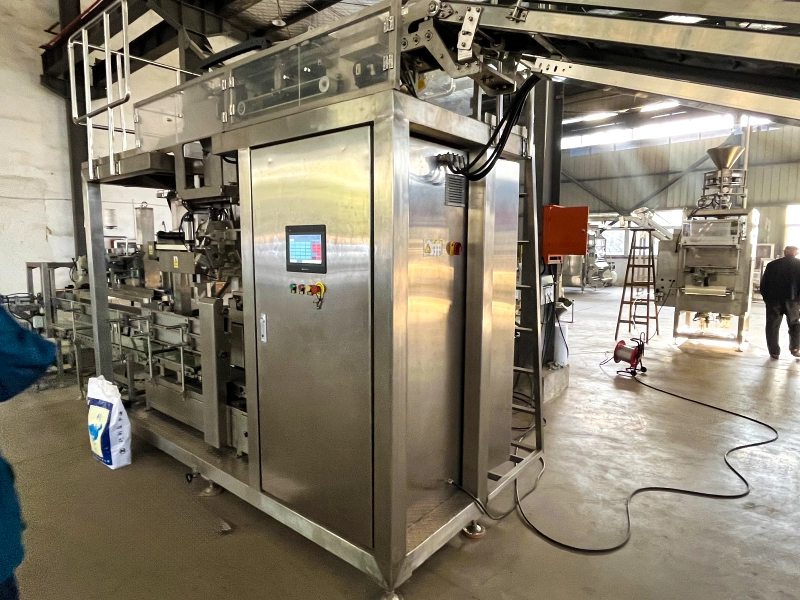
BIBPU addresses that exact gap with a secondary packaging layout built around controlled conveyance and a clean sewing sequence. The workshop image shows the line logic clearly: incline conveyors, elevated working platforms, electrical control cabinets, and a machine arrangement that supports continuous flow instead of stop-and-correct handling.
When a filled woven sack reaches the closing station with a skewed mouth, the operator must fight the geometry instead of closing the bag. That wastes time and creates avoidable rework. For hygroscopic salt, the longer the bag stays open and unstable, the more the process depends on manual correction.
Why the BIBPU structure fits this job
The internal machine view explains why the line is suitable for this duty. Pneumatic guides, protective doors, and compact mechanical routing help keep the handoff controlled and the operator interface predictable. The line is not trying to be a generic packing machine; it is arranged for the specific sequence of secondary packaging, bag stabilization, and sewing preparation.
The workshop frame assembly image also supports the same point. A rigid machine frame and standardized build approach matter because secondary packaging lines must hold alignment over long shifts. On salt applications, consistent mechanical behavior is not optional. It is what keeps the bag feeding path and the sewing point repeatable throughout production.
bpmpack Engineering Insight: In a salt line, the best secondary packaging design is the one that reduces correction work before the stitch. BIBPU does that by combining line transfer, shape control, and a sewing-ready bag path instead of treating closing as a separate manual operation.
What the closing sequence proves in practice
The final two images are the strongest evidence. First, the dual belt feeders hold the woven bag opening in position so the mouth stays aligned before sewing. Then the industrial sewing head closes the bag with a clean, continuous stitch. That sequence is exactly what a salt plant needs when it wants fewer misfeeds, fewer deformed bag mouths, and a more stable downstream palletizing result.
For operations teams, the benefit is simple: the line turns a fragile manual handoff into a repeatable mechanical process. The result is better bag presentation, more stable closing quality, and less dependence on constant operator intervention at the sewing point.
| Plant problem | BIBPU response | Visible evidence |
|---|---|---|
| Bag mouth shifts before closing | Controlled transfer and alignment path | Inclined conveyor line and control cabinet |
| Operator correction slows output | Secondary packaging flow designed for repeatability | Internal mechanism and frame assembly views |
| Closing quality varies shift to shift | Stable feeding into the sewing head | Dual belt feeder and industrial sewing station |
Need a cleaner handoff before sewing?
If your salt bags are arriving crooked, soft, or too hard to close consistently, BIBPU is built for the secondary packaging step that sits between filling and sewing. It helps keep the bag straight, the mouth aligned, and the line moving.
Request a line discussion English
 Русский