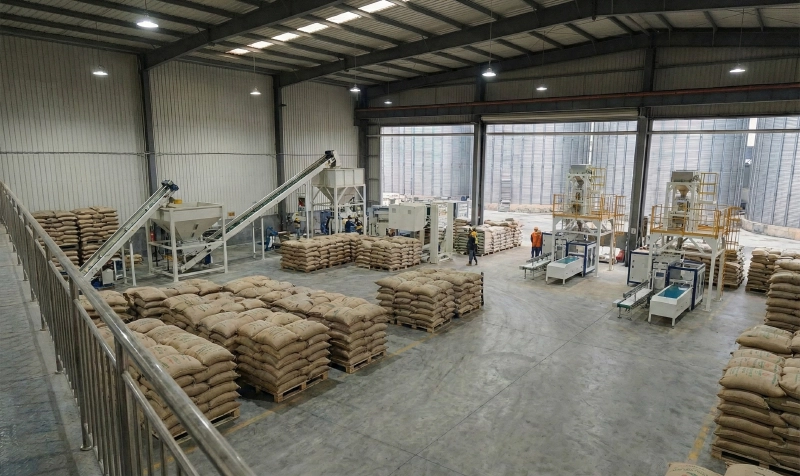
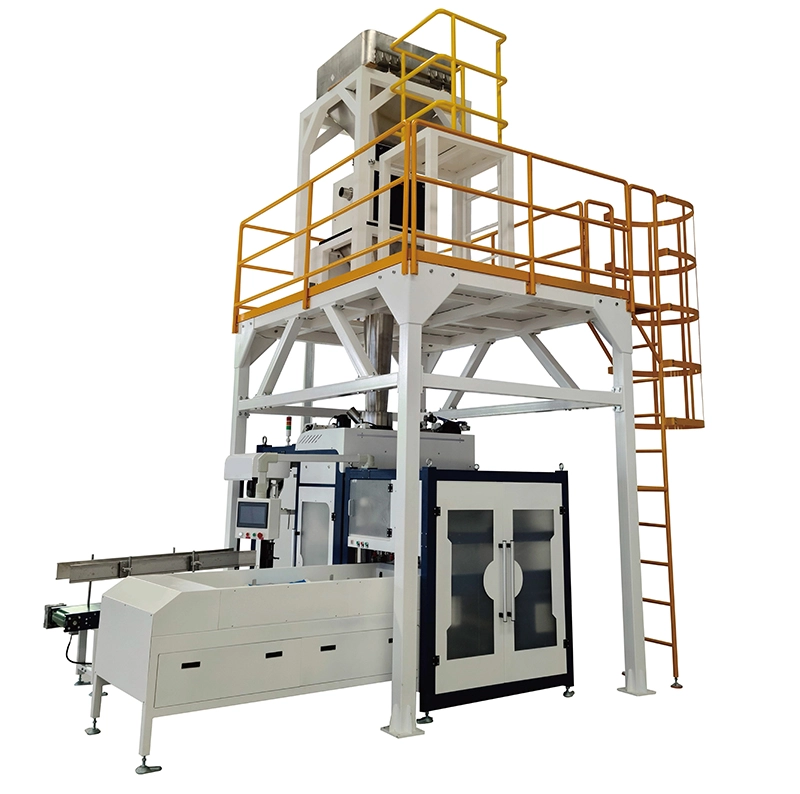
Automatic Bagging Machine & Palletizing Systems Manufacturer

Category: Статьи

  • ppline Dry-Bulk Bagging for Cleaner Sack Transfer in a Southern Grain Warehouse

    ppline Dry-Bulk Bagging for Cleaner Sack Transfer in a Southern Grain Warehouse

    Dry-Bulk Bagging

    How ppline Keeps Woven Sacks Moving Cleanly from Bagging to Sewing in a Southern Grain Warehouse

    For a southern grain warehouse operator, the hard part is not only filling sacks. The real issue is keeping each woven sack aligned, stable, and ready for the next step without extra handling, edge damage, or floor congestion. This ppline line is built around that transfer problem: a modular hopper-fed layout, a controlled inclined conveyor, and a raised steel platform that keeps the workflow organized from feed to discharge.
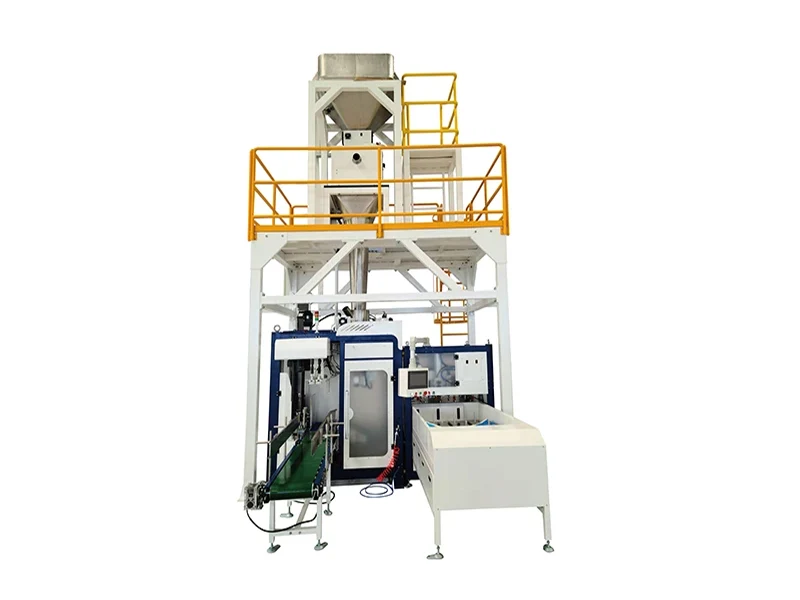
    ppline dry-bulk bagging line with elevated steel platform, hopper, inclined conveyor, and safety railings

    What the warehouse needed to solve first

    The site was handling woven sacks in a busy bulk storage environment where the bagging area, transfer point, and downstream sewing or stacking area were too close to each other in practice, even if they looked separated on the floor plan. Bags were arriving with inconsistent posture, operators were spending time re-positioning them by hand, and the line was losing rhythm every time a sack left the filling point and had to be guided into the next process.

    The ppline concept fits this kind of job because it is designed as a coordinated line rather than a single machine. The image evidence shows a top hopper, an enclosed machine body, side access points, and an inclined conveyor feeding the next movement stage. That combination matters in a warehouse because it reduces loose manual handoff and keeps the process visually readable for operators and supervisors alike.
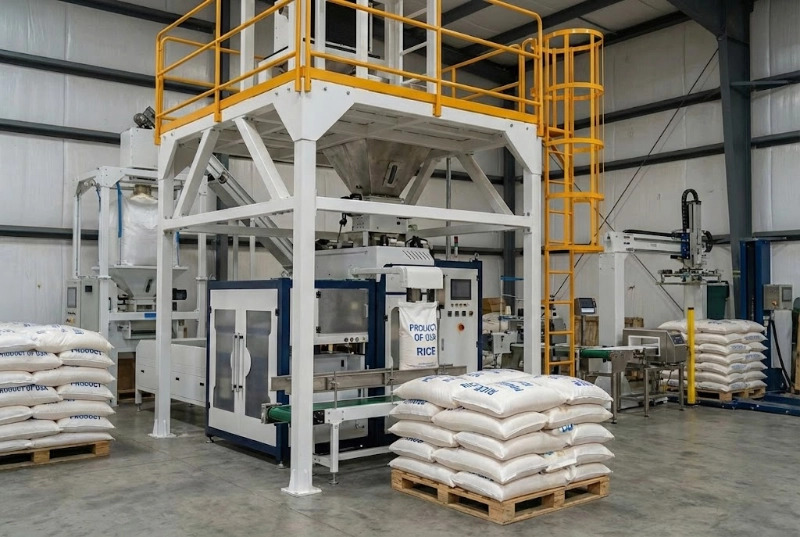
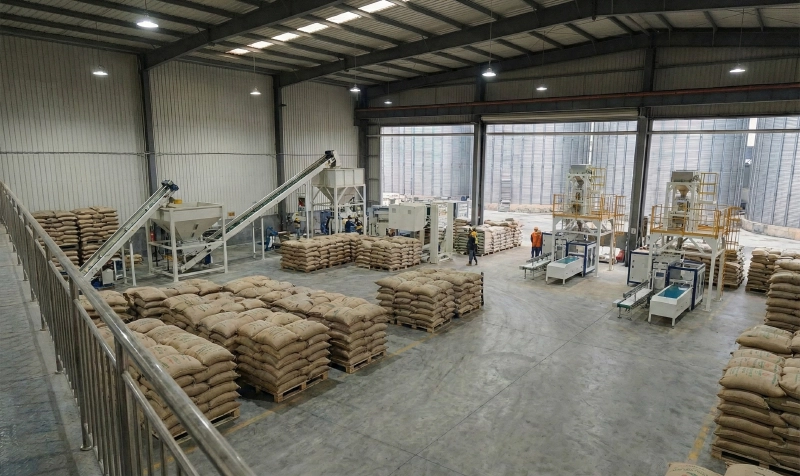
    ppline bagging line for a grain warehouse with steel hopper, weighing frame, and palletized sacks
    Pain point: unstable sack handoff before sewing

    When the output sack is not guided properly, the warehouse pays for it in three ways: more manual correction, more surface wear on woven bags, and more stop-start motion at the discharge point. That creates a bottleneck right where the line should be most predictable.

    Why this layout matches the job better than a simple filling unit

    ppline addresses the problem with layout discipline. The raised steel frame keeps the line off the floor and gives the operator clear access to the process path. The hopper and enclosure help isolate the feed area, while the inclined conveyor creates a controlled route for the next stage of handling. In other words, the line is not just filling product; it is organizing movement.

    That is why the system suits dry-bulk packaging in a warehouse setting. The transfer path is visible, the machine body is modular, and the process can be integrated into a larger bagging and stacking sequence without turning every sack into a separate manual task. For operators, that means less chasing bags. For the warehouse, it means a cleaner rhythm between filling, transfer, and downstream handling.

    bpmpack Engineering Insight: In bulk sack work, the biggest hidden loss is usually not the filling itself. It is the unstable transfer after filling. A line with a steel platform, protected machine body, and directed conveyor path helps keep the sack posture consistent so the next process step starts from the same condition every time.

    What the structure tells us about the result

    The photos show a practical industrial build rather than a showroom setup. You can see the control cabinet, the access doors, the support frame, and the conveyor angle all working together. Those details are evidence that the line is meant to stay serviceable in a real warehouse, not just look good in a render.

    For the customer, that translates into a more stable workflow: sacks leave the filling zone in a more controlled manner, operators spend less time correcting position, and the line is easier to fit into a larger plant flow that includes sewing, stacking, and pallet movement. The end result is a cleaner transfer stage and a more predictable dry-bulk packaging process.

    BeforeWith ppline
    Manual repositioning after fillingDirected transfer path with less hand correction
    Loose floor-level workflowRaised modular frame for clearer process control
    Unstable sack handoffInclined conveyor and enclosed machine body support the next step
    Harder to integrate into the warehouse flowBetter fit for sewing, stacking, and palletizing sequences

    Need a cleaner dry-bulk transfer layout for your warehouse?

    If your line is still relying on manual correction between filling and sewing, ppline can be arranged around the actual sack movement you need to control. Share your material type, bag size, and target output, and we can map the layout to the real process instead of forcing the process to fit the machine.

    Request a layout review
  • ppline for Steadier Woven-Sack Transfer in a Southern Grain Warehouse

    ppline for Steadier Woven-Sack Transfer in a Southern Grain Warehouse

    Bulk Packaging

    Why a Southern Grain Warehouse Chose ppline for Steadier Woven-Sack Transfer

    When a warehouse has to move filled woven sacks from filling to sewing and then into pallet-ready flow, the weak link is rarely the bag itself. The problem is usually transfer stability, floor congestion, and the extra handling that creates scuffs, misalignment, and rework. This is where a modular ppline layout gives the line a cleaner handoff.

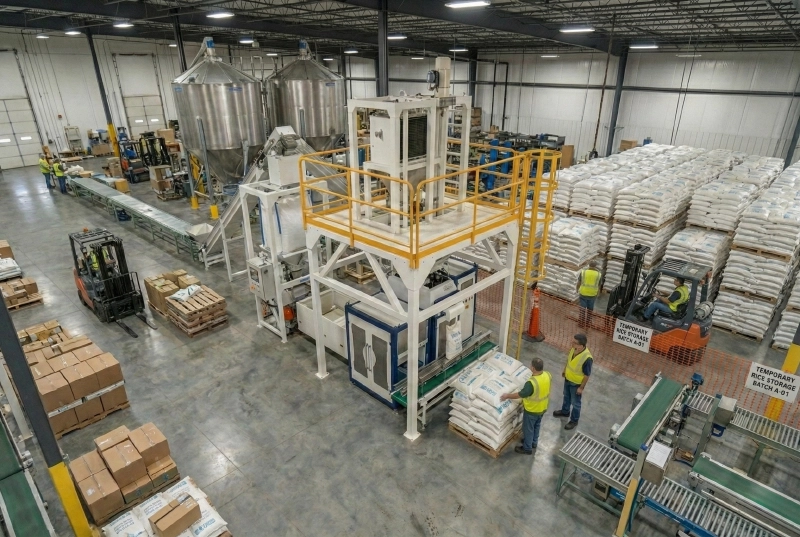
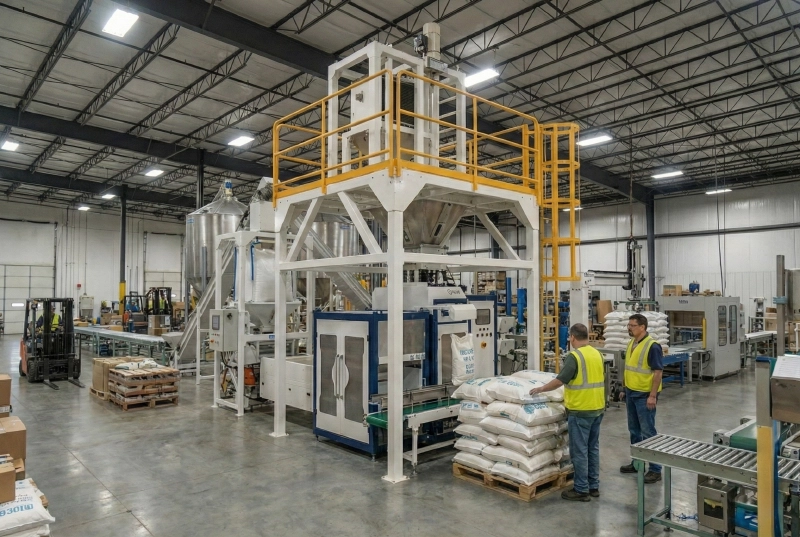
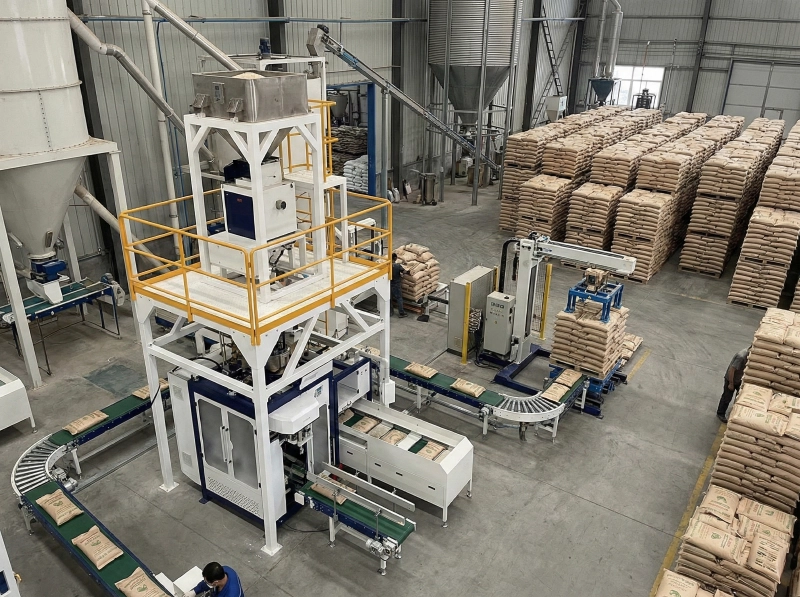
    Industrial powder packaging line with stainless steel silos, elevated platform, conveyors, and bagged product stacks.

    What Was Going Wrong in the Old Sack Transfer Flow

    The warehouse needed a way to move woven sacks without letting the bags wander, twist, or rub against each other between stations. In the old setup, workers had to correct the bag position by hand, and every correction added time. Once the sacks started drifting on the transfer path, the sewing station received inconsistent bag mouths, and the downstream pallet stack became harder to keep square.

    That kind of problem usually looks small on paper, but in daily production it becomes a constant source of extra touches, slower throughput, and avoidable product damage. The visible stack of finished bags in the hero image shows the final goal; the real challenge is building a line that can reach that result without forcing the operator to fight the transfer step.

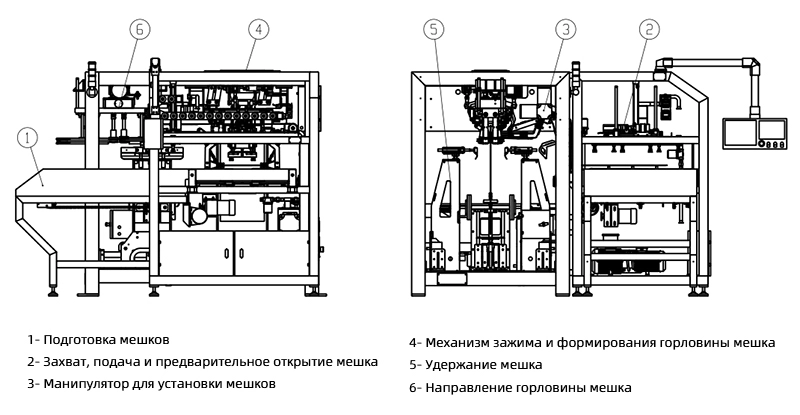
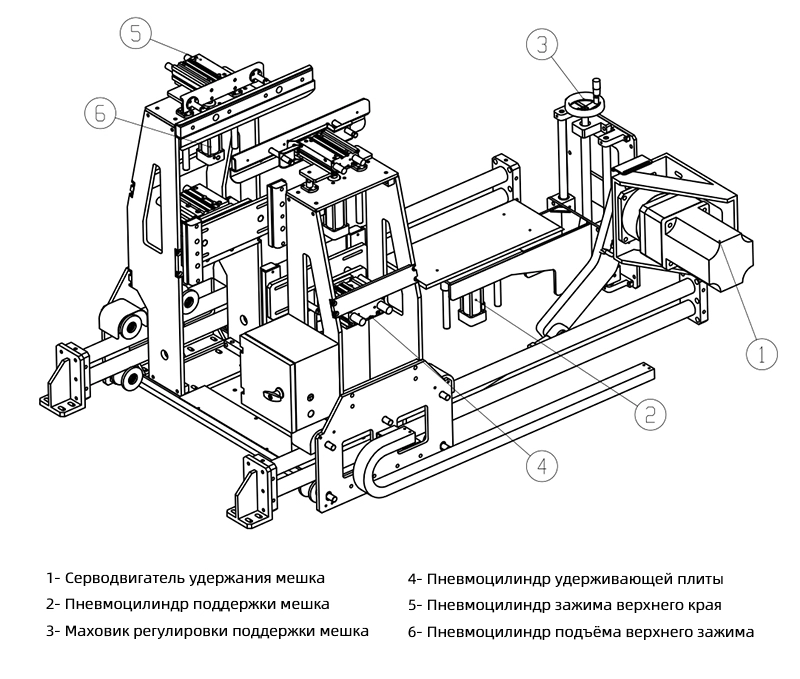
    Technical CAD drawing of bag clamping and bottom support assembly with pneumatic cylinders, servo motor, and Russian annotations.
    Transfer instability

    Woven sacks that arrive unevenly at the next station create misalignment, slower sewing, and more manual correction. The warehouse needed a line that keeps the bag mouth and body under control instead of letting gravity and vibration decide the position.

    Why the ppline Layout Fits This Application

    The selected ppline arrangement fits because it turns the transfer path into a guided process rather than a free-moving one. The elevated platform keeps the main handling equipment organized above floor traffic. The conveyor path separates the bag flow from the general warehouse lane. That matters in a grain plant, where forklifts, pallets, and walking space all compete for the same floor.

    The second image gives the strongest proof: the bag clamping and bottom support assembly is built around pneumatic cylinders and servo adjustment, which is exactly what a transfer step needs when the bag must stay aligned. The support is not decorative. It exists to hold the woven sack during positioning so the next station receives a cleaner, more consistent presentation.

    bpmpack Engineering Insight: A steady sack transfer line is not only about moving product faster. It is about controlling the bag at the moment it changes state: from filling to handling, from handling to sewing, and from sewing to palletizing. By combining a rigid steel platform, guided conveyor flow, and a clamping/support assembly with pneumatic and servo control, ppline reduces the kinds of micro-errors that create macro delays in a busy warehouse.

    Visible Structure, Practical Result

    The warehouse operator did not need a generic packaging pitch. It needed a line that could be explained by what you can actually see: stainless storage, elevated access, controlled bag movement, and a support mechanism that keeps the sack stable at the critical handoff point. That is why the evidence matters. The photos are not just decoration; they show the structural reasons the line works.

    In practice, this means less manual straightening, fewer damaged bag corners, smoother sewing station feed, and a more regular pallet pattern at the end of the line. For a grain warehouse, those improvements add up quickly because the line runs every day and every deviation repeats many times.

    Warehouse problemppline responseVisible evidence
    Bag drift during transferGuided conveyor flow and controlled handoffElevated line with organized conveyor path
    Uneven bag mouth at the next stationPneumatic clamping and support assemblyCAD view showing cylinders and servo adjustment
    Floor congestion and repeated manual correctionModular layout on a raised platformClean, separated machine and pallet zones

    Need a cleaner woven-sack transfer line?

    If your warehouse is still relying on manual correction between filling, sewing, and palletizing, ppline can be laid out around the actual transfer problem instead of forcing the plant to adapt to a generic machine flow.

    Request a layout discussion
  • ppline for Stable Woven-Sack Transfer in a Southern Grain Warehouse

    ppline for Stable Woven-Sack Transfer in a Southern Grain Warehouse

    Dry Bulk Packaging

    ppline for Stable Woven-Sack Transfer in a Southern Grain Warehouse

    A regional grain operation needed a cleaner way to move filled sacks from discharge to sewing and pallet staging without dragging the bag flow through a crowded forklift lane. ppline fits that problem with a compact bagging layout, controlled conveyor handoff, and a warehouse rhythm that stays predictable during daily production.

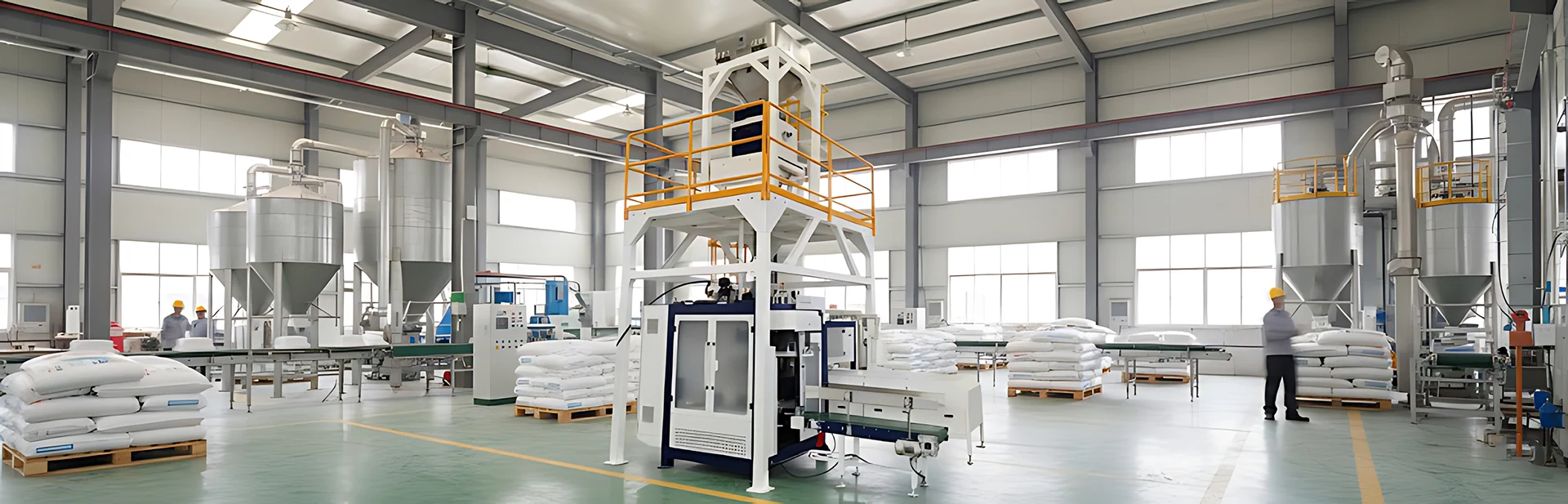
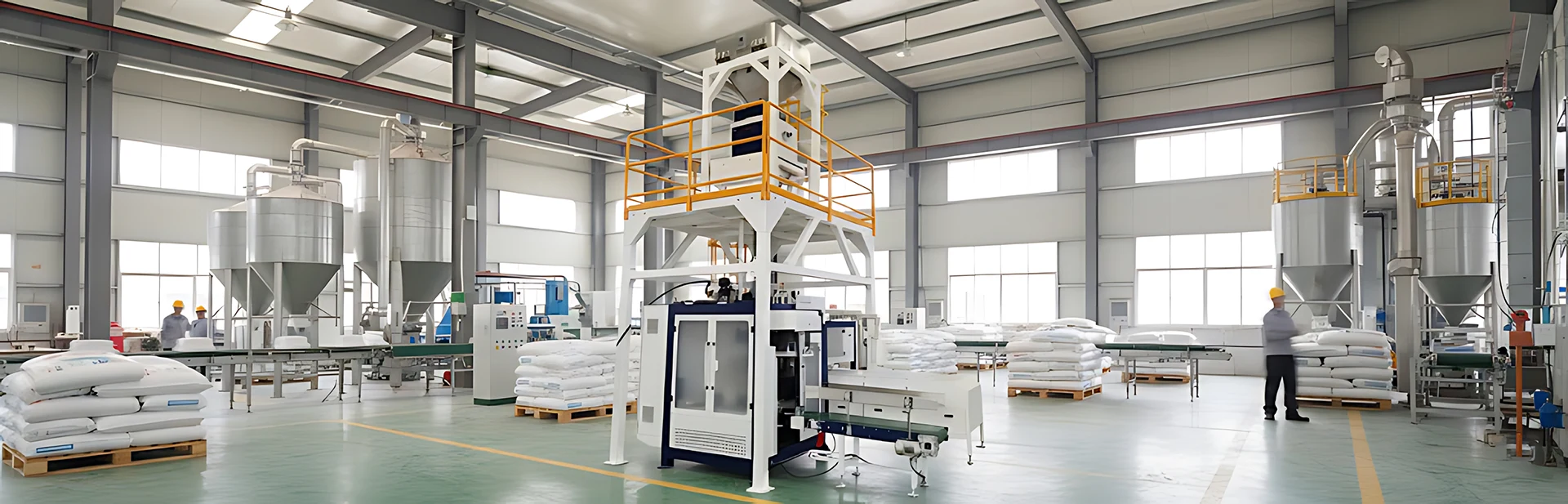
    Wide-angle interior render of a grain bagging warehouse with dual bagging towers, inclined conveyors, and palletized sacks

    Why the warehouse layout matters before the sacks reach sewing

    In a grain warehouse, the biggest loss is not always at the filling point. It often appears one step later, when a filled woven sack has to travel from the bagging station to sewing, then on to palletizing. If that handoff is loose, the bag can swing, rub, or sit too long in a waiting zone. When forklifts share the same corridor, the line gets slower and the stack quality becomes uneven.

    ppline addresses that problem as a layout, not just as a machine. The wide-angle warehouse view shows dual bagging towers, inclined conveyors, and palletized sacks arranged in a clear sequence. That sequence matters because it keeps the filled bag moving in one direction, reduces unnecessary backtracking, and gives the operator a visible path from discharge to the next workstation.

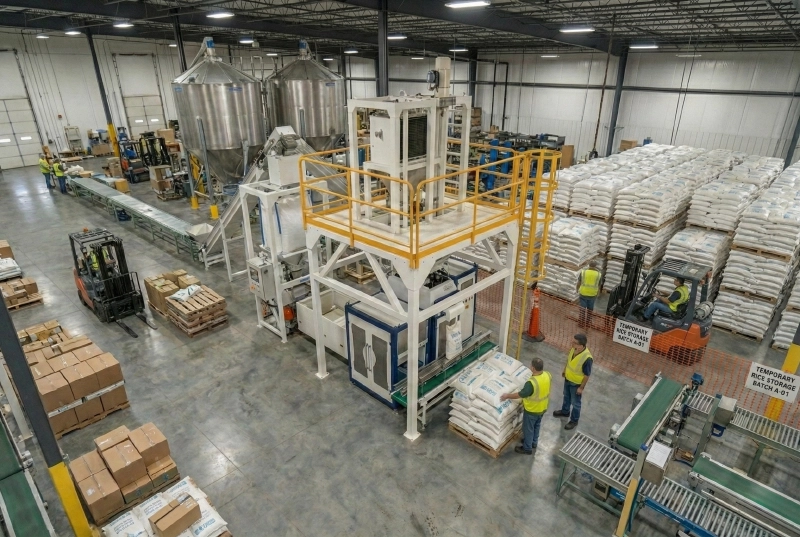
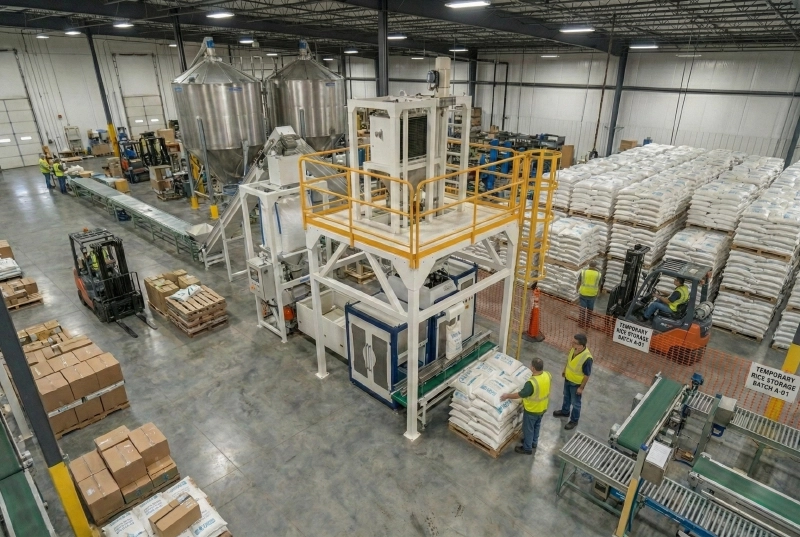
    High-angle operational photo of a QZK-1200 bagging plant with stainless steel silos, conveyors, and active forklift logistics
    Pain point: unstable sack handoff in a crowded lane

    When the bagging area is too open, the transfer from filling to sewing becomes a manual workaround. That creates bag sway, edge scuffing, and an awkward waiting point before the pallet leaves the station. ppline reduces that friction by keeping the workflow short, structured, and easy to supervise.

    What ppline changes in the structure and daily operation

    The operational photo makes the engineering logic clear: stainless steel silos feed a disciplined conveyor route, the bagging plant holds the product in a fixed working zone, and the forklift lane stays separated from the packing logic. That separation is practical. It means the warehouse can keep bulk material moving without forcing the bagged product to cross random traffic or temporary storage piles.

    For a grain operation, the real benefit is repeatability. If the line always presents the sack in the same position and the staging area stays consistent, downstream sewing and palletizing become easier to standardize. Fewer handoffs mean fewer chances for a sack to lose shape, slip off alignment, or wait in a place where the next truck or forklift has to interrupt the flow.

    bpmpack Engineering Insight: For dry bulk packaging, throughput matters, but bag integrity matters just as much. A warehouse layout that preserves the sack shape between filling, transfer, and pallet pickup usually saves more time than a line that simply runs faster but forces extra manual corrections.

    What to verify before you re-layout a grain bagging line

    Do not start with a generic equipment list. Start with the actual movement of the bag. Check whether the discharge point can stay close to the sewing station, whether the forklift route can remain outside the packing lane, and whether the palletized sacks can be collected without crossing the incoming raw material path. Those three checks decide whether the line feels controlled or constantly improvised.

    With ppline, the answer is built into the layout itself. Dual bagging towers, inclined conveyors, and a clear staging zone help the warehouse keep its dry-bulk flow organized from the first filled sack to the final pallet. That is why the system works well for a regional grain plant that needs cleaner handoff, fewer interruptions, and a more predictable operating rhythm across shifts.

    IssueWhat ppline doesResult
    Loose transfer before sewingUses a fixed bagging route with short movement between discharge and stagingCleaner handoff and less sack deformation
    Forklift interferenceSeparates the production lane from the logistics laneSafer movement and fewer stoppages
    Messy pallet stagingProvides a visible, repeatable pallet zone after baggingMore consistent stack quality and dispatch rhythm

    Plan a cleaner grain bagging flow with ppline

    If your warehouse needs a better handoff between filling, sewing, and pallet pickup, ppline can be matched to the available floor space, bag flow, and forklift path. The goal is simple: fewer manual corrections, a cleaner sack route, and a line that keeps production moving without crowding the aisle.

    Talk to BPM
  • Dry-Bulk Bagging for a Southern Russian Grain Warehouse | ppline

    Dry-Bulk Bagging for a Southern Russian Grain Warehouse | ppline

    Dry bulk packaging

    How ppline Stabilized Dry-Bulk Bagging in a Southern Russian Grain Warehouse

    A regional grain plant needed a cleaner way to move woven sacks from filling to pallet loading. The answer was not more manual handling, but a line layout with a rigid steel frame, an enclosed bagging cabinet, and conveyor handoff points that kept every sack square.

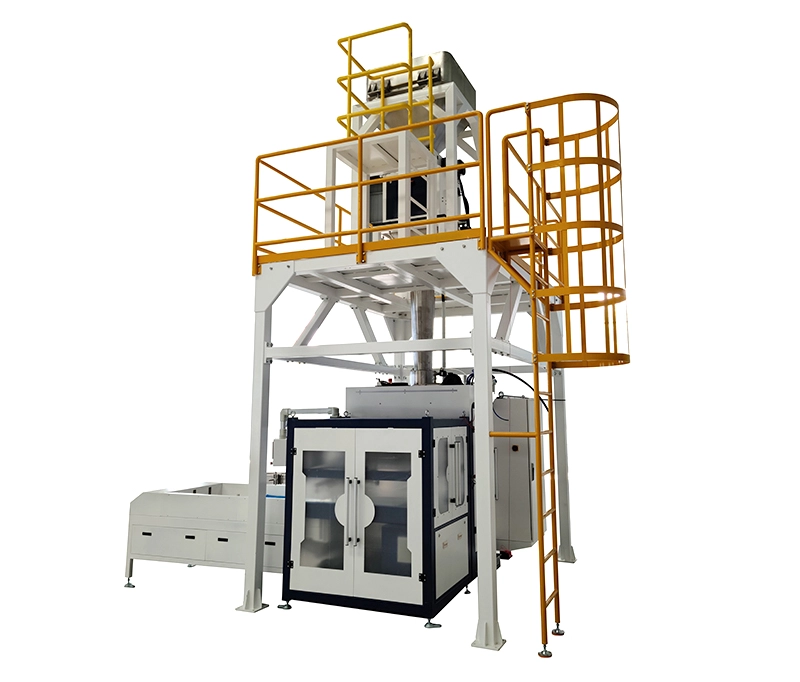
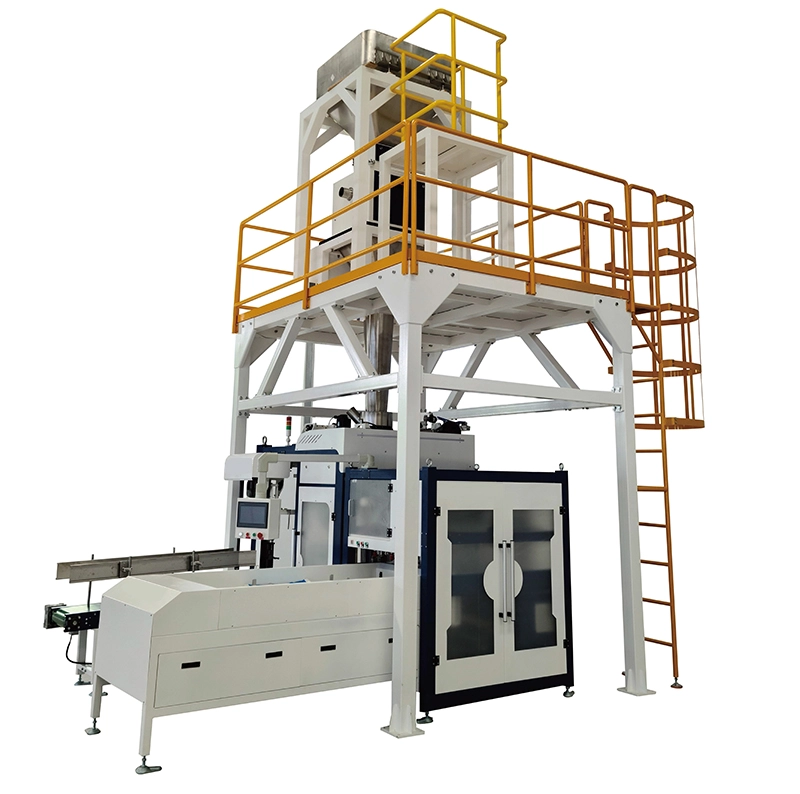
    Front view product photo of QZK-1200 automatic bagging machine with elevated steel framework, safety cage ladder, and enclosed cabinet

    Where the old workflow broke down

    At this plant, the problem was not the lack of material. The problem was the amount of movement between filling, straightening, and stacking. Each extra handoff gave the woven sack another chance to twist, sag, or catch on a frame edge before it reached the pallet area.

    The site also had to live with real warehouse traffic. Forklifts were moving, operators were walking the line, and the packaging cell could not depend on a perfect empty floor. That is why a compact, rigid ppline layout mattered more than a loose collection of machines.

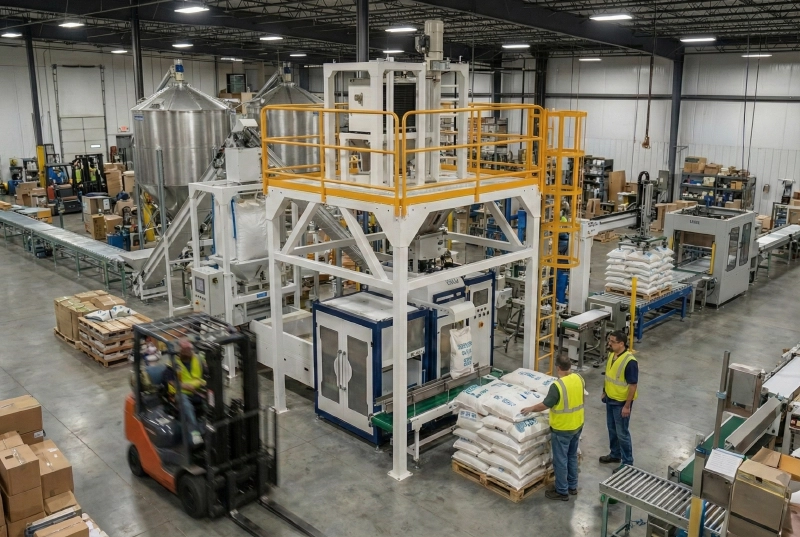
    High-angle perspective photo of running QZK-1200 packaging line with active forklift logistics and high-visibility operators
    Pain point: unstable bag transfer

    When filled bags leave the machine without a controlled handoff, the sack mouth twists, the body bows, and the pallet line spends time correcting every unit. That hidden correction work is what slows throughput and makes a line look busy without actually shipping more.

    Why ppline fit the site

    The line matched the warehouse because the structure does the handling work before people have to. The elevated steel framework separates the process zone from floor traffic, the enclosed cabinet protects the bagging point, and the outfeed path keeps the sack travel straight from fill to discharge.

    The second image confirms that the machine can run in a live plant environment, not only in a clean showroom. Forklifts, operators, and pallet staging all remain part of the workflow, which is exactly where dry-bulk lines often fail if their geometry is too open or too soft.

    bpmpack Engineering Insight: For dry-bulk plants, the real design target is not only filling accuracy. It is the geometry of the bag journey. A rigid frame, a fenced platform, and a straight outfeed section reduce the small impacts that make woven sacks lose shape before palletizing. That is why the plant can scale output without forcing every bag through a manual straightening step.

    What the structure proves on the floor

    The product evidence is visible in the hardware itself. The front-view machine photo shows an elevated steel framework, a safety cage ladder, and an enclosed cabinet. The operation photo shows the same line working with forklifts and operators around it. Together, they prove that the layout is built for repeated service, stable bag discharge, and real warehouse logistics.

    The result is simple: fewer bag corrections, cleaner pallet edges, less floor congestion, and a line that keeps moving even when the warehouse is busy. Instead of treating bag transfer as a separate manual task, ppline keeps the flow controlled inside one physical path.

    Physical proofWhat it solvesResult on site
    Elevated steel framework and safety cage ladderCreates a fixed service level and protects the process zone from floor trafficSafer maintenance and fewer interruptions around the machine
    Enclosed bagging cabinet and straight discharge pathKeeps the bagging point stable during filling and releaseCleaner sack shape and fewer alignment corrections
    Live forklift lane beside the lineShows the layout can coexist with warehouse logisticsFaster pallet staging without crowding the packing cell

    Need a cleaner bagging layout for your grain site?

    If your line is still losing time to bag corrections, floor congestion, or awkward handoffs, ppline can be laid out around your plant traffic, not against it. That is usually where the fastest operational gain appears.

    Request a layout review
  • Ppline Bulk Packaging Line for Cleaner Sack Transfer Before Sewing

    Ppline Bulk Packaging Line for Cleaner Sack Transfer Before Sewing

    Bulk Packaging

    Cleaner Sack Transfer Before Sewing in a Grain Plant

    A ppline bulk packaging line helps a southern Russian grain plant keep woven sacks straight at the last handling point, so the bag mouth stays aligned before sewing and the finished load moves to palletizing with less rework.

    Eye-level photo of ppline bagging station with steel safety cage ladder, conveyor, and operators stacking woven sacks

    Why the handoff point keeps causing trouble

    In many grain plants, the packaging line is not judged by the filling step alone. The real losses start when a woven sack leaves the bagging station and has to be carried, squared up, and sent to sewing. At that moment the bag mouth can twist, the body can fold, and the outer layers can pick up scuffs from uneven transfer. If the line depends on manual correction, one operator may be able to save the bag shape for a while, but throughput quickly becomes inconsistent.

    The result is familiar: a cleaner-fill machine still produces messy sacks downstream. Sewing speed drops, inspection becomes more frequent, and the palletizing crew has to pause for sorting. That is why the plant needs a line that protects the sack geometry after discharge, not just a machine that fills quickly.

    Isometric product photo of ppline bagging machine showing swing-arm HMI touchscreen panel, outfeed belt conveyor, and platform
    The real problem is the last meter.

    When a woven sack is already filled, small distortions are expensive. If the outfeed does not support a stable transfer, the mouth loses alignment, the seam line shifts, and the bag reaches sewing in a shape that the operator must correct by hand. The plant then pays for extra labor, slower cycles, and a higher risk of rejected bags.

    Why ppline fits this job

    The ppline layout is built around controlled movement, not loose handling. The steel platform, safety cage ladder, and guided conveyor create a predictable transfer path from the bagging point to the next operation. That matters because the bag is not simply “moving”; it is still a product under formation. A stable outfeed belt keeps the sack body supported, while the elevated machine layout makes the handoff easier to supervise from the working platform.

    For a grain plant, that means the line can be tuned around the sewing station and the palletizing rhythm instead of forcing every downstream operator to adapt to unstable bags. The HMI on the swing arm also helps operators keep the discharge sequence consistent, which reduces the chance that a good bag becomes a damaged bag in the transfer zone.

    bpmpack Engineering Insight: a good bulk packaging line is not only about output capacity. It must preserve bag shape between filling, sewing, and stacking. The combination of a rigid steel frame, elevated access, and a guided outfeed path is what keeps woven sacks square enough for the next step, especially when the line runs continuously.

    What changes after the upgrade

    Once the transfer point is stabilized, the plant usually sees three immediate improvements: fewer sacks need manual correction, the sewing station runs with less interruption, and palletizing becomes cleaner because the bags reach stacking in a more uniform condition. In practice, this is where a ppline-based setup adds value: it turns the last stage of packaging into a controlled process instead of a rescue operation.

    For plants handling dry bulk and woven sacks, that controlled transfer is often the difference between a line that merely works and a line that stays productive on long shifts. The equipment does not replace the operator; it gives the operator a better physical process to manage.

    Plant issueppline responseExpected result
    Bag mouth twists before sewingGuided discharge and stable conveyor transferCleaner alignment at the sewing station
    Manual reshaping slows the lineElevated platform and predictable outfeed pathLess rework and steadier throughput
    Uneven sacks complicate palletizingMore consistent bag geometry after handlingCleaner stacking and fewer rejected bags

    Need a cleaner sack transfer line for your grain plant?

    If your current setup fills sacks well but still loses quality before sewing or palletizing, a ppline bulk packaging line can be configured to keep the transfer stable and the workflow consistent.

    Talk to bpmpack
  • Cleaner Woven-Sack Handoff Before Sewing with ppline

    Cleaner Woven-Sack Handoff Before Sewing with ppline

    Bulk Bagging

    Cleaner Woven-Sack Release Before Sewing at a Southern Russian Grain Plant

    When a grain plant keeps seeing dust, bag-mouth skew, and slow handoff at the sewing station, the problem is usually not the operator. It is the way the sack is released, aligned, and transferred. This ppline layout is built to make that transfer more stable, more visible, and easier to keep in rhythm.

    Modular bulk bagging line with hopper feeder and inclined conveyor for cleaner woven-sack transfer before sewing

    Why the plant needed a cleaner handoff

    The customer scenario is familiar in bulk grain handling: the line may already be filling sacks, but the last transfer into sewing still creates waste. Bags arrive slightly twisted, the mouth is not fully settled, or the operator has to pause to straighten the sack before it reaches the next station. That creates small delays that add up fast over a full shift.

    For a southern Russian grain plant, the weak point was not the product itself. It was the transition between filling and closing. Once the sack left the fill point, the handoff had to stay predictable so the sewing team could work without extra repositioning. That is exactly where a purpose-built ppline layout becomes valuable.

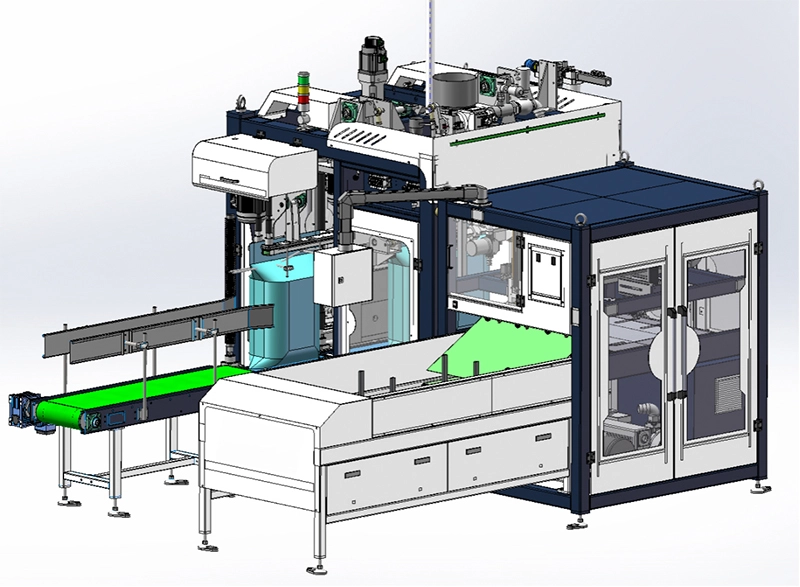
    Automatic bagging machine with bag magazine, bag clamp, and outfeed conveyor for stable sack handoff before sewing
    Old handoff pain

    Loose sack transfer usually comes from a mix of poor bag presentation, weak mouth alignment, and an outfeed path that does not hold the bag in a steady position. If the plant has to rely on repeated manual correction, output becomes operator-dependent and the sewing station becomes a bottleneck.

    Why ppline fits the job

    This line is a good match because it does not treat the bag transfer as a side effect. The hopper feeder gives the upstream supply a stable source point, while the inclined conveyor helps keep material movement smooth and controlled. In the visible machine layout, the bag magazine, clamping point, and outfeed conveyor are arranged to support repeatable sack presentation before sewing.

    That matters in real factory use. A cleaner handoff means less twisting at the bag mouth, less stopping to correct position, and less dependence on one experienced operator. The steel frame, enclosed machine body, and clear access points also make the line easier to place inside a working plant where maintenance, cleaning, and safety all matter.

    bpmpack Engineering Insight: The value is not just automation. It is control over the last meter before sewing. When the hopper feed is consistent, the conveyor movement is stable, and the bag clamp keeps each sack in a repeatable position, the sewing station receives a more predictable workload and the whole line becomes easier to balance.

    What the structure and photos show

    The hero image shows a modular industrial layout with a hopper feeder, control cabinet, and inclined conveyor. That is important because the plant does not need a loose collection of machines. It needs a connected transfer path that supports the bag from filling through the next action. The second image makes the transfer logic even clearer: the bag magazine, clamp zone, and outfeed conveyor are all visible in one machine view.

    Those visuals support the operating goal of the project. The line is not trying to be flashy; it is trying to make the sack path cleaner. For a grain plant that ships woven sacks, the practical result is more stable downstream sewing, fewer interventions, and a smoother rhythm between filling and closing.

    Evidence pointWhat the photos showOperational result
    Upstream feed controlHopper feeder and inclined conveyor are integrated into one modular lineMore stable material flow into the bagging process
    Bag presentationBag magazine and clamp zone are visible in the machine layoutCleaner sack positioning before sewing
    Transfer stabilityOutfeed conveyor supports the bag after fillingLess manual correction at the sewing station
    Plant fitEnclosed machine body and control cabinet are built into the frameEasier integration into an active production area

    Need a cleaner sack handoff line for sewing or palletizing?

    Share the bag size, the material, the target output, and the point where the sack currently loses alignment. We can map the ppline layout to the exact transfer problem and propose a practical arrangement for feeding, clamping, and outfeed control.

    Discuss your line layout
  • ppline Bulk Packaging Line for Cleaner Sack Handoff Before Sewing and Palletizing

    ppline Bulk Packaging Line for Cleaner Sack Handoff Before Sewing and Palletizing

    Blog

    How a Grain Plant Keeps Woven Sacks Square Before Sewing and Palletizing

    At a southern Russian grain plant, the handoff between filling, sewing, and palletizing is often where sacks lose shape, get knocked off line, or need too much manual correction. This ppline layout is built to keep the transfer cleaner, the bag body steadier, and the outbound flow easier to control.

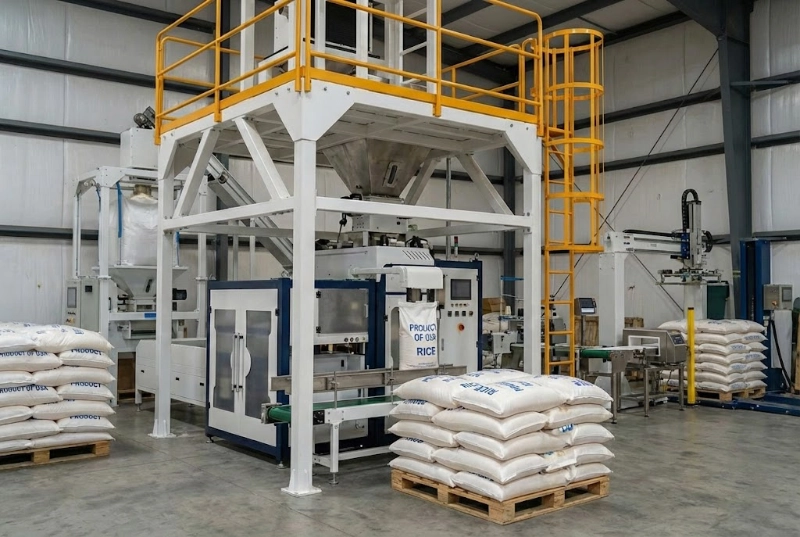
    Automated rice bagging line with steel hopper, weighing frame, and palletized sacks in factory

    Why the old sack handoff causes trouble

    Many grain plants can fill sacks, but the process becomes unstable at the next step. If the bag leaves the filling point with a slight twist, a weak mouth alignment, or too much movement on the transfer belt, the sewing station has to recover that error. The result is slower work, more operator attention, and a higher chance of uneven pallet stacks.

    The first plant image shows the full line logic: a steel hopper, a weighing frame, a conveyor-based transfer path, and palletized sacks waiting for the next move. That is the right starting point when the goal is not only to fill, but also to hand off each sack in a cleaner, more controlled way.

    Automated rice bagging line with steel hopper, weighing frame, and palletized sacks in factory
    Uneven bag transfer

    When a woven sack arrives at sewing already skewed or loosely supported, the operator has to fix the bag position before the next cycle can continue. That creates visible bottlenecks, more handling, and a less predictable palletizing rhythm.

    What the ppline structure does to stabilize the line

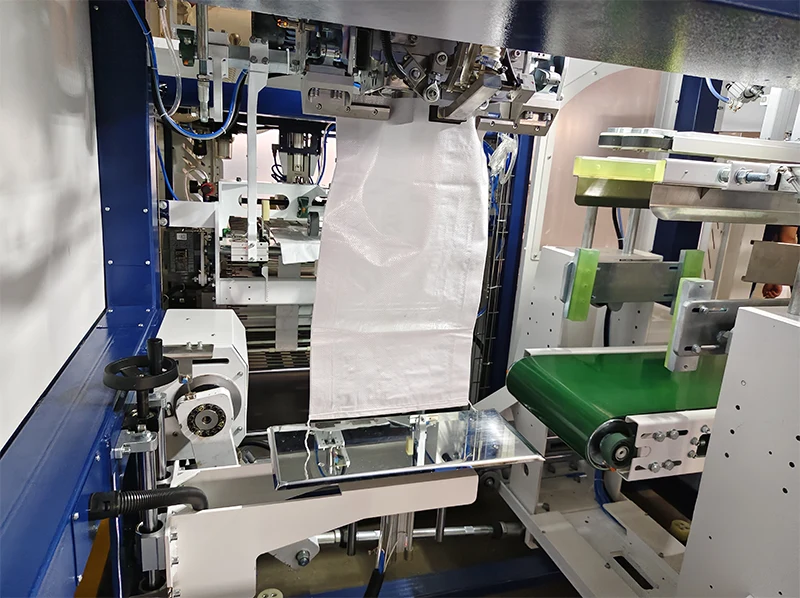
    The close-up image shows the part of the machine that matters most at the handoff point: vacuum suction cups, a robotic placing arm, a green conveyor, and the white woven sack itself. Those elements work together to keep the sack supported while it moves, which helps preserve shape before sewing or downstream transfer.

    The structural evidence in the two photos matters. The plant-level view shows the rigid steel frame and elevated weighing section; the close-up shows the aligned bag handling mechanism and adjustment hardware. In practice, that means the line is not trying to solve the problem with force. It solves it with layout, support, and controlled movement.

    bpmpack Engineering Insight: In bulk bagging, the quality of the final result is often decided before the seam is closed. A cleaner transfer path, a steadier support point, and a rigid frame reduce the amount of correction needed at sewing and palletizing, which is exactly where throughput is usually lost.

    How the line turns into a better outbound result

    For the customer, the win is straightforward: fewer touches on each bag, less visible deformation, and a more consistent flow from filling to stack-building. That makes the plant easier to run during busy shifts, especially when the team needs to move from bagging to sewing without stopping to re-square every sack.

    In other words, the line is not only about bagging capacity. It is about keeping the sack square long enough for the rest of the process to stay efficient. When the transfer point is clean, the sewing station works faster, the stack looks better, and the final pallet is easier to move.

    Plant problemWhat the ppline line addressesResult at the end of the shift
    Twisted or unstable sacksRigid frame, guided transfer, and supported bag handlingCleaner sewing handoff
    Manual correction at the seamVacuum suction cups and controlled placementLess operator rework
    Uneven pallet buildingSteadier bag shape and more predictable outbound flowMore stable stacking

    Need a cleaner sack handoff for your grain line?

    Send your bag size, material, target throughput, and whether the next step is sewing or palletizing. We will match the layout to the real transfer point, not just the filling station.

    Request a layout review
  • Dry-Bulk Bagging for Cleaner Sack Handoff in a Southern Russian Grain Plant

    Dry-Bulk Bagging for Cleaner Sack Handoff in a Southern Russian Grain Plant

    Dry-bulk packaging

    Dry-Bulk Bagging for Cleaner Sack Handoff in a Southern Russian Grain Plant

    When a plant moves dry bulk products from filling to sewing and palletizing, the real risk is not only speed. It is bag stability, cleaner transfer, and whether the line keeps sacks aligned enough for the next manual or automatic step. This installation shows how a ppline bagging line supports that handoff with a steel platform, enclosed machine sections, conveyor transfer, and a layout built for factory logistics.

    High-angle operational photo of QZK-1200 bagging plant featuring twin stainless steel storage silos, conveyors, and active forklifts

    Why the old transfer point became the bottleneck

    In many dry-bulk plants, the filling station is not the hard part. The problem starts after discharge, when sacks are still warm, slightly deformable, or not perfectly squared. If the handoff to sewing or palletizing is inconsistent, operators spend time re-straightening bags, clearing jams, and correcting load edges before the pallet pattern is acceptable.

    This is exactly where the pictured ppline setup helps. The elevated structure, controlled outfeed, and visible conveyor routing keep the bag path predictable. The factory scene also shows a real logistics environment, with forklifts, pallet zones, and storage silos working around the line instead of forcing the line to fight the plant layout.

    Close-up internal photo of bagging unit with vacuum suction cups, robotic placing arm, green conveyor, and white woven bag
    Common pain point: unstable sack geometry after filling

    Dry-bulk products often leave the filling point with air trapped in the bag, uneven corners, or a loose mouth section. That creates crooked sewing, weak stacking, and unnecessary rework before the pallet is finished.

    Why this ppline line is a better fit

    The support image makes the adaptation clear. The internal bagging unit uses vacuum suction cups, a robotic placing arm, and a green conveyor to guide the sack through a controlled path. Instead of letting the bag fall or twist freely, the line maintains contact and alignment during transfer, which is the key requirement before sewing or palletizing.

    The overall machine layout also matters. The steel frame, enclosed cabinet sections, maintenance-friendly access, and elevated platform are not cosmetic features. They reduce operator interference, help keep the production zone organized, and make the line easier to run in a plant where dry bulk packaging must stay consistent across long shifts.

    bpmpack Engineering Insight: For dry-bulk products, the value is not only throughput. A stable outfeed path protects the bag shape, and stable bag shape protects every downstream step. When the filling, conveyance, and transfer geometry stay fixed, the plant gets cleaner sewing, more square pallets, and fewer manual corrections at the end of the line.

    What the line solves in real production terms

    For the Southern Russian grain plant in this example, the target is not a generic packaging upgrade. The target is a cleaner transition from filled sack to finished pallet, with less dependency on operator skill and less sensitivity to minor changes in product flow. The visible silos, conveyors, and forklift-ready floor space show that the line is designed to work inside a real warehouse and not just in a showroom render.

    That is why the ppline format is suited to dry-bulk products: it creates a controlled bridge between upstream filling and downstream handling. Once the bag path is stable, the plant can keep the sewing station cleaner, maintain a tighter pallet face, and reduce the hidden losses that come from hand-correcting every sack.

    Production issueWhat the ppline setup providesOperational result
    Bag shape drifts after fillingVacuum suction cups and guided transferCleaner sack alignment before sewing
    Operators spend time re-straightening sacksControlled conveyor route and stable frameLess manual correction at the transfer point
    Pallet face becomes unevenPredictable outfeed into the logistics zoneStraighter stacks and better pallet quality
    Plant layout creates flow conflictsElevated platform and integrated line footprintBetter fit for forklifts, silos, and warehouse movement

    Need a dry-bulk bagging line that keeps sacks cleaner before sewing?

    If your plant needs a better handoff from filling to palletizing, ppline can be matched to the bag type, transfer distance, and warehouse flow you actually run. The right layout will not just fill faster. It will keep the sack path stable enough for the rest of the line to work properly.

    Request a packaging layout review
  • ppline Bulk Packaging Line for Stable Sack Transfer Before Sewing and Palletizing

    ppline Bulk Packaging Line for Stable Sack Transfer Before Sewing and Palletizing

    Bulk packaging

    How a Russian Salt Plant Stabilized Woven Sacks Before Sewing and Palletizing

    For a bulk-material plant, the problem was not only filling bags. The real issue was keeping woven sacks aligned after discharge, so sewing, transfer, and palletizing could run with fewer jams and less manual rework. This is where the ppline bagging line fits: it combines controlled filling, guided outfeed, and a layout that keeps the sack path predictable from hopper to pallet.

    Wide interior render of a bulk-product bagging warehouse with dual bagging towers, inclined conveyors, and palletized woven sacks

    Why the older bag handling method started to fail

    The customer was dealing with a familiar bulk-packaging problem: once the filled sack left the filling point, the bag no longer stayed perfectly square. If the discharge path was too loose, the sack shifted before sewing; if the line was too narrow, operators had to intervene by hand. That creates a chain reaction—slower throughput, more physical handling, and more risk of scuffed bags or poor stacking quality.

    The first image shows the right kind of plant logic for this issue: a defined material flow, clear line separation, and palletized output ready for the next step. A bagging warehouse only performs well when filling, conveying, and stacking are treated as one system instead of three disconnected machines.

    3D perspective render of a bagging line integrated with a robotic palletizer stacking sacks on pallets
    Alignment pain point

    Bulk sacks often arrive at sewing or stacking in a twisted position. That makes the next station unstable, especially when the plant wants fewer operators and a cleaner transfer from bagging to palletizing.

    Why ppline suits this kind of bulk-product line

    ppline is a good fit because the line architecture is built around control, not just capacity. The image set shows the core elements clearly: a bulk bagging machine with hopper feed, a gravity dosing or weighing stage, an HMI touchscreen, a discharge conveyor, and an elevated steel platform with safety rails. In larger layouts, the same line can be connected to twin storage silos, an inclined conveyor, and a palletizing zone.

    That matters for salt and other free-flowing bulk products because the line needs steady feeding and a repeatable outfeed. Once the sack leaves the filling station in a stable position, the plant can keep sewing and palletizing consistent without constantly correcting the bag by hand.

    bpmpack Engineering Insight: In bulk packaging, the biggest productivity loss is often not the filling process itself but the transition after filling. A stable outfeed path, guided conveyor section, and clear platform layout can reduce the small handling errors that accumulate into stoppages over a full shift.

    Structure and parameter logic visible in the images

    The visual evidence matters here. One product image shows a dual-machine packaging concept with HMI control, filling spouts, bag clamps, and an optional sewing closure. Another image shows a high-angle operational plant view with twin stainless silos, conveyors, and palletized sacks. Together they prove the line is not a single bagging point—it is a complete bulk-material handling system.

    For the buyer, that means the decision is simpler: if the current pain is unstable sack transfer, the solution is not a bigger filler alone. It is a better line structure with controlled discharge, enough platform access, and a downstream layout that protects the sack shape until it reaches sewing or stacking.

    Buyer concernWhat the line must solveppline response
    Sack misalignmentKeep the bag square after fillingGuided discharge and conveyor transfer
    Manual reworkReduce operator interventionIntegrated outfeed and palletizing flow
    Plant safetyProvide stable access and guardingElevated platform, ladder, and safety rail structure
    Throughput stabilityKeep the whole line synchronizedHMI-controlled modular packaging layout

    Need a line that keeps woven sacks stable before sewing?

    For bulk products, the best packaging line is the one that protects bag shape after discharge and keeps the whole transfer path predictable. If you want a layout for salt, grains, or other free-flowing materials, ppline can be configured around your bag size, output target, and downstream handling method.

    Request a bulk packaging layout
  • Dry-Bulk Bagging Line for Cleaner Sack Handoff Before Sewing and Palletizing

    Dry-Bulk Bagging Line for Cleaner Sack Handoff Before Sewing and Palletizing

    Dry-Bulk Packaging

    How a Dry-Bulk Bagging Line Improves Woven-Sack Handoff Before Sewing and Palletizing

    At a southern Russian salt plant, the problem was not only filling bags. The real bottleneck was the handoff after filling: sacks needed to stay square, stable, and easy to move into sewing and palletizing without extra rework. A QZK-1200 dry-bulk bagging line was a better fit because it combined controlled bag transfer, a rigid steel platform, and a clean outfeed path in one production flow.

    High-angle operational photo of a QZK-1200 dry bulk bagging plant with twin silos, conveyors, and palletized sacks in factory

    Why the bag transfer stage was the weak point

    In dry-bulk packing, the filling unit gets attention, but the downstream handoff decides whether the line runs smoothly. If a woven sack leaves the machine skewed, soft, or poorly supported, operators waste time straightening it before sewing or pushing it onto the pallet. That means more manual touchpoints, more floor congestion, and a higher chance of damaged sack edges.

    The plant needed a line that did more than discharge product. It needed a machine that could keep the sack aligned through the last meter of the process, from filling to outfeed to stacking. That is where the QZK-1200 layout makes sense: the machine body, platform, and conveyor path are designed as one controlled transfer sequence.

    Isometric product photo of QZK-1200 bagging machine showing swing-arm HMI touchscreen, outfeed belt conveyor, and steel platform
    Old line pain point

    Unstable woven sacks forced operators to re-square each bag before sewing. The result was slower throughput, inconsistent pallet layers, and more handling damage on the factory floor.

    Why the QZK-1200 fit this salt plant

    The selected line suits dry bulk products because it combines a steel-framed elevated structure with a controlled discharge path. The visible twin silo layout supports steady feed, while the conveyor sections help move filled sacks away from the machine without abrupt handling. For a salt plant, that matters because salt packaging often needs repeatable bag shape control, clean transfer, and simple operator access.

    The swing-arm HMI panel is another practical detail. Operators do not need to walk into the main structure to watch the line or make basic adjustments. The control point stays accessible, the bagging station stays organized, and the transfer zone remains clear for the next operation. The same logic applies to the safety cage ladder and platform: the machine is built for industrial access, not improvised floor-side intervention.

    bpmpack Engineering Insight: a dry-bulk line becomes more reliable when the machine frame, transfer conveyor, and operator access points are treated as one system. That is how you reduce sack deformation, keep the outfeed path straight, and make sewing or palletizing easier without adding another manual station.

    What changed in the structure, and why it mattered

    The line evidence is visible in the product photos. The high-angle plant image shows the full workflow: silos above, bagging station in the middle, conveyors below, and palletized sacks at the end. The isometric machine image shows the smaller but equally important details: swing-arm control, rigid platform support, and a clear outfeed belt. Together, they explain why the line is more than a filler. It is a transfer system for dry bulk sacks.

    For the customer, the payoff was practical. Less manual straightening. Cleaner bag handoff. More predictable stacking. And a better chance that the final sewing step happens with the bag in the right shape, not after an operator has had to fix it by hand.

    AreaBeforeAfter the QZK-1200 layout
    Bag shape at outfeedSoft, skewed, inconsistentCleaner, straighter, easier to sew
    Operator handlingFrequent manual correctionLower touchpoint count
    PalletizingUneven layers and slow stackingMore stable stack formation
    Line flowStop-start handoffContinuous transfer from fill to outfeed

    Need a cleaner dry-bulk handoff before sewing?

    If your woven sacks are leaving the line too soft, too crooked, or too hard to palletize, a bagging line should be judged by its transfer path, not only by its filling speed. bpmpack can help you match the machine layout to the material, the sack format, and the downstream handling step.

    Request a line review