
Cement Bagging Types: Inside a 25 kg Valve Line
Walk through the cement bagging types a modern cement, dry-mix or additive plant actually runs on the dispatch floor — 25 kg valve, open-mouth kraft, and 1-ton FIBC bulk — and see how a valve bag packing line ties robotic loading, air-assisted filling, ultrasonic sealing, and palletizing into one closed cell.
Where Cement Bagging Types Actually Run on the Plant Floor
When a cement buyer asks “what cement bagging types are used on a real line,” the honest answer is shorter than the question. Most cement, dry-mix and additive plants ship in three cement bagging types: 25 kg or 50 kg valve bags for construction retail and export, open-mouth kraft or coated woven bags for binder, grout and patch compounds, and 1-ton FIBC big bags for road base, mine backfill and bulk dispatch. Inside those three formats, the 25 kg valve bag is the format plants standardize on when they want a sealed, dust-controlled, retail-ready unit that still flows through a robotic palletizer.
The valve bag itself is a self-sealing paper or woven PP sack with an internal sleeve. Once the bag is slid onto an expandable filling nozzle, the sleeve closes around the powder under its own elasticity — no heat sealer at the bag mouth, no sewing thread, no manual tying. That single mechanical difference is why valve bags dominate cement bagging types in retail construction channels: every other step from ultrasonic sealing through to palletizing can be automated, while open-mouth bags still depend on a sewing head and an operator at the last meter of the line.
Every cement plant that has tried to scale up valve bag output without changing the line says the same things — dust at the fill point, manual bag straightening at the sewing head, off-weight bags slipping into the pallet, and unstable stacks that lean on long-haul trucks. Those are not four separate problems; they are the same problem of open-mouth mechanics applied to a closed bag format.
What Plant Teams Ask Before Changing Cement Bagging Types
The first question is always material behaviour. Ordinary Portland cement flows, but masonry cement, fly-ash blends, and fine-ground slag need different air pressure and a different nozzle sleeve profile. BPMpack confirms bulk density, particle size and flow rate before quoting a cement bagging types solution, because the wrong nozzle-to-sleeve pairing is what causes valve bags to leak at the shoulder and reject at the metal detector gate. The second question is bag supply. Coated woven PP valve bags, kraft paper valve bags and composite valve bags all behave differently under ultrasonic sealing; trials run on the actual bag stock the plant will receive, with sleeve geometry and weld energy matched to that stock.
Then comes layout. A 25 kg valve bag line is roughly 15–20 m long, 4–6 m wide, and needs about 4.5 m of clear ceiling for the robotic palletizer and stretch-hood station. Plants switching cement bagging types from open-mouth to valve usually need to relocate the dispatch conveyor, add a checkweigher and metal detector before the palletizer, and reroute dust extraction to the fill point. We tie those new stations into the same control panel so a single HMI runs the whole valve bag cell, and so the operator only learns one screen when output scales.
Field note: When the dust at the fill point comes from the bag itself — not from the cement — the answer is rarely “more suction.” It is usually a tighter valve sleeve and a slower vent cycle on the expandable nozzle. We test sleeve fit and vent timing on your bag stock before locking the line design, so the cement bagging types format you ship in is the one we built the seal around.
How a 25 kg Valve Bag Line Runs Through Every Station
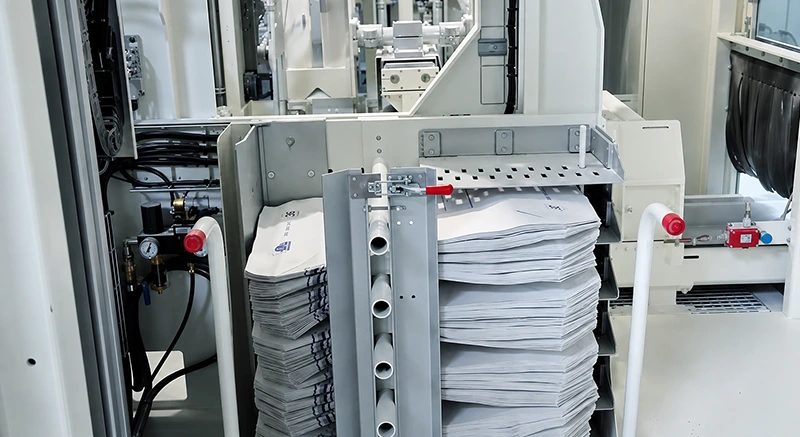
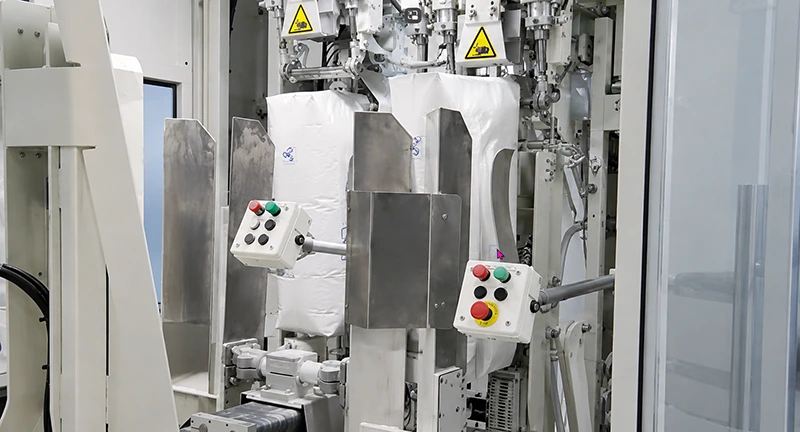
Once the cement bagging types and bag stock are confirmed, the line runs as one continuous sequence. An empty 25 kg valve bag drops from a wheeled bag magazine onto a twin-arm pneumatic gripper; the gripper opens the valve sleeve and slides the bag over the expandable filling nozzle. Air-conveyed cement packs the bag from below through a large-bore feed path with a small-bore vent, the valve sleeve recovers and self-seals under its own elasticity, and a 20–40 kHz ultrasonic head welds the inner valve flap for an extra dust-tight seal. The bag then walks past a checkweigher that rejects underweight or overweight sacks, a metal detector that flags ferrous and stainless contamination, and a negative-pressure shaper that pulls the filled bag flat so the pallet pattern interlocks cleanly.
After shaping, a robotic palletizer stacks the bags three at a time (one across, two along) on an EPAL pallet, rotating each layer so the stack interlocks instead of leaning. A stretch-hood station wraps the loaded pallet in UV-resistant hood film before it rolls out on the roller conveyor to dispatch. This is the same station sequence for any cement bagging types built around the 25 kg valve format, with cycle rate set by material flow, bag size and pallet pattern rather than by an operator’s pace. The result is a 25 kg cement bagging types output that stays square, weighed and sealed from silo to truck.
| Station | Function in the cement bagging types flow | Key specification |
|---|---|---|
| Wheeled bag magazine | Empty valve bag stack ready for pick | Holds 100–150 empty 25 kg valve bags, casters for refill |
| Twin-arm bagger | Picks, opens, slides bag onto nozzle | Pneumatic grippers, 5–12 cycles/min matched to filler |
| Air-conveyed filler | Packs cement through expandable nozzle | 304 SS wetted parts, 0.5–0.7 MPa plant air, large bore feed / small bore vent |
| Ultrasonic sealer | Welds inner valve flap | 20–40 kHz horn, validated on coated woven PP and kraft paper valve stock |
| Checkweigher | Rejects out-of-band bags before pallet | ±0.2–0.4 kg on 25 kg, automatic divert arm |
| Metal detector | Catches ferrous and non-ferrous tramp metal | Fe ≥1.5 mm, Non-Fe ≥2.0 mm, SS ≥2.5 mm |
| Negative-pressure shaper | Evacuates air from filled bag | Pulls bag flat against profile plate for stable pallet pattern |
| Robotic palletizer | Stacks bags three per layer | EPAL pallet, interlocked 5–8 layer stack, layer sheet feeder |
| Stretch-hood wrapper | Final load seal for dispatch | UV-resistant hood film, pallet exits onto roller conveyor |
Plan a 25 kg Valve Bag Line for Your Plant
Send us your cement grade, target output in bags per hour, current bag format, bag stock supplier and floor layout. We will return a station-by-station cement bagging types recommendation with cycle rate, pallet pattern, ultrasonic seal trial notes and a price envelope for the valve bag line that fits your dispatch floor.
Send Your Plant Layout English
 Русский