
Cement Valve Bag Packing Line: 25 kg Robotic Loading
A purpose-built cement valve bag packing line ties a wheeled bag magazine, twin-arm robotic loader, air-assisted filling, ultrasonic sealing, checkweighing and robotic palletizing into one continuous 25 kg cement cell — replacing open-mouth dust, manual bag handling and unstable pallet stacks on the dispatch floor.
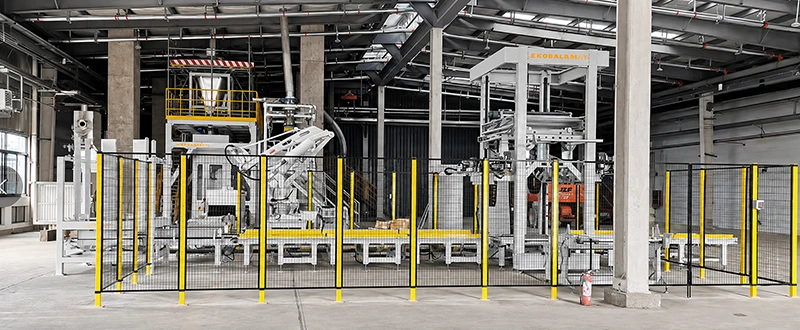
Why 25 kg Cement Valve Bags Stall on a Manual or Half-Auto Line
Most cement mills still ship 25 kg in valve bags that are loaded, sealed and palletized by hand. The packer holds the bag against the discharge spout while a screw or gravity stream fills it, an operator brushes cement dust off the valve mouth, and the bag is then stacked by lift onto a wooden pallet. The result is predictable: airborne cement in the packing hall, giveaway weight on every bag because the operator cannot read a scale, and pallet stacks that lean after a few layers because the bags are still half-full of air.
A cement valve bag packing line that is engineered as one continuous cell removes each of those failure points at the station where they originate. The bag magazine feeds empty 25 kg sacks in a clean orientation, the loading arms seat the valve onto the nozzle without an operator’s hands, and the filling interface is sealed before dust has a chance to escape. Cement does not forgive open-mouth filling — the airborne fraction is what triggers respiratory complaints, regulatory inspection findings, and rejected export pallets.
By the time a half-auto line has filled, sealed and stacked 25 kg cement at 4–5 bags per minute with two operators per station, the labor cost alone is already above the energy and depreciation bill of a fully automatic cement valve bag packing line. The reason many plants tolerate the manual workflow is that they have not yet seen what robotic loading and ultrasonic sealing can sustain at production cadence.
How a Robotic Twin-Arm Loader Handles 25 kg Valve Bags
The first station that makes a real difference on a 25 kg cement valve bag packing line is the loader. The empty-bag supply sits on a wheeled magazine that an operator can refill in a low-dust zone away from the fill point; a fork picks a single 25 kg sack off the stack and presents it to the loading arms.
The twin-arm loader then drives the bag onto the inflatable filling nozzle. Both arms move in mirror image: one arm grips the bag from above, the other opens the valve mouth, and a coordinated stroke seats the valve onto the nozzle collar so the bag does not slip sideways when the air stream starts. Because the valve is loaded onto a tapered stainless-steel collar, the cement enters through the large feed channel and displaced air returns through the smaller vent channel, so the bag is filled without whipping dust back into the hall.
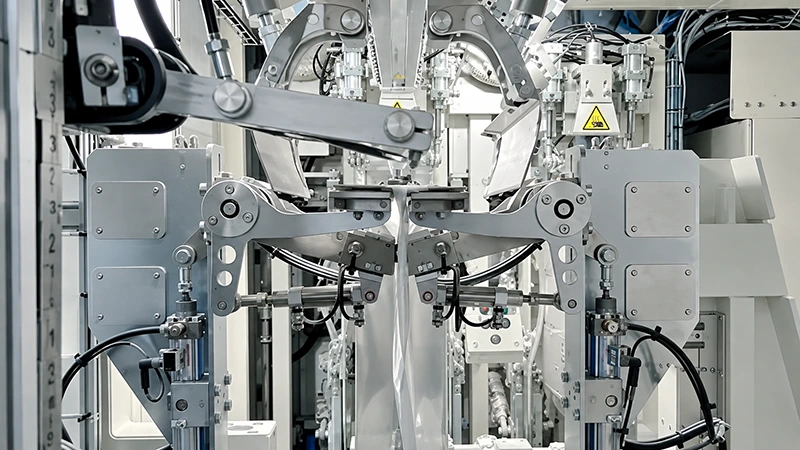
On a 25 kg cement valve bag packing line, the twin-arm loader is what lets a single machine serve two filling heads in turn. One arm places a bag on the active filling station while the previous bag is being sealed on the other station, which raises the effective bag-per-minute count without doubling the loader’s footprint. That is the layout you can see on a VPLINE cell when one bagging robot is shown alternating between two packers — it is a configuration choice for capacity, not a one-size-fits-all default.
Air-Assisted Filling and the Stainless-Clamp Inflatable Nozzle
The filling nozzle is the only part of the cement valve bag packing line that touches cement inside the bag. On a 25 kg run that contact zone is also where dust leaks, where the bag slips, and where the bag weight drifts. VPLINE uses an inflatable valve-seat: a tapered nozzle with a stainless collar that expands once the valve is in position, clamping the bag against a 304 stainless surface so the cement stream enters through the feed channel while displaced air bleeds back through the vent channel.
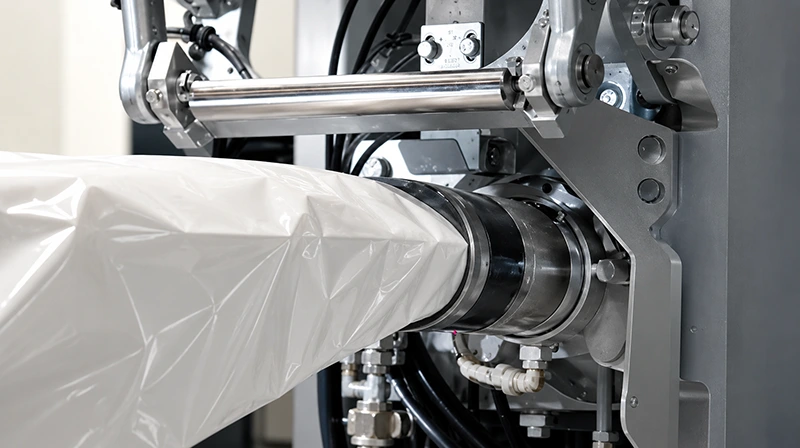
Because the nozzle is 304 stainless on every cement-contact surface and carbon steel on the structural frame, the cell tolerates the abrasive cement fines that wear down mild-steel collars after a few months. The feed and vent channels are sized so that a 0.5–0.7 MPa plant air supply can fluidize the cement and push 25 kg through the valve without back-blowing dust into the loading zone. The pressure window has to be confirmed against the actual cement bulk density and moisture content on site — it is a parameter, not a guaranteed throughput.
What that nozzle delivers on the dispatch floor is a sealed fill event: the valve mouth never opens to the hall air, so the operator at the loader station sees a clean contact, not a dust cloud. For a cement valve bag packing line, that single interface is what separates a packaging cell from a packaging room.
Ultrasonic Sealing, Checkweighing and the Dual-Station Guard Cell
Once a 25 kg bag is filled, the valve must close in a way that survives stacking, transport and outdoor storage. Ultrasonic sealing applies a 20–40 kHz vibration at the valve mouth; the plastic and film layers melt locally and bond even if a fine film of cement dust is still present. Compared with hot-bar sealing, ultrasonic sealing tolerates the residual dust that always lives on a cement valve, and it does so without heating the entire bag.
After sealing, the bag travels through a dual-station guard cell: a checkweigher reads each 25 kg sack to the rated tolerance, and a metal-detection gate rejects any bag with ferrous or non-ferrous contamination. Both stations are wrapped in stainless steel guards with a pendant control and an emergency stop on the front face — the layout you see on a real VPLINE installation, where two filling stations are flanked by their own guarding so a jam on one side does not stop the line.
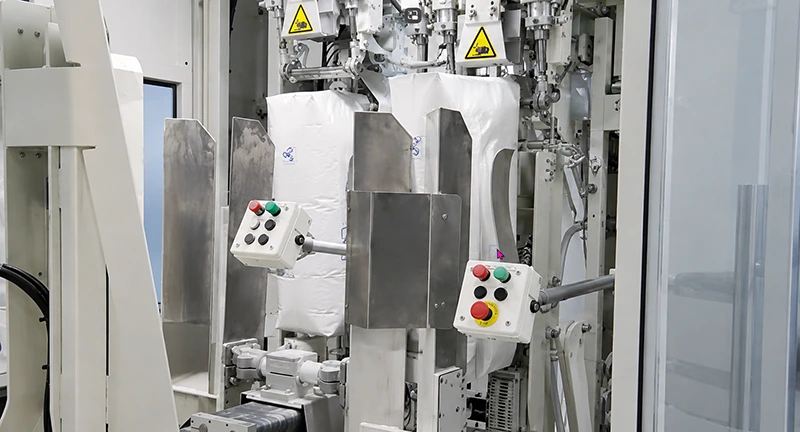
The reject path drops the off-weight or contaminated bag onto a side conveyor before the bag enters the palletizer, so a rejected 25 kg cement sack never makes it onto a customer’s pallet. On a cement valve bag packing line that ships to retail and export, this gate is the difference between a 0.5% customer complaint rate and a 0.05% rate.
Spec Snapshot for a 25 kg Cement Valve Bag Packing Line
| Parameter | VPLINE reference value | Project note |
|---|---|---|
| Bag weight | 25 kg typical (10–50 kg envelope) | Confirm 25 kg bag spec, not 50 kg upgrade |
| Filling speed | 5–12 bags / minute | Depends on cement bulk density and air pressure |
| Filling tolerance | ±1–2‰ nominal | Verify against checkweigher rejection rate |
| Bag material | Coated woven PP, kraft paper, laminated | Valve must accept ultrasonic sealing layer |
| Contact material | 304 stainless | Carbon-steel frame and guards |
| Air supply | 0.5–0.7 MPa | Confirm dynamic pressure drop at peak draw |
| Power | AC 380 V / 50 Hz / 15 kW (packer unit) | Add palletizer, checkweigher, metal detector loads |
| Sealing | 20–40 kHz ultrasonic valve seal | Bag material test required before sign-off |
| Inspection | Checkweigher + metal detector | Reject path to side conveyor |
| Palletizing | Robotic, interlocking layers | Layer count and pattern set per project |
All of these numbers are VPLINE reference values; the project-specific figure must be locked after the bag, cement and air-supply trials. The 25 kg cement valve bag packing line is not a catalog configuration — it is built up from these parameters once the cement bulk density, valve-bag tolerance and plant air pressure are confirmed.
Final Result: Stable 25 kg Cement Pallets Leaving the Cell
A 25 kg cement valve bag packing line that runs as one cell delivers a different kind of pallet than a manual or half-auto line. The bag arrives at the palletizer already sealed, already weighed, already cleared by the metal-detection gate, and already shaped against the conveyor so it does not balloon. The palletizer places 25 kg bags in an interlocking pattern with separator sheets on the configured layers, then a stretch-hood wrapper locks the load against rain and forklift handling.
The visible result on the dispatch floor is a pallet that leaves the cell square, holds its shape through container loading, and arrives at the customer without giveaway weight claims or dust on the bag surface. For a cement mill running 25 kg valve bags to retail, export or hardware channels, that is the operational payoff of the cement valve bag packing line: less labor at the bagging station, less dust in the hall, less giveaway in every bag, and a pallet that looks the same on day 300 as on day one.
If you are scoping a 25 kg cement valve bag packing line, share your bag spec, plant air supply and target bags-per-minute and we will return a layout, a station list, and a parameter sheet keyed to your cement — not a generic quote.
Ready to scope a 25 kg cement valve bag packing line for your plant? Send us your cement bulk density, valve-bag spec and target bags-per-minute.
Request a Project Review English
 Русский