
Cement Valve Bag Packing Line Price: 25 kg Plant Budget
A 25 kg cement valve bag packing line price is built from the bagging cell, the air-assisted filler, the ultrasonic sealer, the inspection stations, the negative-pressure shaper, the robotic palletizer and the stretch-hood wrapper — not from a single machine card. This page breaks the 25 kg cement cell cost into the stations that actually drive it, and shows where the hidden costs on an open-mouth or manual line usually come from.
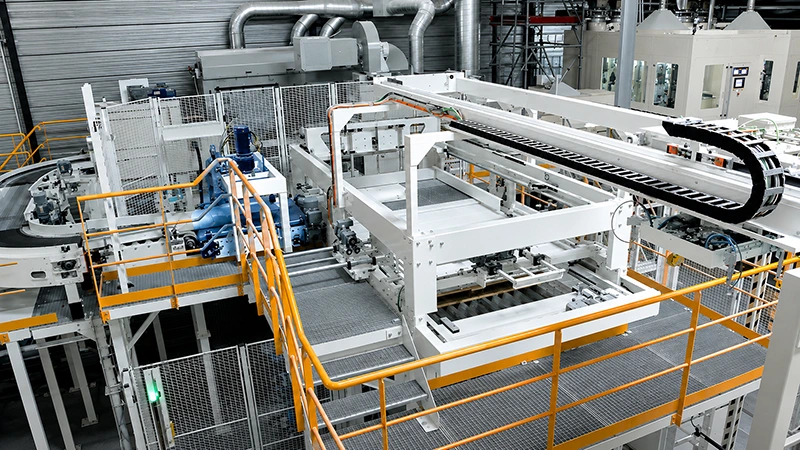
How the Cement Valve Bag Packing Line Price Is Built
A 25 kg cement valve bag packing line price is not one number — it is a layered budget that ties a wheeled bag magazine, a twin-arm robotic bagger, an air-assisted filling nozzle, an ultrasonic valve sealer, a checkweigher, a metal detector, a negative-pressure shaping station, a robotic palletizer and a stretch-hood wrapper into one continuous cell. Each station has its own drive, frame, control panel, guarding and integration scope. Plant contact parts in 304 stainless steel and frame in carbon steel are the default, with AC 380 V / 50 Hz / 15 kW on the packer electrical load and 0.5–0.7 MPa on the plant air.
The choice between skid-mounted stations and a welded single line base changes the cement valve bag packing line price by a wide margin. The skid-mounted plant is faster to install on a tight site, but the welded base delivers a tighter dust seal between the filler and the sealer and a shorter commissioning trial. Most 25 kg cement plants end up with welded bases for the filler-sealer block and skid-mounted stations for the inspection and palletizing block, so the first capex discussion must lock the layout before any supplier prices anything.
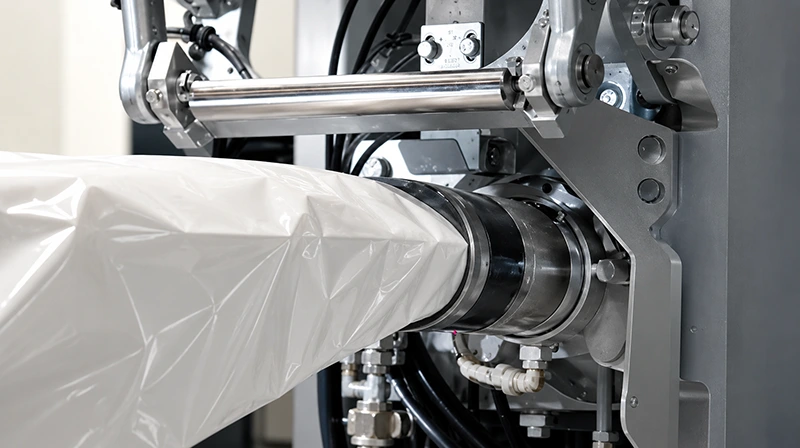
Manual bagging or open-mouth auger filling lets cement dust escape into the packing hall. Visible dust forces the bagging team to slow down, drops the line below its nameplate 5–12 bags per minute, and raises the cost per bag because labor, building, compressed air and depreciation still run per minute. A bag that leaves the hall dusty also triggers customer claims on the retail pallet, and each claim is a real line item in the cement plant cost model.
Where the Old 25 kg Cement Cell Loses Money
The first hidden cost on an old cement cell is not the machine — it is the dust. A 25 kg cement valve bag packing line with a closed boot at the air-assisted filler keeps the bag mouth inside a sealed interface during fill. That sealed interface is what justifies the higher station cost versus an open-mouth auger packer, and it is what protects the plant’s per-bag cost on a 5–12 bag-per-minute run.
The second hidden cost is the bag itself. Old cells tend to step up to a heavier paper sack or a multi-ply laminate to fight seal failures from dust contamination, and the heavier sack adds freight cost to every truck that leaves the dispatch floor. A clean ultrasonic valve sealer running at 20–40 kHz lets the plant step down to a single-ply laminate or a coated woven PP sack, and that step-down alone usually pays for the cell over a few years.
Engineering note: Bag speed 5–12 bags per minute and ±1–2‰ filling accuracy are project-record numbers, not catalogue guarantees. They depend on the cement grade, the bulk density and the air-pressure stability on site. None of those numbers can be quoted without a sample test on the customer’s cement, so they belong in the project record — not in a marketing line card.
Cement Valve Bag Packing Line Price by Station
The complete cement valve bag packing line price for a 25 kg cement plant stacks station by station. The table below shows what each station does and what drives its share of the budget, so the capex conversation starts from real line items rather than a single round number.
Plants that buy walk-up stations and integrate them in-house usually pay more, because the integration scope, the commissioning hours and the dust-tight interface are priced as one budget only when the supplier owns the full line. A 25 kg cement valve bag packing line price that is split across four or five vendors tends to grow on the integration day, not in the quote stage.
| Station | What it does | What drives its price |
|---|---|---|
| Wheeled bag magazine | Holds 200–400 empty 25 kg valve sacks, feeds the bagger | Bag format, magazine count, sensor refill vs foot switch |
| Twin-arm robotic bagger | Picks, opens and slips the bag onto the filling nozzle | Arm reach, gripper type, single- vs twin-arm configuration |
| Air-assisted filler | Fills the bag through an expanding nozzle inside a closed boot | Filler drive, expanding boot material, dust port size |
| Ultrasonic valve sealer | Seals the valve mouth with 20–40 kHz vibration | Horn material, generator size, valve-sack lamination |
| Checkweigher + metal detector | Rejects out-of-spec bags before palletizing | Reject arm type, belt width, detector aperture |
| Negative-pressure shaper | Evacuates air from the filled bag before palletizing | Vacuum pump size, bag-volume range |
| Robotic palletizer + sheet feeder | Builds an interlocking pallet stack with interlayer sheets | Robot reach, gripper head, sheet stack size |
| Stretch-hood wrapper | Seals the finished pallet for outdoor storage or export | Hood size, film format, throughput |
| Integration: PLC, HMI, electrical, piping, guarding | Ties every station into one 25 kg cell | Number of stations, plant air, plant power, plant layout |
Quote a 25 kg Cement Valve Bag Packing Line Price
Send your 25 kg cement grade, bag format, plant air pressure, plant layout sketch and dispatch window. We will price the cell station by station, with the dust-tight interface, the integration scope and the commissioning hours on the same line — so the capex conversation stays on real numbers from day one.
Request a Cement Valve Bag Packing Line Price English
 Русский