
Flour Bagging Line at a Pasta Plant: Where Durum Semolina Bags Lose Their Shape
A flour bagging line in a pasta plant is not judged at the dosing screw. It is judged in the last two metres, where a 25 kg semolina bag either arrives at the sewing head square or gets straightened by hand first. Mipline holds the bag mouth in a clamp from the bag magazine through filling, transfer and the sewing handoff.
Where a pasta plant really loses semolina bags
Durum semolina is not the easiest powder to put into a 25 kg bag. It is coarse, it carries air out of the conveying system, and it fills unevenly, so the bag turns bottom-heavy within two seconds of the fill ending while the mouth is still open. On the older layout — a fixed spout, a bag stand and an operator holding the mouth by hand — that is the exact moment the bag starts to sag and rotate on the stand. By the time it reaches the sewing head the mouth is out of square, the stitch line drifts and the seam folds over itself.
The cost rarely shows up as a machine fault on the maintenance sheet. It shows up as one operator parked at the last metre, straightening every bag by hand before the sewing head, and as pallet stacks that lean because the bags are no longer square to each other. Across a shift the sewing head is adjusted far more often than the filler, because a skewed mouth is what actually moves the seam — not the dose.
Bag format change is the other place the old layout costs time. When the plant switches from a 25 kg kraft bag for bulk dispatch to a shorter bag for a customer line, a bag-stand layout needs the spout height and the support re-set by hand, and the first bags of the new run are usually straightened twice before the seam settles.
Downstream, the pasta extruder asks for one thing only: a bag that presents the same edge at the same height every cycle. A flour bagging line that guarantees that handoff is worth more to a pasta plant than a filler with a wider dosing window.
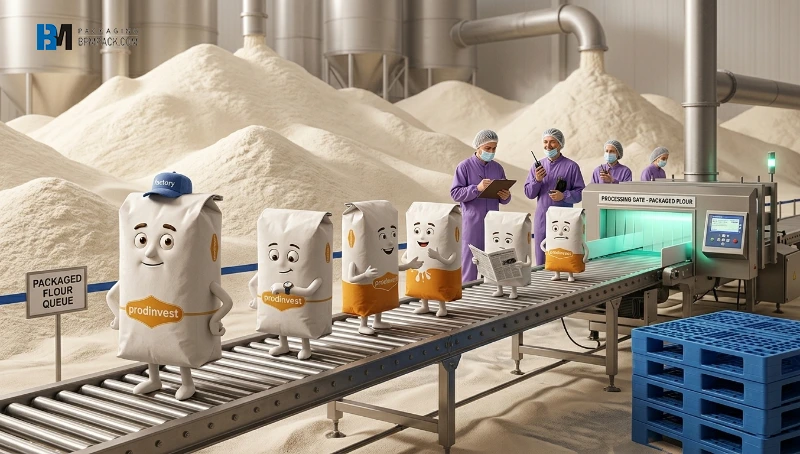
A semolina bag is not lost at the dosing screw. It is lost after the clamp opens, when nothing holds both faces parallel and the sewing head receives a mouth that has already turned.
Why the Mipline layout suits semolina and durum flour
Mipline is designed around the handoff rather than the dose. Flat kraft or woven bags sit in a magazine and are carried forward on a bag-feeding conveyor, picked, and clamped at the mouth before any product enters. Because the bag is held by the mouth instead of standing on its own base, the fill cannot tip it, and the mouth stays parallel to the sewing plane. That single decision is what separates this flour bagging line from a spouted filler sitting next to a bag stand.
Filling happens inside an enclosed stainless steel station with guarding and blue inspection windows, so the operator can watch the mouth, the fill level and the bag face without opening a door. Dosing into a clamped bag also allows a bottom-up fill, which pushes air ahead of the product instead of through it; a semolina bag filled that way settles flatter and stays flatter once the clamp releases.
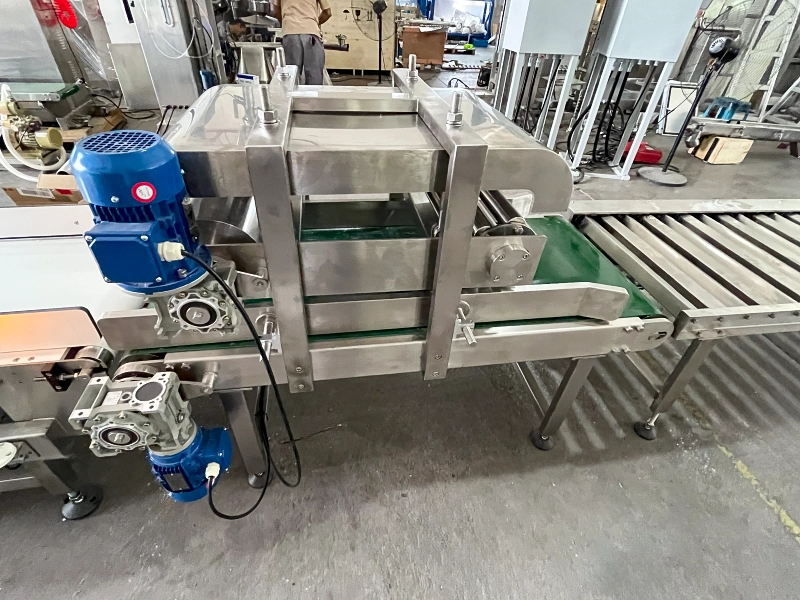
Field note: downstream, the guides set the bag shape, not the filler. Twin-belt transfer sections with adjustable side guides hold both bag faces after the clamp opens, so a bag that was square at the spout is still square at the sewing head.
Structure and evidence to check on the machine
Ask to see the machine from the clamp to the sewing head, not from the control cabinet. The useful evidence on a Mipline flour bagging line is mechanical: where the bag is held, what keeps both faces parallel, and how the bag is handed over at the end of the conveyor.
These are the stations a pasta plant should follow during a factory acceptance run, and what each one is doing for the bag.
| Station | Job for the bag | Visible evidence |
|---|---|---|
| Bag magazine and feed conveyor | Presents flat kraft or woven bags square to the pickup | Green belt, dual gear motors and clamping frame on a stainless conveyor |
| Mouth clamp at the filling station | Holds the bag open and parallel to the sewing plane before dosing | Clamp jaws at the enclosed station, bag face visible through the blue window |
| Clamp-held filling | Doses semolina into a supported bag so the fill cannot tip it | Bottom-up fill inside the stainless enclosure with dust kept in the cell |
| Twin-belt transfer | Keeps both bag faces parallel and settles the aerated fill | Adjustable side guides, twin belt runs and a central control housing |
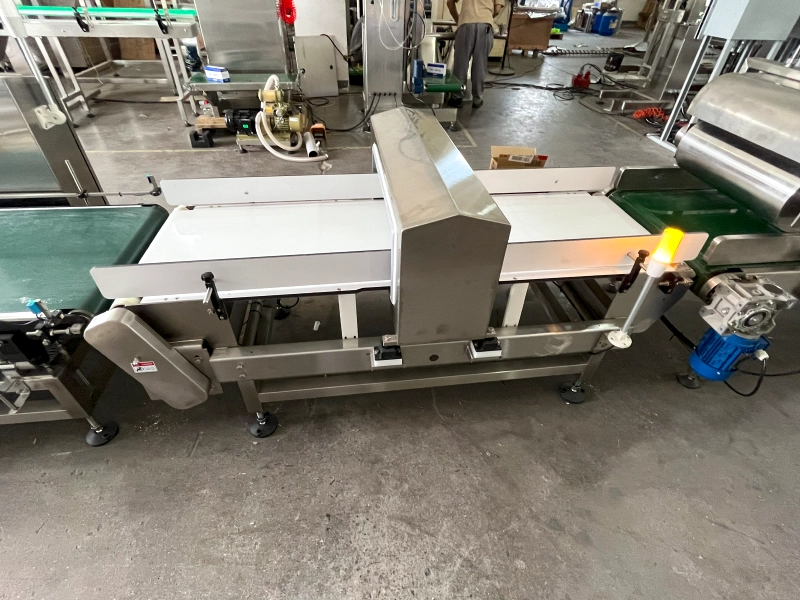
| Roller handoff | Delivers the bag level and square to the sewing head | Roller conveyor with adjustable leveling feet and side rails |
| Control and inspection access | Lets the operator verify the transfer without reaching inside | Touch screen HMI, stack light, emergency stop and hinged guards |
On a pasta plant floor the result is a bag that no longer needs straightening in the last metre. The sewing head sees the same mouth height and the same edge every cycle, seams stay closed through the palletizer, and finished bags stack flat because they are already square when they leave the flour bagging line. Inspection and cleaning also stay outside the product path: stainless surfaces, hinged guards, blue windows instead of open hatches, and a touch screen from which the transfer can be checked.
Send one bag before you specify the line
Every plant has its own bag — paper weight, gusset, mouth width, and the way the empty bag behaves when the clamp takes it. Send one bag and your target weight, and we will confirm the clamp position, the guide settings and the sewing handoff on the flour bagging line for your semolina, then return a layout and a station list.
Send your bag sample English
 Русский