
FFS bagging line for 25 kg polyester sacks
A polyester or PE film sack is soft, slippery and about 40 grams lighter than a woven bag. When a plant moves 25 kg fill into that format, the bottleneck is rarely the dosing screw — it is the bag shape at the moment the seal closes. An FFS bagging line forms the sack on the machine, fills it through the same tube and seals it in line, so there is no empty bag to open, square up or sew.
Where the old sack and sewing setup loses 25 kg bags
Most plants still filling polyester, woven PP or kraft sacks buy the bag as a finished article. That means a bag magazine, a bag placer, a clamp, a sewing head, a thread supply and a crease line where the bag was folded on a pallet. Every one of those steps adds an interface where a 25 kg sack can be dropped, twisted or under-sewn.
The loss is measurable. A pre-made film sack arrives flat and folded, so the mouth must be opened by suction and held square while 25 kg of product falls through it. If the clamp slips a few millimetres, the bottom gusset sits crooked, the sack leans on the conveyor and the sewing head catches one face only. Multiply that by a sewn seam that lets moisture through, and a reject pallet at the end of the shift is normal. The second cost sits upstream of the filler: buying, storing and trucking empty bags, then paying to move them back as waste.
A sack that leaves the filler 15 mm out of square will not sit flat on a pallet layer. The palletizer either rejects it or builds a leaning stack that collapses in the truck — and the sewing thread does not stop moisture ingress on a polyester film sack the way a heat seal does.
How an FFS bagging line handles a soft 25 kg film sack
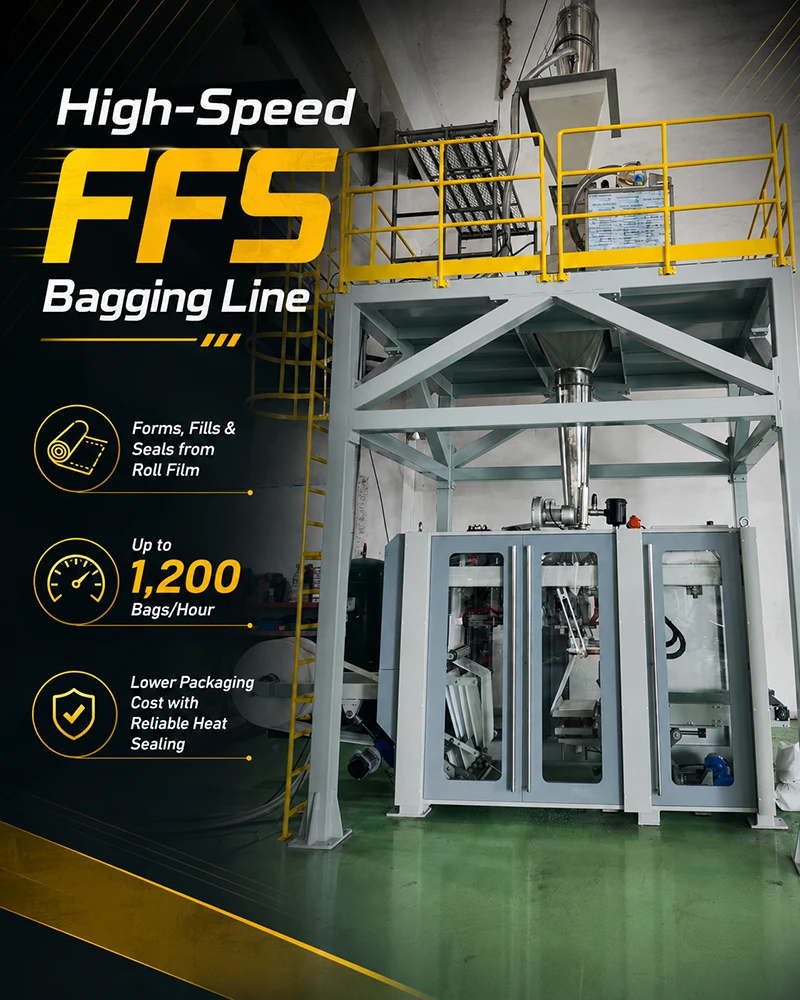
The FFSline takes heavy-gauge PE roll film, typical working range 200–1200 mm film width and 7–11 µm film thickness, and runs it over a forming collar into a tube. Product is dosed into the tube, the bottom seal closes, the sack is pulled to length and the top seal closes on the same cycle. Because the bag is made around the product, the sack is square by construction — there is no empty bag to open and no mouth to hold while filling.
Seal quality is what protects a 25 kg load. The FFSline uses imported Italian heating wire for the seal bar, and both the bottom and the mouth seal are cooled pneumatically straight after the weld, so a thick film is not weakened by residual heat when the sack drops onto the take-away conveyor. A 25 kg impact is not the place to discover a seal was welded too hot.
Field note: on film sacks, seal integrity is a cooling problem before it is a temperature problem. Pneumatic cooling on both seams lets the belt run faster without trading seal strength for output, and it keeps a 25 kg sack from bursting at the palletizer instead of at the customer’s silo.
Specifications that decide output and cost per sack
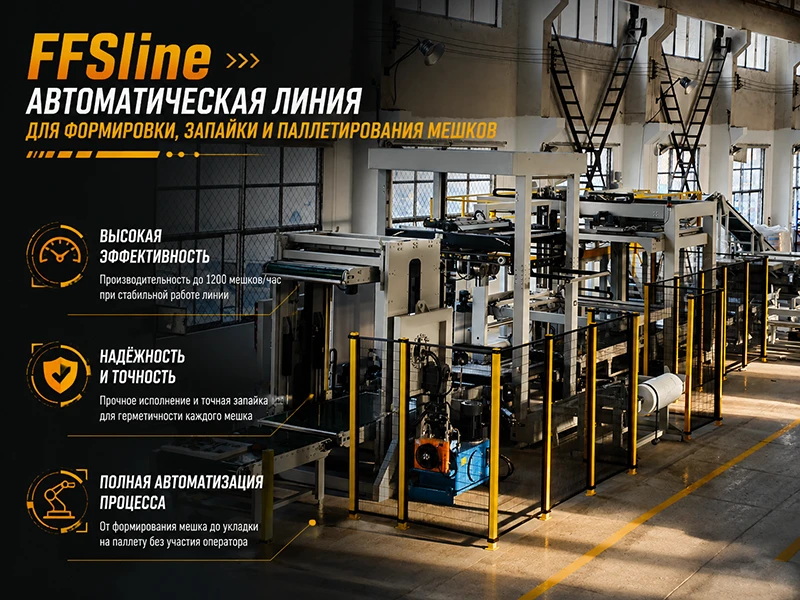
Film cost is the reason most plants ask about an FFS bagging line in the first place. Roll film for in-line bag making runs more than 30 percent cheaper than kraft, woven or laminated pre-made sacks, it is recyclable, and it removes the empty-bag warehouse entirely — film arrives on a roll, not on forty pallets. The same line carries the sack through forming, filling, sealing, transfer and palletizing, so the labour that used to open and square bags moves to supervision.
Throughput is set by the film path, not by the weigher. On the FFSline, bag forming and sealing keep pace with a dosing accuracy of about ±0.1–0.2 percent, up to roughly 1200 bags per hour at the machine and 1500–2000 bags per hour where a high-level palletizer takes the finished sacks. The cabinet is built onto the machine frame, and a typical line footprint sits around 5.5 × 5 × 6 m, so a plant replacing a bag magazine, sewing line and thread supply can recover floor space rather than add it.
| Parameter | FFSline working value | What it changes on a 25 kg sack |
|---|---|---|
| Bag format | Formed in line from PE / PP roll film | No pre-made bag magazine, no bag placer |
| Film width | 200–1200 mm | Sets sack face width and gusset depth |
| Film thickness | 7–11 µm heavy-gauge roll film | Puncture resistance under a 25 kg drop |
| Closure | Heat seal, Italian heating wire, pneumatic cooling on both seams | Moisture-tight seal instead of a sewn seam |
| Dosing accuracy | ±0.1–0.2% | Fewer underweight sacks at the checkweigher |
| Output | Up to 1200 bags/h at the machine | Matches palletizer rate, not weigher rate |
| Footprint | Approx. 5.5 × 5 × 6 m, integrated control cabinet | Replaces magazine, sewing head and thread supply |
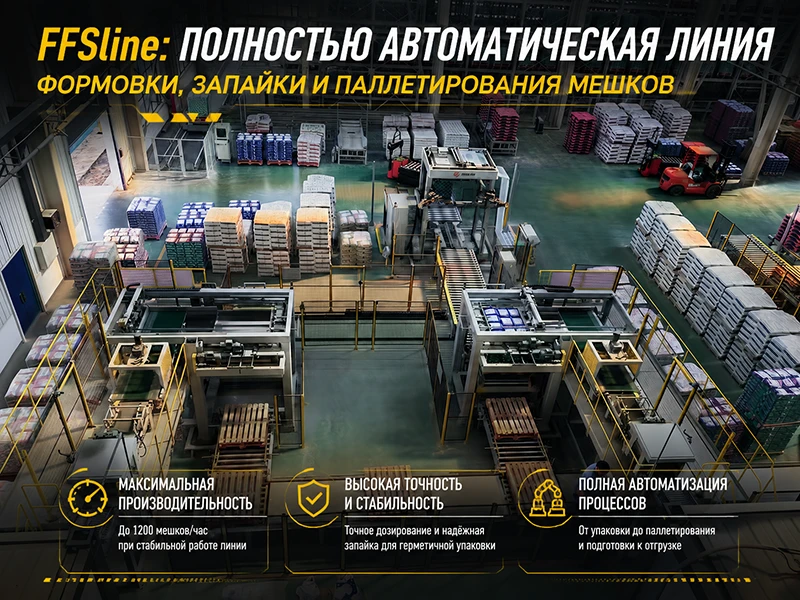
Downstream, the same FFS bagging line can be fitted with a metal detector and a checkweigher with reject, and with an explosion-proof cabinet, piping and servo drives where the product is a combustible powder. The finished sacks leave on a conveyor and can be handed to a robotic palletizer, which is where the last shape problem is solved: a sealed film sack with a flat, cooled seam stacks predictably from the first layer.
Specify your 25 kg sack before you order film
Send us the product, the bulk density and the target bags per hour. We will come back with the film width, seal configuration and palletizer handoff that fit the sack you actually need, not a catalogue format.
Send your sack specification English
 Русский