
Flour Bagging Machine: Dust-Controlled Kraft Bag Filling at 1–5 kg
A flour bagging machine that runs premade kraft paper bags has one problem to settle before anything else: the powder has to stay inside the bag while the bag is open, filled, folded and glued. On a milling plant or bakery packing 1 kg, 2 kg and 5 kg retail flour bags, dust is not only a housekeeping cost — it lands on the M-fold panels and on the glue line, and that is where a bag comes out soft, slipping or leaking.
What manual bag handling costs on a flour packing floor
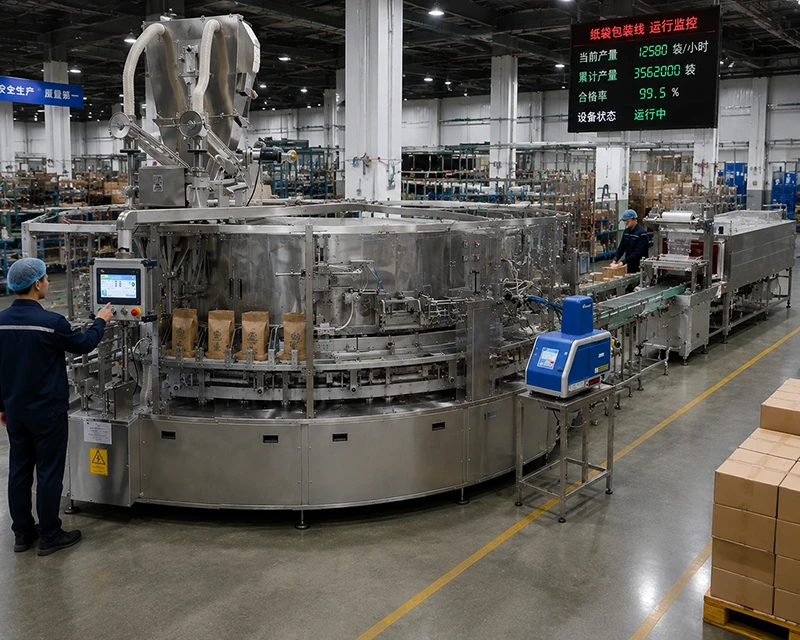
The traditional layout is simple: an operator lifts a flat bag from a stack, opens it by hand or with a short air blast, holds it under a dosing spout, then folds the M gusset and carries it to a separate gluing or sealing point. At retail rates the operator moves a bag every few seconds, and the bag is never held in the same position twice. Two operators on two shifts rarely produce the same bag twice either.
The failures are predictable. The bag mouth stays open to the room while the auger doses, so fine flour leaves the bag and settles on the machine, the floor and the outside of the next bag. Powder on the top panels is what makes a hot-melt glue seam bond to flour instead of paper, and an open bag standing on a conveyor loses its square shape before it reaches the scale. A flour bagging machine earns its floor space only when it takes those three motions — holding, opening and settling — out of the operator’s hands.
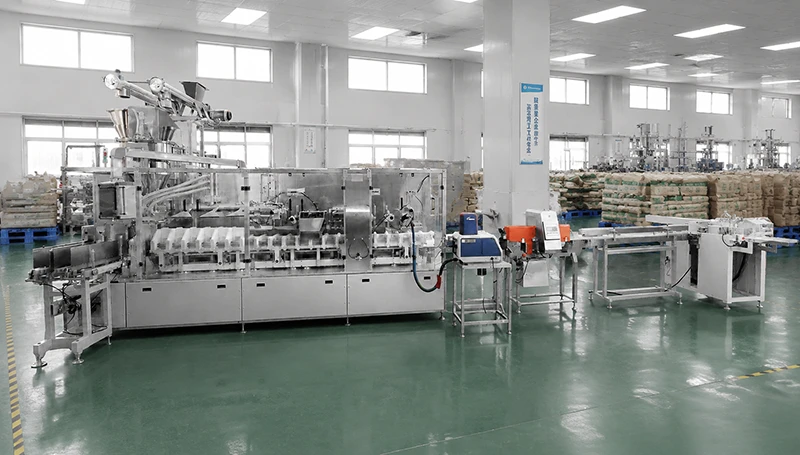
Dust is not a housekeeping complaint. Powder on the bag mouth and on the M-fold panels is what makes a glue seam fail, and a seam that fails on the pallet becomes a customer complaint at the shop shelf. Control the dust at the filling position and the seam becomes a paper-to-paper bond.
How the fill, settle and glue chain is built
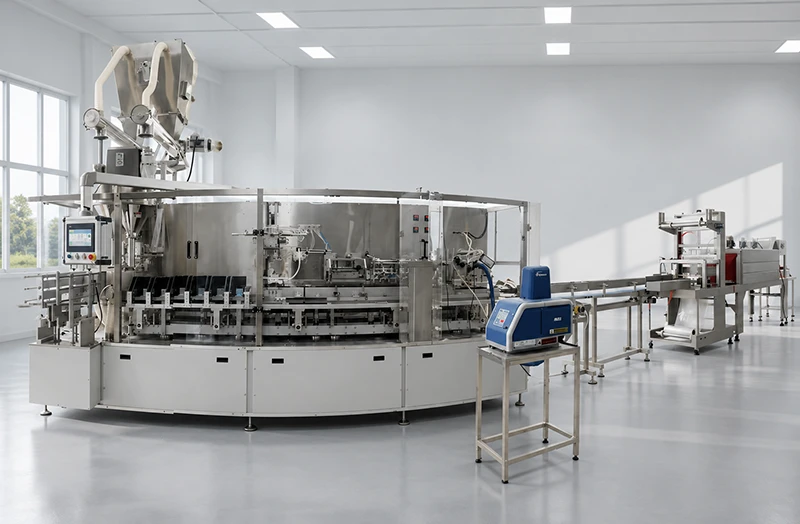
Zpacker takes the bag from a flat blank to a closed retail pack in one straight line. Belt-type feeding draws the premade bag from two bag magazines; the bag is picked up, opened into a three-dimensional M-fold bottom bag and clamped under the dosing head. Screw dosing fills it at the filling station, where extraction is positioned to pull air and dust away from the open mouth. Behind that station the bag passes several vibration and extraction points that settle the powder and drive out air, then the M edge is folded back, trimmed, rolled, sprayed with hot-melt glue in dots or lines and pressed at the top. Material-contact parts are 304 stainless steel; the main frame is powder-coated carbon steel.
A twin-station 2 kg layout is what makes the machine practical on a real floor. Two bag magazines and two pick-up and dosing positions work together, and the reference logic stops and alarms a station that has run out of bags while the other station keeps producing — final logic to be confirmed on the configured machine. The controller is a 10.4-inch touchscreen with a Siemens PLC as the reference configuration, and the safety chain is built around the bag: no bag, no opening, no filling, no sealing. Air-pressure, guard and glue-temperature faults stop the cycle with an alarm. That is the practical difference between a flour bagging machine and a filling head — the machine refuses to make a bag it cannot close.
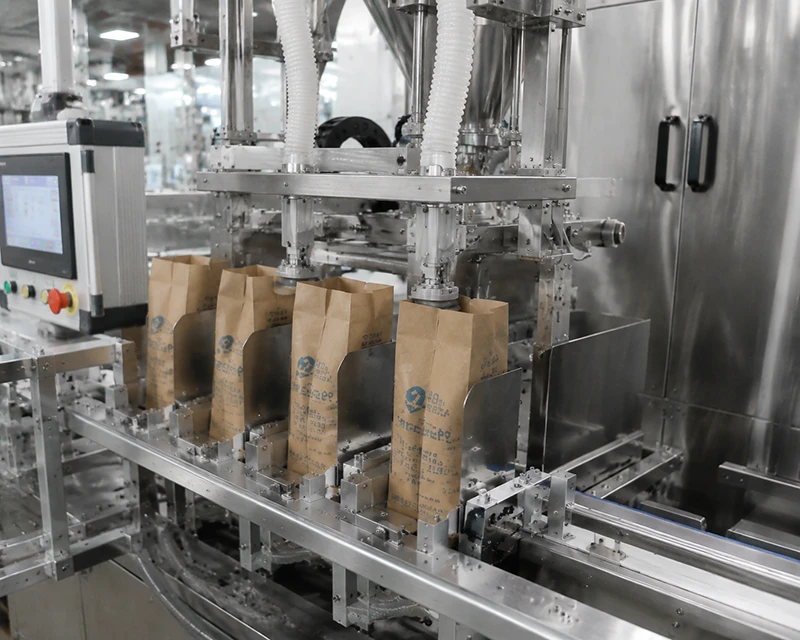
Field note: Settling time is the hidden variable. The faster the dosing cycle, the less time the powder has to de-aerate, which is why the extraction at the filling position and the settling stations behind it decide seam quality more than the headline bag rate does. Run a bag trial on your own flour and your own kraft bag before you fix a cycle time.
Specification check before you fix the bag size
The reference specification is split in two: one machine size for 1–2 kg bags at roughly 30–35 bags per minute and a second for 2.5–5 kg bags at roughly 15–20 bags per minute, with weighing accuracy of about ±0.5%. Speed depends on flour flowability, feed capacity and the settling time you allow, so it belongs in the acceptance conditions rather than in a headline. Before a flour bagging machine is quoted, the bag itself has to be defined.
Bag width 80–140 mm, bag length 240–320 mm and a side gusset around 60–80 mm are the reference window; a printed paper bag also has a front and a back, so bag direction must be fixed before the magazines are set. Closure is hot-melt glue, dot or line spray, then top press — not heat sealing, and paper-plastic laminates need the layer bond checked first. Air supply is quoted at 0.6 MPa or 0.6–0.8 MPa depending on configuration at about 0.76 m³/min; power is 15.5 kW at 380 V ±10%, 50 Hz, and the machine weighs about 3000 kg. Our 1–5 kg kraft bag reference walks the same sequence station by station.
| Reference parameter | Zpacker value |
|---|---|
| Bag weight range | 1–2 kg specification / 2.5–5 kg specification |
| Output | about 30–35 bags/min (1–2 kg); about 15–20 bags/min (2.5–5 kg) |
| Weighing accuracy | about ±0.5% |
| Bag width / bag length | 80–140 mm / 240–320 mm |
| Side gusset (M edge) | about 60–80 mm, confirmed on the bag sample |
| Bag material | premade kraft paper or paper-plastic, M-fold flat bottom |
| Closure | hot-melt glue dot or line spray, then top press |
| Material contact parts | 304 stainless steel |
| Control | 10.4-inch touchscreen, Siemens PLC reference configuration |
| Air / power | 0.6–0.8 MPa, about 0.76 m³/min / 15.5 kW, 380 V ±10%, 50 Hz |
| Machine weight | about 3000 kg |
Send the bag, not just the weight
A flour bagging machine is sized by the bag and the flour, not by a bag count per minute. Send one premade kraft bag, your target weight and your hourly requirement, and we will return the station layout, the extraction points and the line proposal behind it.
Request a line layout English
 Русский