
Flour Milling Complex: How a Zpacker Flour Packaging Line Controls Dust and Labor
For flour mills and food production plants, an automatic flour packaging machine must do more than fill a bag. Zpacker is an automatic paper bag packing machine for 1–5 kg flour and powder formats, linking screw dosing, dust removal, sealing and downstream inspection in one automatic packaging line.

Why manual flour bagging becomes a production constraint
In a flour mill, the route from a silo or buffer hopper to the retail bag looks simple on a flow chart. In practice, operators may still take a flat paper bag, open it, position it under the filler, wait for the dose, settle the powder, clean the mouth and close the top. Manual powder filling in a continuous process creates variation in timing, bag position and housekeeping.
Powder makes the weakness more visible. If the bag is not opened correctly, flour can escape around the mouth. If the product is not settled before sealing, the bag may be unstable and the sealing area may carry dust. A semi-automatic machine can reduce part of the work, but it does not automatically solve the complete M-fold bag sequence or the connection to checkweighing, metal detection and secondary packaging.
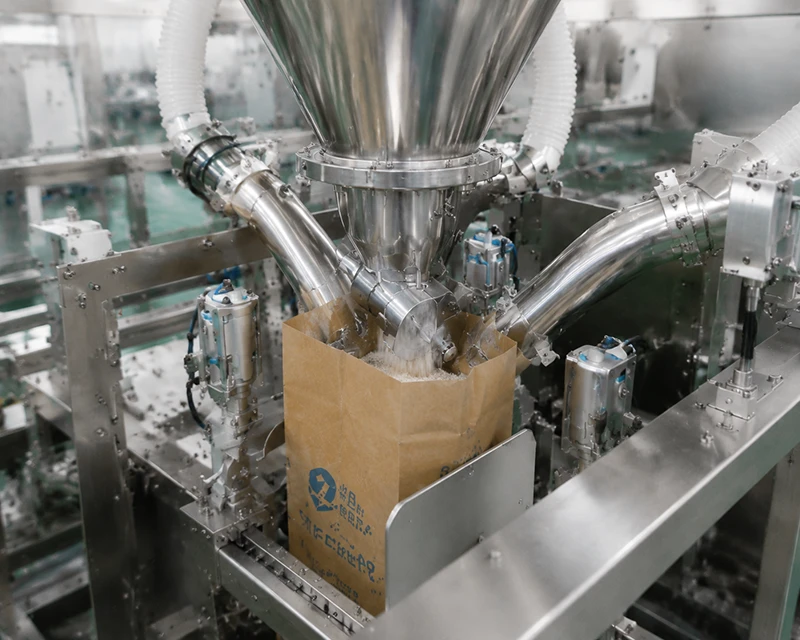
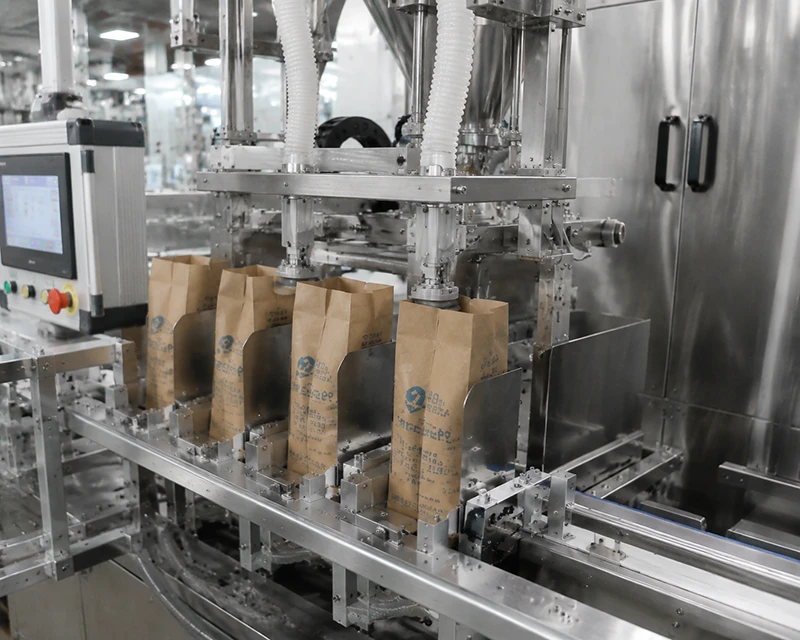
For flour, the correct equipment must match the powder, bag construction, retail weight, available feeding system and required downstream controls at the same time. A machine designed for roll film, liquid filling or valve sacks is not automatically suitable for a premade kraft package with side folds.
Why Zpacker fits premade paper bags and powder dosing
Zpacker is built as a fully automatic, two-station linear system for premade paper or paper-plastic bags. The belt-fed bag handling section takes a flat M-fold square-bottom bag, opens it into a three-dimensional package and holds it in position for filling. After dosing, the line returns to the bag geometry: settling and dust-removal operations are followed by M-edge folding, trimming, edge rolling, glue spraying and top pressing. The sealing method is hot-melt point or line spraying with pressing, rather than heat sealing.
The product range is organized around common flour retail formats. One configuration covers approximately 1–2 kg and another approximately 2.5–5 kg. Reference speed is about 30–35 bags per minute for 1–2 kg and about 15–20 bags per minute for 2.5–5 kg, while material, feeding stability and site conditions determine the final acceptance value. The reference dosing accuracy is approximately ±0.5% (5‰). Bag samples remain essential because the reference envelope—about 80–140 mm wide, 240–320 mm long and 60–80 mm side fold—must be checked against the actual bag.
Engineering note: Common retail planning points include 1 kg, 2 kg and 5 kg flour bags. The practical specification must still confirm bag direction, M-fold size, powder flow, dust behavior, air supply and the required line layout before quotation.
From screw dosing to inspection and group packing
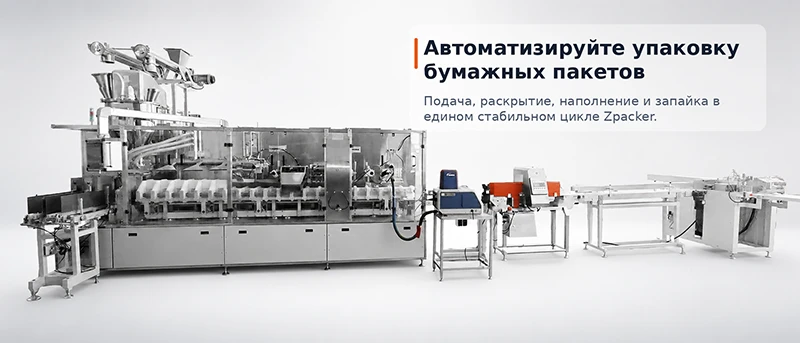
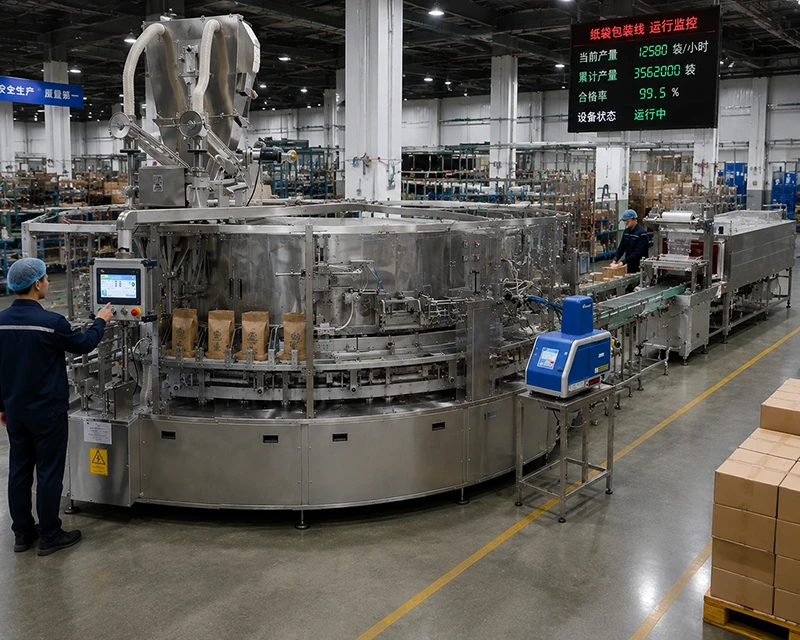
A practical automatic packaging line can start with a flour storage silo or buffer hopper, then use a screw conveyor or elevator to feed a twin-screw dosing section. Zpacker handles the premade bag sequence, while the outfeed can be connected to a checkweigher, metal detector, date printer, bag arranger and a secondary packing step. Depending on the logistics requirement, finished small bags may enter a heat-shrink group pack or be manually placed into a larger sack or case before palletizing.
This modular flow addresses the original labor problem without claiming that every project has the same output. Operators can focus on material supply, inspection and exception handling instead of repeating every bagging action. Safety logic is also part of the process: when no bag is detected, the machine does not open, fill or seal; pressure, guard, motor, variable-frequency drive and glue-temperature abnormalities can trigger an alarm or stop. Product-contact and exposed relevant parts are specified as 304 stainless steel, with the final bill of materials confirmed for each project.
| Project item | Zpacker reference | What must be confirmed |
|---|---|---|
| Product and pack | Flour or compatible powder in premade paper or paper-plastic M-fold bag | Flowability, dust behavior, bag layers and bag direction |
| Retail formats | Approximately 1–2 kg or 2.5–5 kg; common points include 1 kg, 2 kg and 5 kg | Target weight range and changeover requirements |
| Dosing and output | Reference accuracy about ±0.5%; speed depends on format and conditions | Feeding capacity, test results and acceptance speed |
| Utilities | 15.5 kW; 380 V ±10%, 50 Hz; air demand about 0.76 m³/min | Final air pressure, electrical supply and installation space |
| Downstream control | Checkweigher, metal detector, marking, arranging and group packing can be connected | Required inspection sensitivity and packing route |
Build the flour packaging line around the real bag sample
Send the flour type, target weights, bag drawings or samples, expected output and available utilities. BPM can then confirm the screw dosing, dust-removal, sealing and downstream configuration for a Zpacker project instead of forcing a premade paper bag into a generic vertical packaging machine.
Discuss your flour packaging line English
 Русский