
Gypsum Plaster in 25 kg Valve Bags: How an Automated Line Solves Dust, Bag Shape, and Pallet Stability
Gypsum plaster is light, dusty, and unforgiving in a 25 kg valve bag. This guide shows how a complete valve-bag packing line—automatic bagging, ultrasonic sealing, negative-pressure shaping, and robotic palletizing—delivers clean stacks and accurate weights at 5–12 bags per minute on the shop floor.
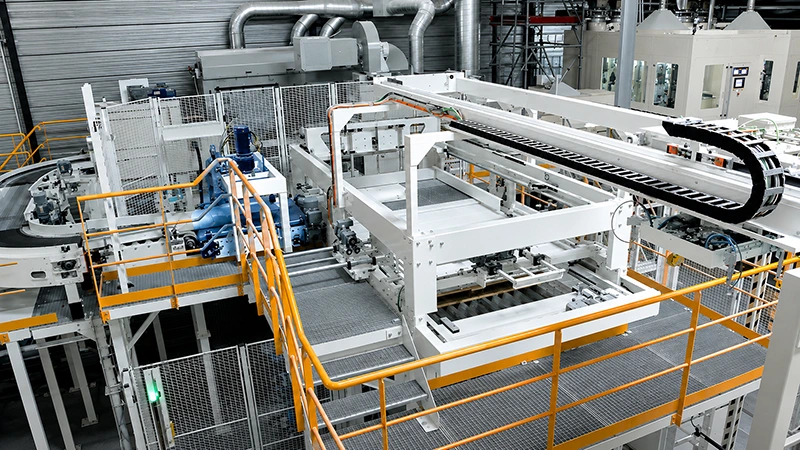
What 25 kg gypsum plaster demands from a valve bag line
Gypsum plaster is a fine, low-bulk-density powder that flows well but throws dust at every transfer point. When you load it into 25 kg valve bags, three things matter at once: clean filling, accurate weight, and a bag that does not bulge in the stack. A valve bag line that meets these three demands is a complete system, not a single filler standing alone.
The valve bag has a self-sealing paper or laminated valve sleeve. The line must push product through that sleeve without tearing it, then close it without leaking. Because gypsum plaster is so fine, leakage at the valve translates directly into airborne dust on the floor, on the operators, and on the pallet wrap. The right answer is a sealing interface that confines the dust and a bag-handling path that never lets the valve sleeve drag across a sharp edge.
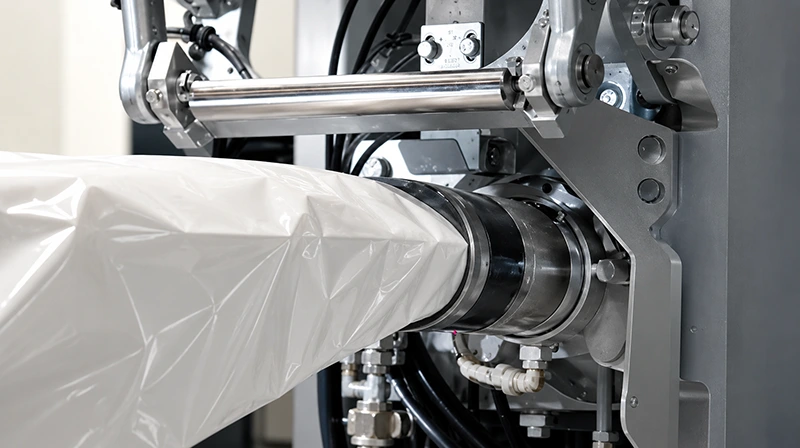
Manual or semi-automatic gypsum lines usually leak dust at the valve, drift 200–500 g per bag, and ship pallets that lean or collapse on the truck. Each defect is a small cost; together they decide whether a dry-mix producer keeps its contract with the next builder.
Where old gypsum plaster lines lose money
Three failure patterns show up again and again on a 25 kg gypsum plaster line. First, dust escape at the valve during filling, especially when the product carries residual moisture and forms micro-clumps that break against the sleeve wall. Second, trapped air leaves bags visibly bulged, so the stack leans and the bottom row crushes under load. Third, missing weight verification lets underweight bags leave the floor and overweight bags quietly eat margin on every shipment.
Our VPLINE valve bag packing line addresses all three inside one continuous chain: an expansion-style filling nozzle with separate infeed and air-return channels that keeps dust inside the bag during filling; ultrasonic sealing in the 20–40 kHz range applied directly to the valve sleeve to close the bag without stitch or glue; plus an on-line checkweigher and metal detector before the bag reaches the palletizer, so every shipped bag is right weight and free of tramp metal.
Engineer’s note: After sealing, every bag passes a negative-pressure shaping station that pulls trapped air out before palletizing. This single step is what turns a stackable, transport-stable pallet out of a bag that would otherwise arrive bulged and leaning. We also configure a stretch-hood wrapper downstream so the load stays tight through long-haul truck or container moves.
Specifications for a 25 kg gypsum plaster valve bag line
The table below lists the operating envelope of a VPLINE valve bag packing line configured for 25 kg gypsum plaster. Values come from the standard design envelope; final throughput, weight accuracy, and dust performance must be confirmed against your specific bulk density, moisture content, valve-bag tolerance, and compressed-air supply. We run sample bag tests at our facility before any quotation is finalized.
Bag materials accepted on this configuration include coated woven polypropylene, kraft paper, and laminated paper-poly bags with a valve sleeve that tolerates ultrasonic sealing. Material-contact parts are 304 stainless steel; the frame and guarding are carbon steel with industrial surface treatment rated for the gypsum-dust environment.
| Parameter | Value (25 kg gypsum plaster configuration) |
|---|---|
| Bag weight range | 10–50 kg (25 kg typical for gypsum plaster) |
| Throughput | 5–12 bags per minute, depending on bulk density and bag size |
| Weight accuracy | ±1–2‰ of target, on-line checkweigher with auto reject |
| Filling interface | Expansion-style valve nozzle with separate infeed and air-return channels |
| Sealing method | 20–40 kHz ultrasonic sealing on the valve sleeve |
| Bag shaping | Negative-pressure flattening station before palletizing |
| Quality gates | Checkweigher + metal detector, both with reject lane |
| Palletizing | Robotic palletizer with 3-bag interlocking layer pattern |
| Load protection | Automatic pallet dispenser, interlayer sheet feeder, stretch-hood wrapper |
| Bag materials | Coated woven PP, kraft paper, laminated paper-poly valve bags |
| Material-contact parts | 304 stainless steel; frame carbon steel with industrial coating |
| Compressed air | 0.5–0.7 MPa, stability to be confirmed on site |
| Power supply | AC 380 V, 50 Hz, approximately 15 kW for the packing unit |
| Line footprint reference | Approximately 15–20 m long × 4–6 m wide, ≥4.5 m clear height |
Need a 25 kg gypsum plaster valve bag line configured to your plant?
Send us your bag type and supplier, target throughput, available air pressure and stability, plant layout with clear height, and the gypsum plaster grade you actually run. We will come back with a line layout, a sample-bag test plan, and a reference budget within a few working days.
Talk to a packing line engineer English
 Русский