
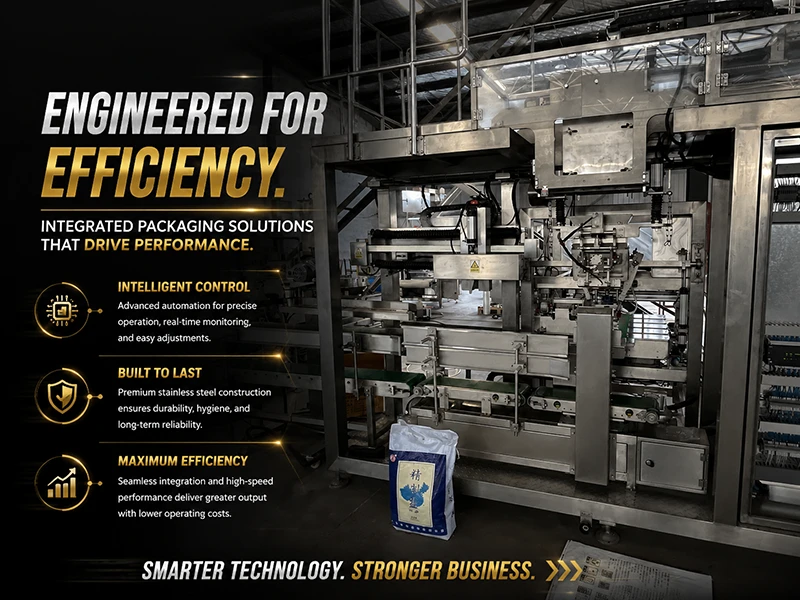
How a Siberian Salt Producer Builds Stable Dispatch Units from Finished Salt Pouches
For a Siberian salt producer, the expensive part is not filling the pouch. It is what happens after the pouch leaves the bagger: corners get knocked, air remains inside the shipment unit, and stacked loads start shifting before they reach the warehouse rack or the truck bed.
This BIBPU secondary packaging line is built for that gap. It takes finished salt pouches, places them into a woven PP overbag, compresses the load into a flatter shape, and then closes the mouth with a heavy-duty sewing head. The goal is simple: make the dispatch unit behave like a unit, not like a pile of loose bags.
 Compact stainless-steel line layout with transfer sections, buffer space, and operator access.
Why the handoff is the real bottleneck
Salt plants usually focus on the primary pouch first, but the damage often begins later. Once the packs leave the filling area, they need a controlled route into the secondary unit. If the transfer is too abrupt, the edges deform, the load becomes uneven, and the stack loses discipline before it ever reaches dispatch.
That is why the line needs more than a single machine body. The image above shows a compact layout with integrated conveyors and a buffering zone. This is where the system absorbs pace differences between upstream packing and downstream handling. A stable handoff is what keeps the flow continuous instead of forcing operators to stop and re-stack bags by hand.
 Enclosed frame, transfer conveyor, and service aisle keep the line practical for daily operation.
Operators need a screen they can read without guessing
Every packaging line becomes harder to run when the interface is unclear. For a salt plant, that means longer startup checks, more time spent on recipe changes, and more chances for a wrong setting to slip through during a shift handover. The control system on this line solves that with a straightforward HMI layout and Russian-language operation text.
The MCGS screen in the image below shows labels such as запуск, сброс, and скорость. That matters because the crew can check status, reset the line, and adjust speed without decoding a foreign interface. In a production environment, clarity is not cosmetic. It is what reduces misread settings and keeps the machine moving at the same pace as the warehouse.
 Localized HMI helps operators change speed and reset the line without hesitation.
The overbag stage must protect the pouch geometry
Once the finished pouches move into the woven PP sack, the machine cannot simply dump them in. The transfer has to stay controlled, because the load still needs to fit a transportable shape. In the close-up below, the clamping jaws hold the sack open while the smaller packs move in from above. That keeps the entry neat and reduces the chance of a crushed corner or a twisted face panel.
This is the stage that turns individual retail or bulk pouches into a shipment unit. It is also where the line shows whether it was designed for real logistics or only for production footage. If the fill is messy here, the rest of the process has to work harder to recover the shape.
 Pneumatic clamping keeps the woven overbag open while the finished pouches drop in cleanly.
Compression comes before sewing, not after complaints at the dock
After filling, the sack still needs to be flattened before it is closed. Otherwise the unit carries trapped air, bulges at the sides, and becomes harder to stack. The side compression station solves that by pressing the loaded sack into a tighter profile before the mouth is sent to the sewing head.
The image below shows the side clamping plates compressing the filled sack. The 150 mm stroke is enough to bring the bag into a more stable shape without overworking the material. For dispatch teams, that means cleaner stacking, less wobble on the pallet, and fewer adjustments when the truck is loaded.
 Side compression flattens the load so it can be stacked and moved with less deformation.
A proper sewn closure protects the whole load
The final closure is not just a finishing step. It is the point where the dispatch unit either holds together or starts to unravel in handling. A heavy-duty sewing head gives the line the closing strength it needs for woven sacks that will be lifted, moved, and re-stacked many times before delivery.
Here the Newlong DS-9C head stitches the opening with a strong double-line chain seam, while the cutting and sensing components keep the process controlled. For a salt producer, that means the overbag is not only closed; it is closed in a way that supports the rest of the logistics chain.
 Heavy-duty sewing gives the final overbag the closure strength needed for warehouse and truck handling.
For a salt plant, secondary packaging is not an extra layer of paperwork or an afterthought on the floor. It is the stage that decides whether finished pouches reach dispatch as a flat, stable, easy-to-handle unit. When the transfer, compression, and closure steps work together, the line stops creating loose bags and starts producing shipment units that are ready for the warehouse, the truck, and the customer.
Need a consultation on packaging equipment?
CONTACT US → English
 Русский