
Limestone Powder Packaging Line: 5 kg Bags That Stay Square
A mineral filler plant in the Sverdlovsk region of the Urals packs ground limestone into 5 kg kraft bags for agricultural liming and construction filler. On the old bench the bag was held by hand under the spout, so the mouth reached the sewing head skewed and somebody straightened it every few seconds. A powder packaging line closes that gap in the last two metres, not at the dosing head.
Where a 5 kg limestone flour bag actually fails
Ground limestone is dense for its bulk and it does not settle like wheat flour or spray-dried milk. A 5 kg bag is light enough to lift off the filling spout while the auger is still running, and light enough to slide sideways on a belt that was originally set up for 25 kg sacks. The result is predictable. The bag lands on the closing conveyor leaning, the gusset folds inward, and the sewing head stitches a mouth that is already out of line.
The usual workaround is a second operator at the last metre, a length of roller table and a hand-held clamp. It holds together until the shift speeds up. Then bags are reshaped by hand, weight drift creeps in because the bag is pulled off the scale early, and the dust that escapes at the fill point settles on the bag surface and the floor around it. Nobody is doing anything wrong at that bench; the missing part is mechanical, because no component holds the bag for the whole distance between filling and closure. That is exactly the distance a powder packaging line is supposed to control.
On a 5 kg mineral powder bench the scale is usually accurate and the operator is usually experienced. What fails is the link between the filling spout and the sewing head. Once a bag leaves the spout at an angle, no pressure on the sewing guide can straighten it again, because the fold is already set in the paper.
Why this powder packaging line fits a mineral filler
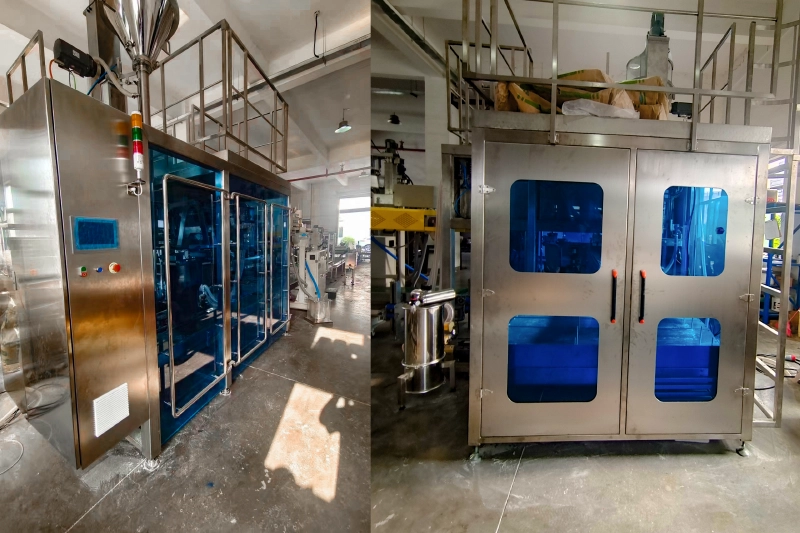
Mipline works the other way round. The bag comes off a magazine conveyor, is opened and clamped before the product is released, and stays clamped inside a stainless steel station until the fill is finished. Because the mouth is held mechanically, a 5 kg bag cannot lift off the spout and cannot rotate while it fills. The fill point sits inside an enclosed stainless frame with blue inspection windows, so the operator watches the bag rise without standing in the dust plume.
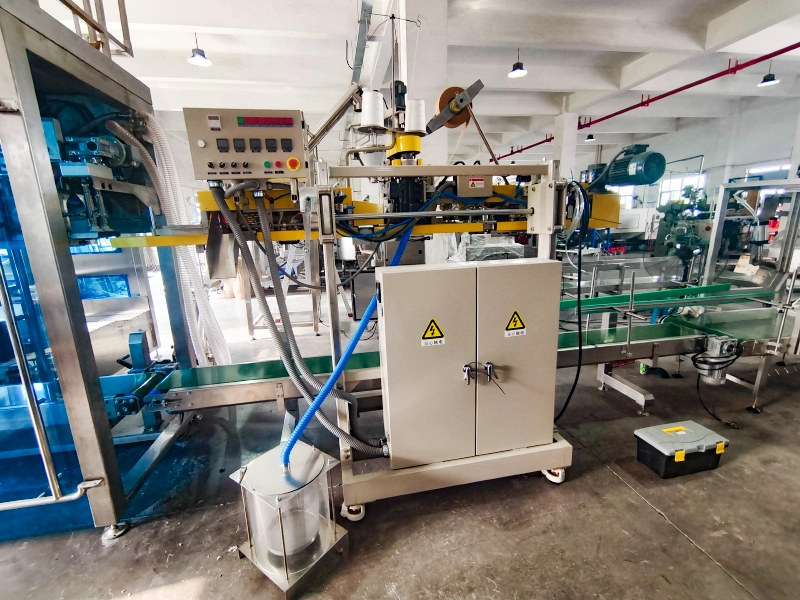
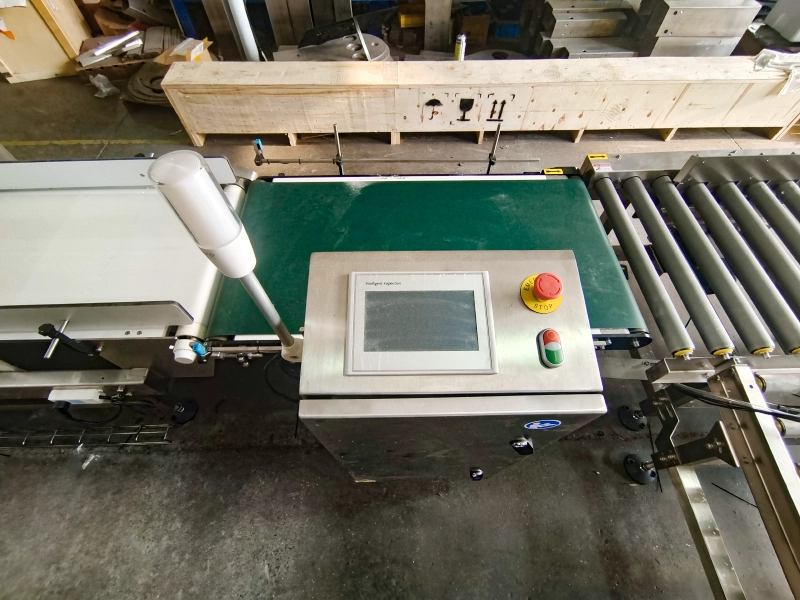
After filling, the bag is handed to a guided transfer. Twin belts with adjustable side guides carry both faces of the bag, then a roller section takes over and delivers it to the sewing head with the mouth level and centred. For limestone flour the adjustable guides matter more than motor power: the gap is set to the real bag width, so a light bag cannot fold over on itself between two stations. The same clamping and guide logic is described in our walk-through on keeping bags square before sewing.
Line note The operator has to see the fill on a mineral powder. That is why the enclosed station on this powder packaging line uses blue transparent inspection windows in the doors instead of sealed panels: the fill point stays visible, maintenance access goes through the same doors, and the drive zone stays guarded.
Structure and evidence, station by station
The table maps each zone of the powder packaging line to the bag problem it removes. Everything in it is visible on the machine photographs on this page, not copied from a specification sheet.
Two details are worth pointing out. The magazine conveyor feeds flat 5 kg bags to the pickup station under its own transparent guard, so a bag cannot be dragged open before it reaches the clamps. And every station sits on a welded stainless frame with adjustable feet, which keeps the transfer height constant after wash-down and is the quiet reason the bag still arrives square at the sewing head. The bag magazine and clamp sequence is shown in more detail on the automatic bagging machine for powder page.
| Line zone | What goes wrong with 5 kg limestone bags | What the Mipline line does |
|---|---|---|
| Bag magazine and pickup | Flat kraft bags stick together and arrive creased or half open | Magazine conveyor feeds flat bags to the pickup station under a transparent guard, with vacuum pick-up and a separate control cabinet |
| Mouth clamping | Light bags lift off the spout and release dust into the room | Bag mouth is clamped and held open through the whole fill, inside the stainless enclosure |
| Filling zone | Dust escapes, and nobody can tell how full the bag is | Enclosed stainless station with blue inspection windows on the doors and a top maintenance platform |
| Transfer to closure | Bags slide, twist or tip on belts sized for heavier sacks | Twin-belt transfer with adjustable side guides holding both bag faces, followed by a roller conveyor section |
| Handoff to sewing | Skewed mouth, restitched or rejected seams | Roller transfer delivers the bag to the sewing head level, centred and square |
| Control and access | Settings changed blind, no safe way to stop the line | Touch-screen HMI, emergency stop on the control box, welded frame with adjustable feet |
Building a 5 kg limestone flour line?
Send one filled bag, its flat size before filling, the bag material and the weight you run today. We will map the magazine, clamp, fill, transfer and closure stations of your powder packaging line around that bag, and tell you which zones you can keep from your existing bench.
Send your bag sample English
 Русский