
Milk Powder Bagging Line: Clean Bag Mouth Before Sewing
Most 25 kg milk powder bagging line problems start at the last metre, not at the weighing hopper. The bag is already full, heavy and dusted with fine powder when it reaches the sewing head. Mipline is built around that handoff: bag magazine and clamp, bottom-up filling, guided roller and twin-belt transfer, settling and shaping, then metal detection and checkweighing before the bag leaves the cell.
Where a full 25 kg dry milk bag loses its shape
Dry milk is fine, hygroscopic and slow to settle, so the bag shape is decided long before the pallet. In many dairy plants the 25 kg kraft paper or paper-plastic composite bag is still started by hand: an operator lifts it from the stack, opens the mouth, holds it under the spout and squares it after filling. Filling ends and control of the bag ends with it. The bag leaves the fill point with a folded gusset, powder on the seam area and a mouth that is no longer parallel to the sewing head. On a milk powder bagging line that is not cosmetic. A skewed mouth gives a wandering seam, a dusty mouth gives a weak seal, and both end up in the reject bin with the weight already paid for.
Mipline treats bag supply, opening and clamping as part of the filling process rather than a manual pre-step. A bag magazine conveyor feeds the stack, vacuum pickup opens the bag at the top, and clamp points hold it square while a lifting platform follows the fill level, so the screw outlet stays close to the powder surface. Fast, medium and slow screw stages trim the weight at the end of the fill instead of at the weigher, and dust removal plus trimming at the mouth follow before the bag is released to transfer. The same logic is described in the bottom-up filling and dust control configuration.
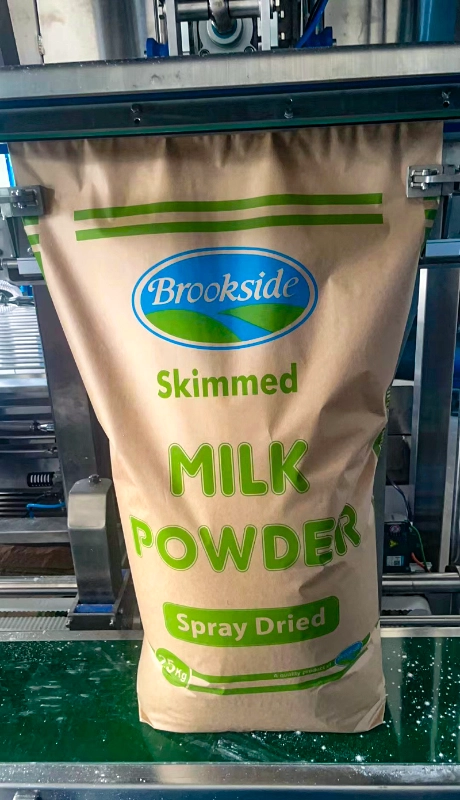
A twisted or dusty bag mouth is rarely a sewing head problem. It comes from an uncontrolled handoff: the bag is released off-square, runs on a belt without side guides and arrives with the gusset folded inward. At 25 kg, correcting it by hand is a lifting risk and a new dust source at the seam at the same time.
Why the last transfer decides the seam, not the filler
Filling accuracy gets the attention in the quotation, but on a milk powder bagging line the transfer decides whether that accuracy survives to the pallet. Roller sections and twin-belt transfer conveyors carry the closed bag at a fixed height with adjustable side guides on both faces, so the bag cannot rotate between the clamp and the sewing head. Straight is also what the downstream stations need. A settling conveyor gives the powder time to move inside the bag, a shaping section presses the bag to a repeatable profile, and the metal detector then sees a stable window instead of a bag that changes shape as it passes. The same handoff principle is worked through for flour bags before the sewing head.
Conveying references from the Mipline line build: a 5,000 mm PVC belt at 10 m/min and 0.75 kW, a 3,000 mm settling conveyor 600 mm wide at 15 m/min, and a 1,500 mm shaping section with a 600 mm belt running at the same speed. Guides are adjustable in height and width, so one section accepts a different bag gusset without rebuilding the line, and emergency stop boxes sit at the operating positions rather than only at the main cabinet. On an enclosed station the operator sets the guides through the blue inspection windows and checks the bag path without opening the guard.
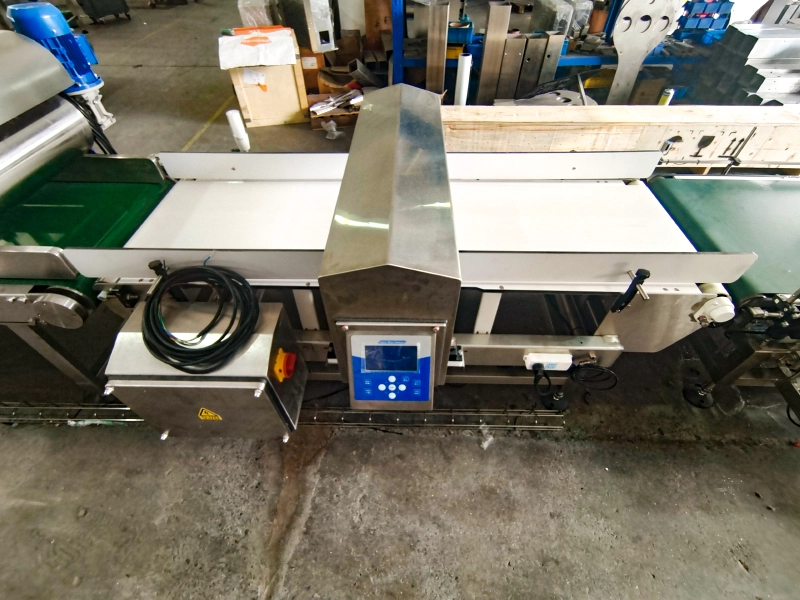
Field note: measure from the clamp release point to the first pair of guide rails. If that gap is longer than the bag length, the bag has room to rotate before anything corrects it, and no sewing-head adjustment will recover the seam.
Specify the bag first, then the machine
No quotation for a milk powder bagging line is meaningful before the bag itself is measured. Length, width and gusset decide the magazine, the opening cups and the clamp stroke. Bag construction decides the closure: a paper-plastic composite with an inner liner needs dust removal, trimming, inner heat sealing, pressing, sewing and often a hot-melt paper tape, while a plain sewn kraft bag needs a different sequence at the same station. Powder behaviour decides the fill, because bulk density, flowability, moisture content and how much air the material holds after conveying all change the dosing profile.
The reference layout below is a 25 kg dairy powder build. Throughput, stated accuracy and residual oxygen are configuration values, not universal promises: they are confirmed against the bag sample and the material test, and they move when the bag, the closure or the target weight changes.
| Specification | Mipline reference | Consequence for the bag |
|---|---|---|
| Bag weight | 25 kg industrial powder bags; DS25K reference covers 5–25 kg | Sets magazine size, clamp stroke and platform travel per project |
| Fill method | Vertical screw feed with bottom-up lifting platform, fast / medium / slow stages | Fill point stays near the powder surface, so less dust reaches the mouth |
| Stated accuracy | ≤ ±0.1–0.2% on the referenced 25 kg configuration | Confirm on a bag sample before the figure enters a contract |
| Closure path | Dust removal, trimming, inner heat sealing, pressing, sewing, hot-melt paper tape, final pressing | Seam area is cleaned and protected before the sewing head, not after it |
| Transfer | Roller conveyor and twin-belt sections with height and width adjustable guides | Bag stays square from clamp release to sewing head |
| Settling and shaping | 3,000 mm settling conveyor and 1,500 mm shaping section, 600 mm belts at 15 m/min | Powder settles and the bag takes a repeatable profile |
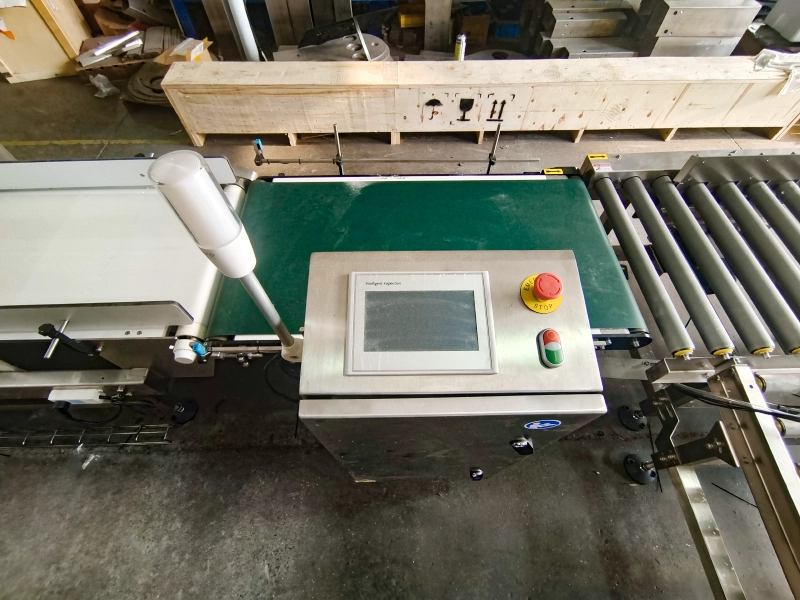
| Inspection | Metal detection window 600 × 230 mm at 28 m/min; checkweigher per project datasheet | Reject decision is taken on the finished, closed bag |
| Body and access | SUS304 body, enclosed guarding, blue inspection windows, top platform and ladder | Cleaning and maintenance without breaking the process line |
That list is also the budget. Bagging station, closure module, transfer sections and inspection equipment are priced as one line because they are commissioned as one line; buying the filler alone and adding conveyors later is exactly what produces the manual straightening this milk powder bagging line is designed to remove.
Send the bag, the weight and the closure
For a dairy or dry milk project the fastest route to a usable proposal is a bag sample with its dimensions, target weight, throughput and the closure method your buyers already accept. Send those four items with the site layout, and the milk powder bagging line is quoted station by station against your own bag instead of a catalogue format.
Request a project review English
 Русский