
Milk Powder Packaging Line: Dry Milk Bag Handoff
A dairy plant filling 25 kg kraft bags with spray-dried skimmed milk rarely loses output at the filler. It loses it in the last metre, where the full bag leaves the clamp and meets the sewing head. This milk powder packaging line clamps the bag mouth before filling, holds both bag faces through a guided transfer and hands the bag over square.
Where Dry Milk Bags Lose Their Shape
The older layout is familiar. An auger or screw filler sits on a short spout, an operator holds the bag mouth by hand, the filled bag drops onto a two-metre roller table and gets pushed toward a sewing head. Dry milk makes that layout expensive. The powder is light, it fluidises while it falls, and the second half of the fill shifts weight into one corner. A bag that was straight at 10 kg is leaning at 25 kg, the block bottom is skewed, and the sewing head receives a mouth that is not square. The operator then walks the last metre to straighten the bag by hand, which is exactly where dust escapes and where the seam starts to wander. That manual step is the cost this milk powder packaging line is built to remove.
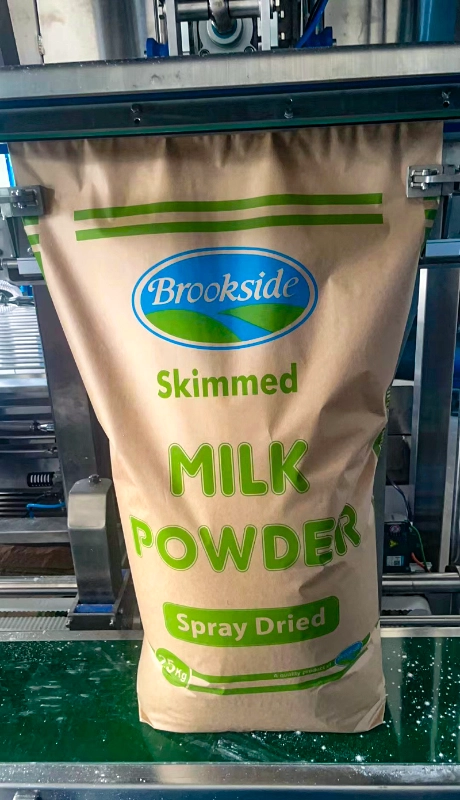
A milk powder packaging line replaces the hand with a mechanical hold. Flat kraft bags sit in a magazine conveyor. A bag is picked, opened and pushed onto a clamp station where the mouth is gripped on both faces before the first kilo of powder enters. Filling runs bottom-up, so the bag builds its own base instead of dropping into a slack sack. The clamp releases only when the bag is formed, square and standing on a supported conveyor surface.
Dairy plants usually discover this after a capacity upgrade: the filler keeps up, the sewing head does not, because half the bags arrive with a twisted mouth or a collapsed shoulder. Manual straightening hides the problem at line speed and shows it again at the palletizer.
Why This Milk Powder Packaging Line Fits Dairy Powder
Dry milk is not flour. It is low in bulk density, it aerates, and it holds air after dosing, so a filled 25 kg bag stays soft for several seconds after the clamp opens. A milk powder packaging line has to keep the bag supported through that settling window instead of dropping it. On the Mipline layout the bag stays inside an enclosed stainless steel bagging station with blue inspection windows, then moves onto green belt and roller conveyor sections sized for that settling distance.
Three details matter more than tonnage for this product. First, the mouth is clamped on both faces, so the fill cannot push the bag sideways. Second, the transfer after filling is guided: adjustable side guides on the twin-belt section hold the bag body upright. Third, access is designed for cleaning — top maintenance platform, hinged inspection doors and an open stainless frame — because dairy powder residue is a sanitation issue, not only a dust issue.
Shop-floor note: most sewing complaints we receive are actually clamp and transfer complaints. Check where the bag is supported in the last metre before replacing the sewing unit.
From Clamp to Sewing Head: The Evidence
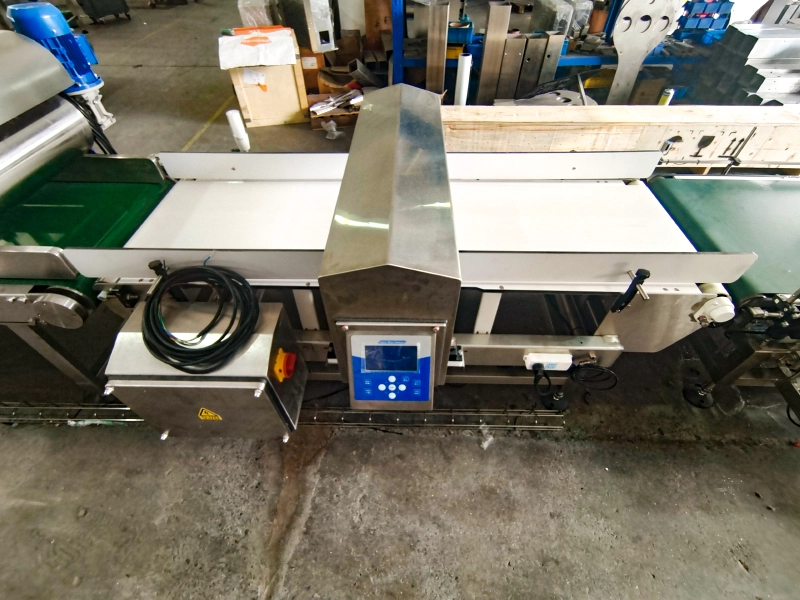
The photo evidence is easy to read. A milk powder packaging line from Mipline moves the bag through four supported states: clamped at the mouth, filled bottom-up, released onto a belt with fixed side guides, and handed to the sewing head at a height and angle set by the conveyor line rather than by the operator’s hands. Twin-belt transfer with adjustable guides, green infeed and outfeed sections and a welded stainless frame carry a 25 kg kraft bag without sagging between supports. A touch-screen control box with emergency stop sits beside the transfer section, so a jam is visible and reachable.
Where does the gain show up? Fewer stops in the last metre, fewer skewed seams, fewer bags re-shaped by hand, and squareness that survives palletizing. If you already run a 25 kg layout, compare it with our 25 kg powder bagging line walkthrough and the automatic bagging machine for powder magazine-to-clamp sequence.
| Line stage | What the machine holds | What it prevents |
|---|---|---|
| Bag pickup from magazine | Flat kraft bag drawn, opened and pushed to the clamp station | Operator holding the bag mouth by hand |
| Clamp before filling | Mouth gripped on both faces, fill runs bottom-up | Weight shifting into one corner |
| Release after filling | Bag set down on a supported belt, not dropped | Collapsed shoulder on aerated powder |
| Guided transfer | Twin-belt section with adjustable side guides | Twisted bag body and skewed mouth |
| Handoff to sewing | Height and angle fixed by the conveyor line | Unstable seam start and rework |
Send Your Dry Milk Bag Sample
Tell us the bag you already buy — 25 kg kraft, woven or laminated — the powder you run and your target bags per hour. We will size the milk powder packaging line around that bag and your sewing position, not around a catalogue page.
Request a line proposal English
 Русский