
How Mipline Helps a Belarusian Dry Powder Plant Keep 25 kg Bags Square Before Sewing
For a Belarusian dry powder producer running 25 kg kraft paper bags, the real bottleneck is often not filling. The problem appears at the last meter: the bag twists, the mouth drifts, and operators have to straighten every sack before sewing. Mipline is built for that handoff stage, with an enclosed stainless steel bagging station, a bag magazine conveyor, blue inspection windows, and guided transfer conveyors that keep each bag aligned before it reaches the sewing head.
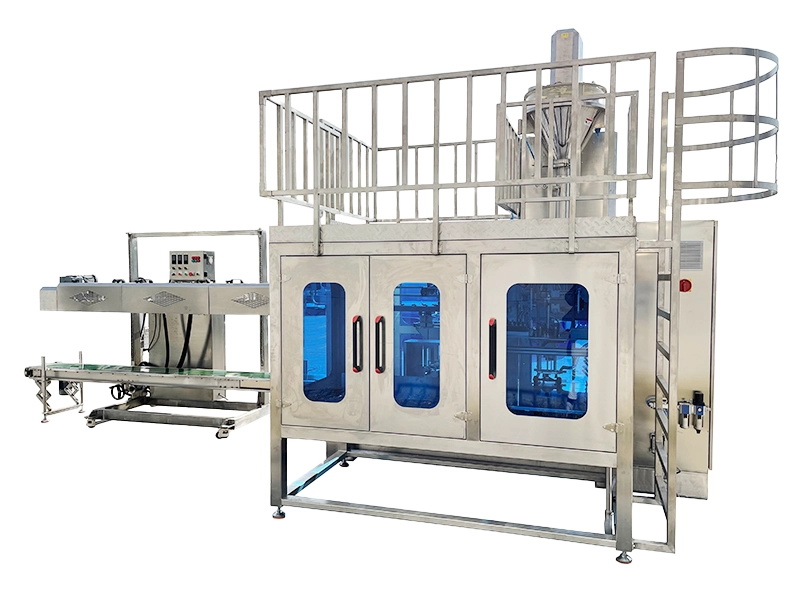
What the line has to solve before the bag reaches stitching
Dry powder plants do not lose time inside the filler itself. They lose time when a filled 25 kg bag arrives skewed, folded, or unstable and the operator must square it by hand. That is why a powder packaging line must do more than fill and move product. It must preserve bag shape, protect the mouth geometry, and hand the sack off in a controlled way before sewing or sealing.
The first image shows the core answer: a stainless steel automatic bagging machine with blue inspection windows and a top access platform. The enclosure makes the station easier to supervise and maintain, while the bag magazine conveyor and guarded transfer path support repeatable bag presentation. This is the difference between a generic automatic bagging machine for powder and a line that is actually engineered for stable bag transfer before sewing.
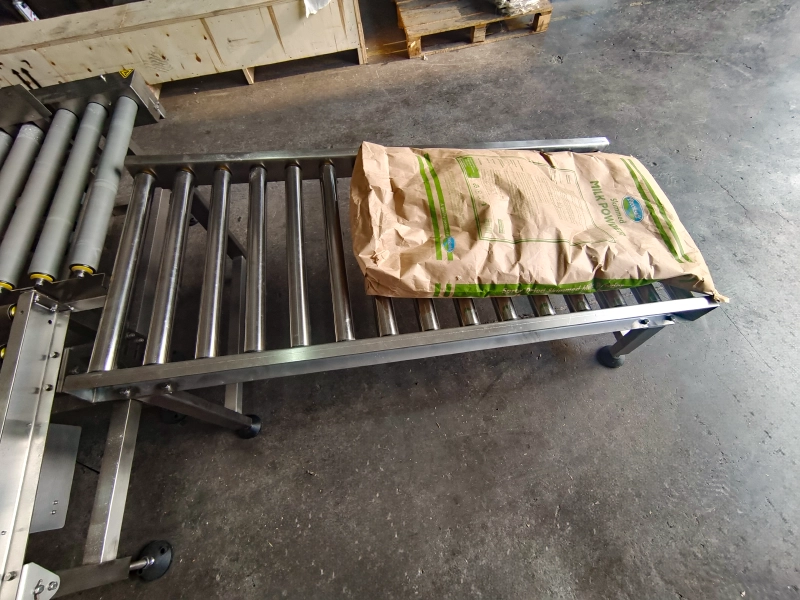
The most common hidden loss is not filling capacity. It is the labor spent re-squaring every bag before the sewing head can take over. When that happens, line speed drops, the stitch point becomes less stable, and the plant pays for both labor and inconsistency.
Why Mipline fits this problem better than a basic powder bagging line
Mipline is designed as dry powder packaging equipment for industrial bags, especially 25 kg kraft paper or woven sacks. Its engineering intent is clear: keep 25 kg bags square before sewing, reduce manual bag straightening, and deliver cleaner bag alignment before sewing. The visible structure in the image set matches that goal: enclosed bagging station, bag clamp alignment, roller conveyor bag transfer, and guided handoff paths.
That matters for milk powder packaging line projects, flour bagging line installations, and starch powder packaging line upgrades alike. The product definition stays the same: a powder filling and bag sewing line must hand off bags in a repeatable way. Mipline does that with stainless steel guarding, inspection windows for operator visibility, and conveyor geometry that supports a stable bag mouth from transfer to stitch.
bpmpack Engineering Insight: If the last transfer section is unstable, every downstream fix becomes a labor patch. A twin-belt or roller-based guided transfer section, combined with a bag clamp station and an enclosed bagging body, keeps the bag square long enough for the sewing head to work consistently. That is why the visible bag magazine conveyor and transfer conveyor are not decorative details; they are the functional reason the line performs better in real production.
Visible evidence from the machine structure
The photo set is important because it shows more than a marketing concept. The bagging station is enclosed. The inspection windows are real. The conveyor path is visible. The roller transfer section is built to carry a kraft paper bag without making the mouth collapse. For a dry powder producer, that physical evidence is what separates a promise from an operating line.
For a 25 kg powder bagging line, the expected result is simple: less manual correction, cleaner transfer between filling and sewing, and a more stable bag mouth at the stitching point. In practical terms, that means less operator fatigue, fewer misaligned bags, and a more reliable end-of-line rhythm. This is the result a buyer wants when upgrading to a powder packing machine with controlled bag handoff.
| Line problem | What the image proves | Mipline response |
|---|---|---|
| Bag twists before sewing | Enclosed station and guided transfer path | Stable bag transfer before sewing |
| Operators straighten sacks by hand | Roller conveyor carries the kraft bag in line | Reduce manual bag straightening |
| Sewing head sees a skewed mouth | Bag clamp and inspection-ready enclosure | Cleaner bag alignment before sewing |
Need a cleaner bag handoff before sewing?
If your powder plant is losing time at the stitching point, Mipline can be configured around your bag size, powder type, and target line speed. Share the bag spec and we will map the transfer path first, not the brochure.
Request a layout review English
 Русский