
Paper Bag Packing Machine for 1–5 kg Flour Bags
A paper bag packing machine only earns its place when it matches the bag your retail buyers already accept. This walk-through covers what a premade M-fold paper bag line has to do between 1 kg and 5 kg — bag pickup, clamp-held auger dosing, dust extraction, glue closure, checkweighing — and where semi-automatic filling and roll-film machines stop fitting.
Where semi-automatic filling and roll-film bagging stop matching the bag
Most flour plants that ask us for a quote are running one of two older routes. The first is a semi-automatic filler: an operator lifts the empty kraft bag onto the spout, holds it through the whole auger cycle, then carries it to a separate seamer. Output depends on the operator’s arms rather than on the dosing system, and the dust that escapes at the bag mouth settles exactly on the seam area the next station has to bond.
The second route is a vertical form-fill-seal machine running roll film. It is fast and it is cheap per bag, but it makes a pillow or fin-seal pack. When the shelf and the customer’s own print artwork call for a flat-bottom M-fold paper bag with a folded side gusset, roll film cannot produce it, and no downstream gadget converts one format into the other. That is the gap a premade paper bag packing machine is built for: the bag is finished before the machine ever sees it, so the machine’s job is to open, fill and close a known shape instead of creating one.
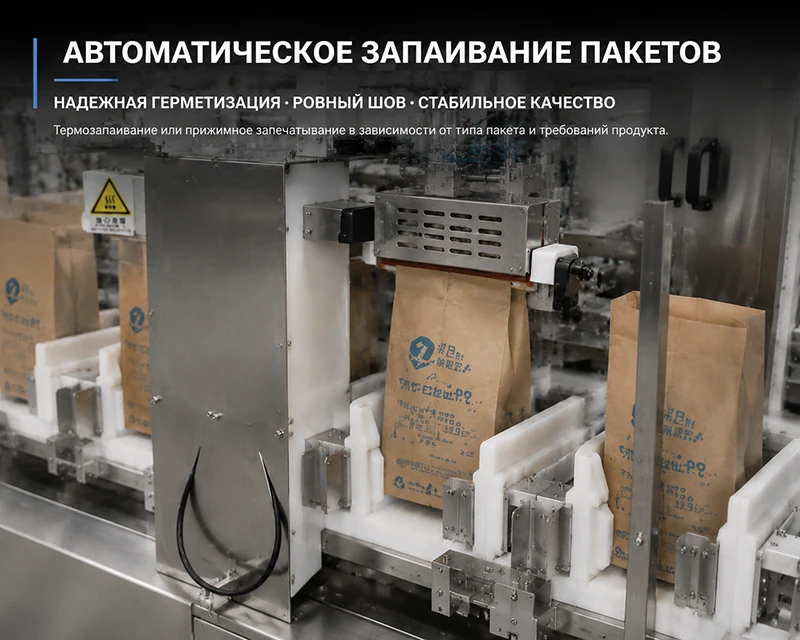
Flour that leaves the bag mouth is charged twice: once as lost material and cleaning time, and again as weight drift when the dose is corrected by eye. On a paper bag it is worse, because airborne dust lands on the glue line that has to hold the folded top shut.
Why a premade design suits M-fold retail bags
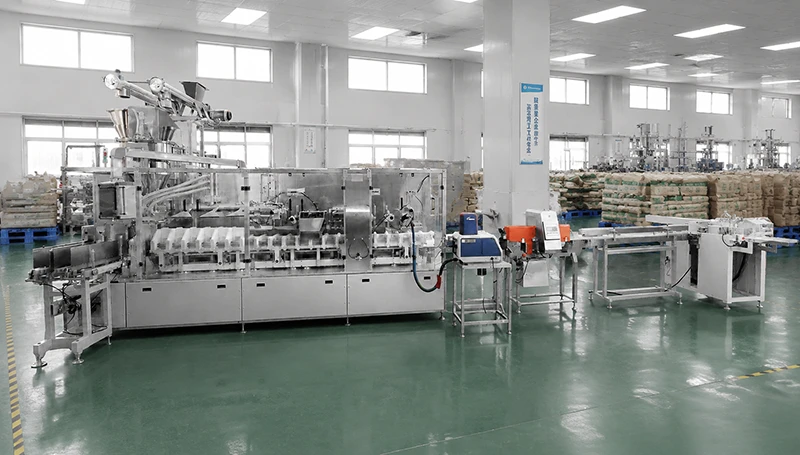
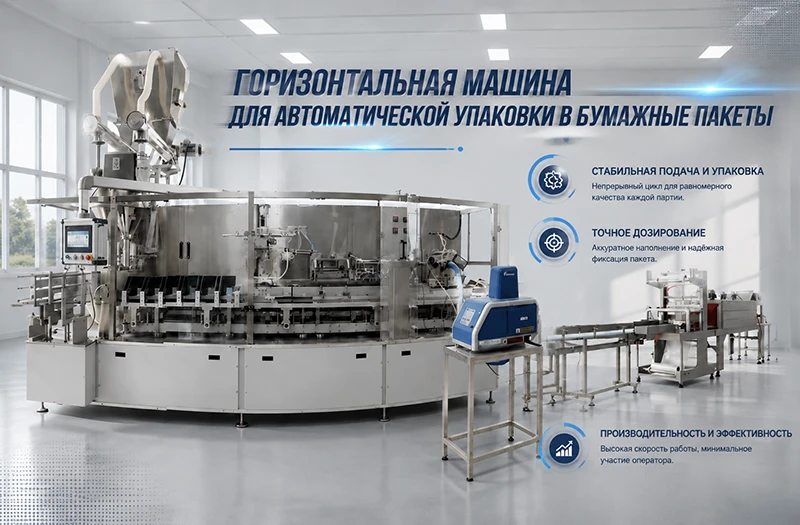
The Zpacker runs two bag stations on a linear frame. Belt feed carries each premade M-fold flat-bottom bag out of the magazine; the bag is picked, opened into a three-dimensional pouch, clamped under the dosing head and filled by twin vertical augers. From there the same machine vibrates and extracts dust at several positions, folds the M gusset back, trims the mouth, rolls the edge, applies hot-melt glue as dots or as a line, and presses the top closed. One paper bag packing machine therefore covers the pick, the open, the fill, the settle, the fold and the seal — the six operations that a semi-automatic line splits between an operator and two standalone units. The flat M-fold bag that leaves the press is the same bag the artwork was approved for, only standing up and closed.
Dust control is designed into that sequence rather than bolted on afterwards: extraction sits at the filling position and again at the vibration stations, so the material settles before the gusset is folded and the glue is applied. The machine also refuses to work blind — with no bag in position it does not open, fill or seal, and it alarms on air-pressure loss, an opened guard, main motor or inverter faults, and abnormal glue temperature. For plants already running kraft bags, the same platform can be specified around the bag sample you send, as shown on the 1–5 kg kraft bag line page.
Field note: paper-plastic laminate bags are not kraft bags with a coating. The paper layer and the film layer have to stay bonded through the fold, the trim and the press, and the glue has to grip the outer layer that is actually there. Test the real bag sample before the quotation instead of assuming the settings that close a 2 kg kraft bag will close a laminated 5 kg bag.
Specifications that decide the line layout
Two Zpacker formats cover the retail range: one for 1–2 kg and one for 2.5–5 kg. Sizing a paper bag packing machine starts with the bag drawing, not with the tonnage you want to ship — bag width, bag length and M-gusset depth decide whether a bag can be opened, clamped and folded at all on a given frame. The reference figures below come from the technical proposal; speed, air pressure and gusset examples vary between versions, so the signed specification and the bag test govern.
The frame carries 304 stainless steel on product-contact and exposed parts, with a powder-coated carbon steel main frame and anodised aluminium in places, a 10.4 inch touchscreen, and 15.5 kW of connected load at 380 V ±10%, 50 Hz. Downstream, the same line can continue into a checkweigher and metal detector, a date coder, bag collation, and either shrink-wrapped multi-packs or manual outer-bagging; a 17 m by 3.6 m footprint is a layout discussion point, not a fixed drawing. Second-shift output on the 2 kg format is covered in more detail on the twin-station 2 kg page.
| Item | 1–2 kg format | 2.5–5 kg format |
|---|---|---|
| Bag type | Premade M-fold flat-bottom paper or paper-plastic bag | Premade M-fold flat-bottom bag, bag sample to confirm |
| Retail weights | 1 kg and 2 kg | 2.5–5 kg, commonly 5 kg |
| Reference speed | Approx. 30–35 bags/min | Approx. 15–20 bags/min |
| Dosing | Twin-station vertical auger, approx. ±0.5% | Twin-station vertical auger, approx. ±0.5% |
| Bag size reference | W 80–140 mm, L 240–320 mm, M gusset 60–80 mm | Same range, to be confirmed on the bag drawing |
| Closure | Hot-melt glue dots or line, then top press | Hot-melt glue dots or line, then top press |
| Air and power | Approx. 0.6 MPa, 0.76 m³/min; 15.5 kW | Same, pressure per final configuration |
Quote the line from the bag, not from the brochure
Send the bag drawing or a physical sample, the target weight range and the output you need per shift. Our engineers will confirm which paper bag packing machine format covers your sizes, which stations the dust and closure sequence needs, and what the layout looks like on your floor.
Send your bag sample English
 Русский