
Salt Filling Machine: How BIBPU Keeps the Handoff Stable Before Sewing
When a salt line moves from filling to sewn secondary packaging, the real risk is usually the transfer, not the fill itself. BIBPU is built to keep that last meter flat, centered, and ready for sewing without trapping air or stressing the bag mouth.
Why salt lines lose control at the sewing station
A salt producer may already have a reliable filling section, but once the package enters the final sewing area, the line can still become unstable. Loose bag mouths drift off center, bag tops bulge after discharge, and the operator ends up compensating with manual correction. That is where seam quality starts to vary.
Salt also adds a second layer of difficulty. Fine particles are abrasive, ambient humidity makes films and woven edges feel sticky, and a slightly overfilled bag can push back on the sewing head. In practice, the last transfer needs more control than raw speed. If the package is not squared up before stitching, the sewing head has to fight the bag instead of sealing it cleanly.
Open transfer points create bulging bag mouths, inconsistent alignment, trapped air before sewing, and repeated operator intervention. The result is slower output and more seam stress on every sack.
Why BIBPU fits a salt filling machine job
BIBPU is a better fit when the problem is not the filler, but the transition from filled package to sewn package. Its dual belt feeder holds the bag mouth in a controlled lane, while the pneumatic clamping section compresses the sack body so the package can arrive at the sewing head in a predictable shape. That is a mechanical answer to a very common line problem.
The machine’s line logic is simple: constrain the bag, remove excess air, and keep the mouth aligned before stitching. For salt applications, the contact-side material choice matters as well. The product package is designed around corrosion resistance, with UNS S31603 (316L) contact surfaces used to handle salt exposure and reduce chloride-related risk. On the packaging side, the dimpled forming shoulder and tension-controlled film path help reduce sticking and keep the transfer steady in humid conditions.
bpmpack Engineering Insight: The fastest line is not the line that moves every bag the quickest; it is the line that removes instability before the bag reaches the sewing head. A controlled handoff usually delivers better real throughput than a loose transfer that needs manual correction after every few sacks.
What the images prove on the line
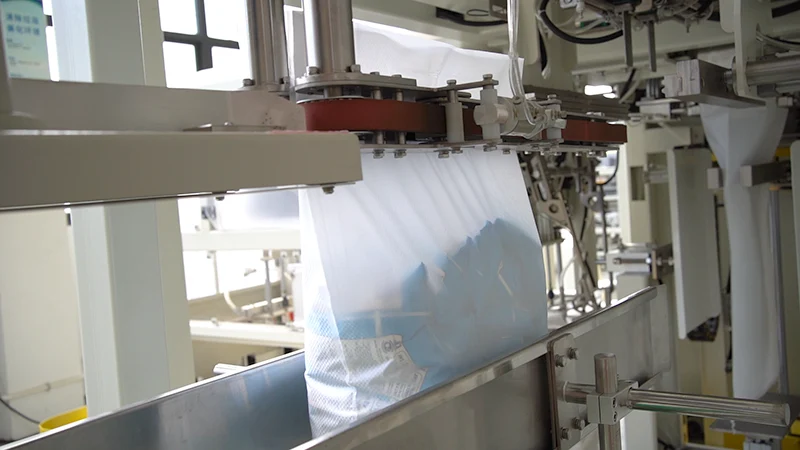
The hero image shows the bag mouth being held by dual belt feeders right before the sewing station. That matters because a sewn salt sack is only as reliable as its entry alignment. Instead of letting the filled bag swing or twist, the feeder keeps the top opening narrow, centered, and ready for stitching.
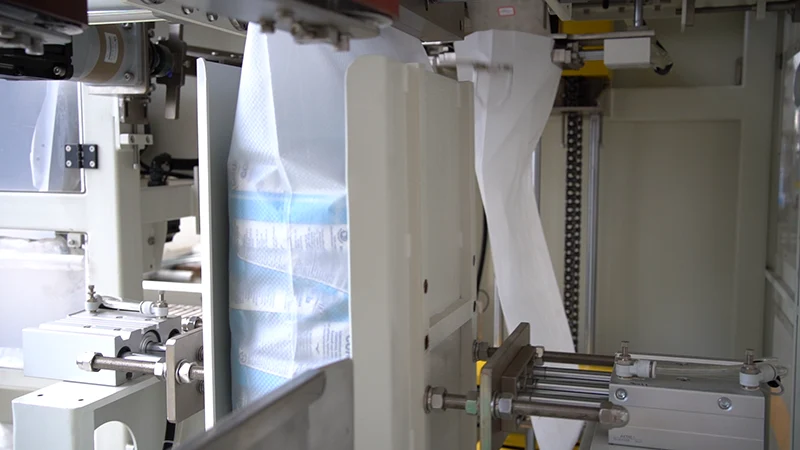
The second image shows the pneumatic side clamping plates compressing the filled woven sack. This is the anti-bulge step. By pushing the sack body into a flatter geometry before sewing, BIBPU helps the line remove excess air, reduce seam load, and make the closing section work under a repeatable shape.
| Line problem | BIBPU response | Visible evidence | Result |
|---|---|---|---|
| Bag mouth drifts before sewing | Dual belt feeders keep the opening centered | Hero image shows the woven bag guided into the sewing head | Cleaner entry and less operator correction |
| Bulging sack body | Pneumatic side clamping plates flatten the package | Feature image shows controlled compression before closing | Less trapped air and lower seam stress |
| Salt exposure and humidity | 316L contact-side materials and anti-stick forming geometry | Product index documents corrosion-resistant contact construction | Better durability on salt service lines |
Need a salt filling machine that stays stable before sewing?
Share your bag type, target throughput, salt format, and the current pain point at the sewing station. We will match the feeder, compression section, and sealing flow to the line instead of forcing a generic layout onto the process.
Request a line check English
 Русский