
Sugar Packing Bags in Food Production: How Zpacker Automates 1–5 kg Premade Paper Bag Packaging
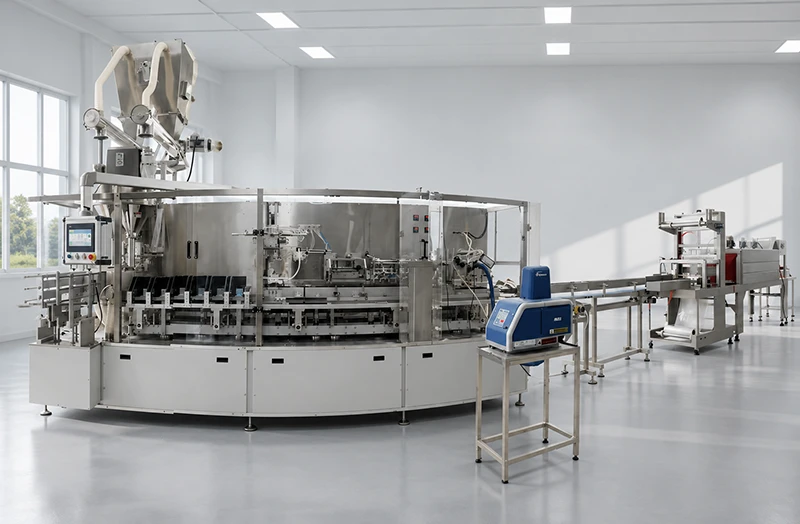
For flour mills, bakeries, and food production plants using sugar or other compatible powders, Zpacker is an automatic paper bag packing machine for premade kraft and M-fold bags. Its screw dosing, dust removal, bag forming, and sealing sequence helps replace manual filling with a controlled automatic packaging line.
Why premade sugar packing bags create a difficult automation step
A sugar or flour pack may look simple at retail level, but a premade paper bag with side gussets and a square bottom requires several controlled movements. The bag must be picked from the magazine, opened into a stable shape, held below the filling point, and kept in the correct orientation. After dosing, the M-fold must be returned, the top edge trimmed and rolled, and the closure prepared with hot-melt adhesive.
Manual filling or a semi-automatic machine leaves operators to coordinate these steps. The result can be inconsistent bag presentation, powder around the mouth, slower changeovers between 1 kg, 2 kg, and 5 kg packs, and extra labor before checkweighing or secondary packaging. A conventional vertical packaging machine is also not a direct substitute: it normally forms bags from roll film, while Zpacker is designed for finished paper or paper-plastic bags supplied by the customer.
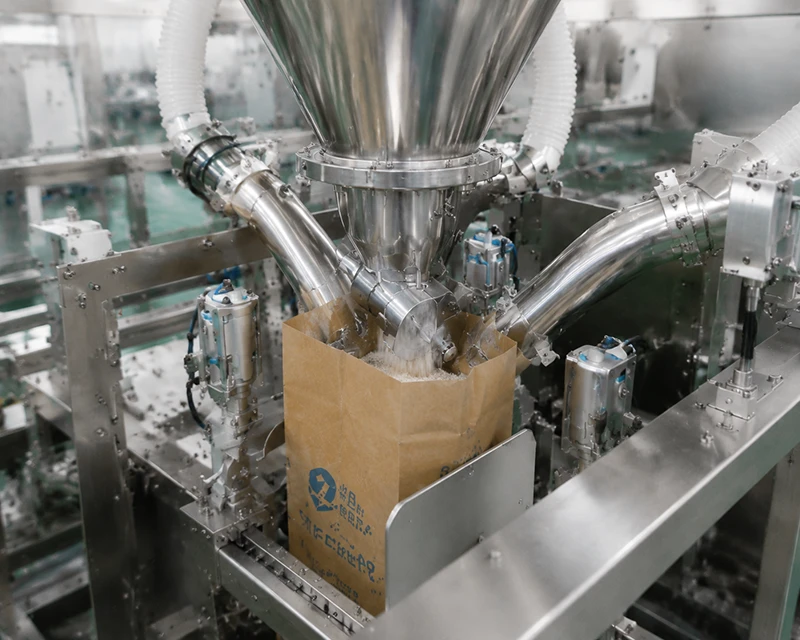
Powder at the bag mouth can interfere with sealing, while insufficient settling can leave an unstable pack. The selected bag, material flow, target weight, and downstream speed must therefore be considered together—not treated as separate machine specifications.
How Zpacker matches the bag, powder, and production sequence
Zpacker uses a double-station, in-line premade bag process. A belt-fed bag handling system takes the M-fold square-bottom bag from the magazine and opens it into a three-dimensional bag. The filling section uses screw dosing for compatible powder products. The machine then combines settling and dust-removal operations with M-fold forming, edge trimming, rolling, adhesive spraying, and top pressing. This is the practical reason it can cover the complete path from a flat bag to a closed retail pack.
The two filling stations are intended to support continuous operation. According to the project configuration, an empty-bag condition can stop and alarm one station while the other station continues; this operating logic must be confirmed during the final design and acceptance test. A 10.4-inch touchscreen and PLC-based control support recipe and sequence management, while no-bag, air-pressure, safety-door, motor, and glue-temperature alarms help prevent filling or sealing under abnormal conditions.
Specification point: the standard reference range covers about 1–2 kg on one format and 2.5–5 kg on another. Reference speeds are approximately 30–35 bags/min for 1–2 kg and 15–20 bags/min for 2.5–5 kg, with actual performance depending on sugar or powder flow, feeding stability, bag quality, and site conditions.
What to confirm before specifying a sugar bag packaging line
The correct selection starts with the actual bag sample rather than a nominal weight alone. Confirm the bag width, length, M-fold or side-gusset dimension, square-bottom construction, paper or paper-plastic layers, and front/back orientation. Reference dimensions are about 80–140 mm wide, 240–320 mm long, and 60–80 mm for the side fold, but the final machine setting must follow the tested bag.
Next, define the powder characteristics and the required control points. A screw conveyor or silo-fed supply can connect to the dosing section; a checkweigher, metal detector, date printer, conveyor, bag arranger, and heat-shrink or manual outer-bag station can be added downstream. This arrangement turns a single filling machine into an automatic packaging line while retaining a clear route for inspection and secondary packing.
| Project item | Zpacker reference or design response |
|---|---|
| Pack formats | Approx. 1 kg, 2 kg, 2.5 kg, and 5 kg formats; confirm the final range by bag sample. |
| Bag material | Premade paper or paper-plastic M-fold square-bottom bags; verify layer adhesion and glue compatibility. |
| Powder dosing | Screw dosing with a reference accuracy of about ±0.5% (5‰), subject to material and acceptance testing. |
| Dust and settling | Filling-point dust removal plus multiple settling and dust-control stations to support a cleaner, more stable pack. |
| Line integration | Conveying, checkweighing, metal detection, coding, bag arranging, and secondary packaging can be planned around the main unit. |
Build the right paper bag packing sequence for your product
Send the sugar or powder sample, target weights, bag drawings, orientation details, and expected output. BPM can use these inputs to confirm the screw dosing arrangement, bag-handling settings, dust-control stages, utilities, and downstream inspection route for a Zpacker automatic packaging line.
Discuss your bag and output requirements English
 Русский