
25 kg Milk Powder Bagging Line: Stable Bag Transfer Before Sewing
A powder packaging line for dairy plants must do more than fill a bag. Mipline coordinates bag supply, controlled filling, closure and transfer so a 25 kg kraft or paper-plastic bag reaches sewing or sealing with a cleaner mouth and a more stable shape.
Why the last bag handoff becomes a dairy powder problem
In a milk powder or whey powder plant, the difficult moment is often not the first contact between powder and bag. It is the short path after filling, when a heavy bag can twist, collapse, retain air or arrive with its mouth skewed. A conventional conveyor may move the bag forward, but it does not necessarily keep the bag square before sewing. Operators then straighten, open or reposition the package by hand, exposing the sealing area to more powder and making the sewing head less consistent.
This is the operating context for an automatic powder bagging machine: bag handling, filling, closure and discharge need to be designed as one process. The Mipline concept is intended for 25 kg industrial bags used in dairy powder, flour, starch, feed and selected dry-powder applications. Final suitability still depends on bulk density, flowability, moisture, aeration, bag construction and the required closure method.
Manual bag straightening at the last meter creates a variable handoff. A dusty or tilted bag mouth can disturb sewing or heat sealing, while uneven settling can make the finished pack difficult to inspect or palletize. The line should control the bag before the operator has to correct it.
How Mipline adapts the powder filling and bag sewing line
Mipline uses a bag magazine, vacuum pickup where configured, bag opening, controlled placement and clamping before filling. The filling section is based on vertical screw feeding and weighing control. A bottom-up lifting fill follows the rising powder level, keeping the fill point close to the material rather than relying on open free-fall into an empty bag. This arrangement is designed to reduce powder escape around the bag mouth and leave a better starting condition for closure.
Three-stage screw feeding—fast filling, medium filling and slow final dosing—supports a controlled weight transition. Depending on the selected configuration, the line can add vacuum extraction or de-aeration before closure. Composite-bag closure may include dust removal, trimming, inner heat sealing, pressing, sewing, hot-melt paper tape and final pressing. The result is not a single generic automatic bagging machine for powder, but a configurable line matched to the bag, powder behavior, target speed and downstream palletizing layout.
Engineering insight: Stable bag transfer before sewing is created by the complete sequence—clamp alignment, bottom-up filling, settling or shaping, guided conveyor handoff and final inspection—not by a conveyor motor alone.
Visible structure and project parameters to verify
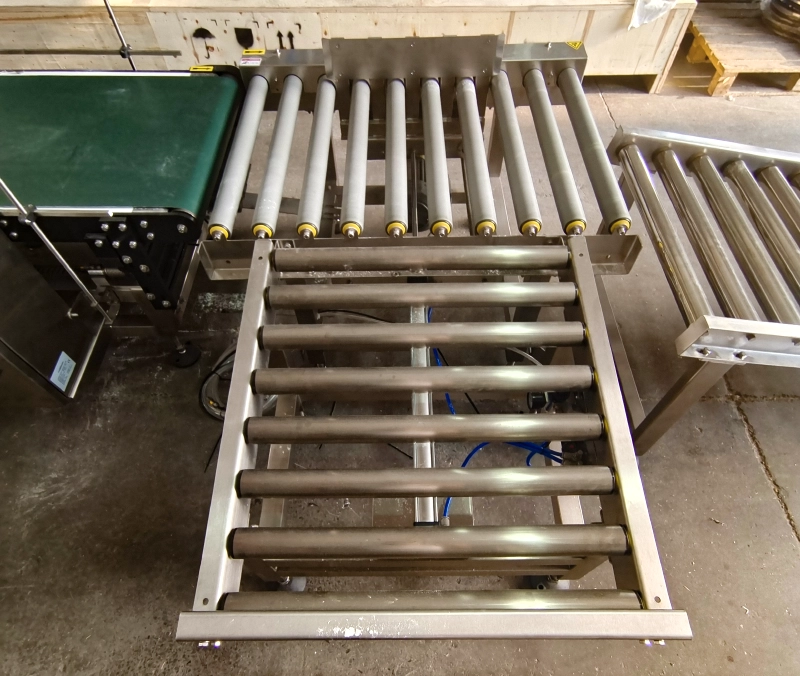
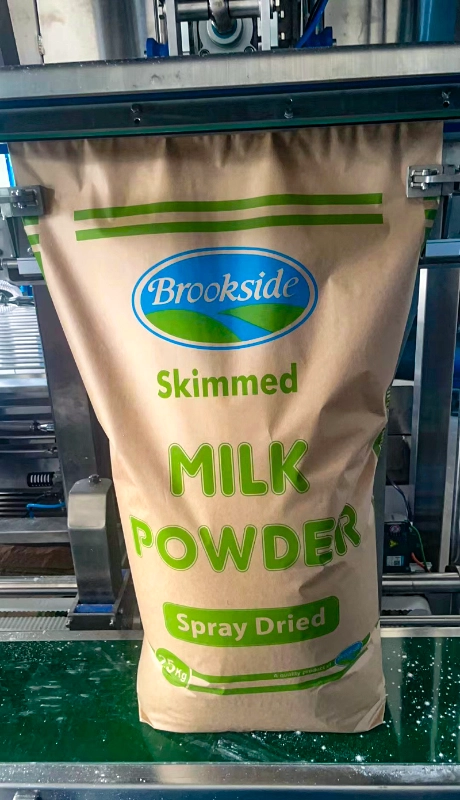
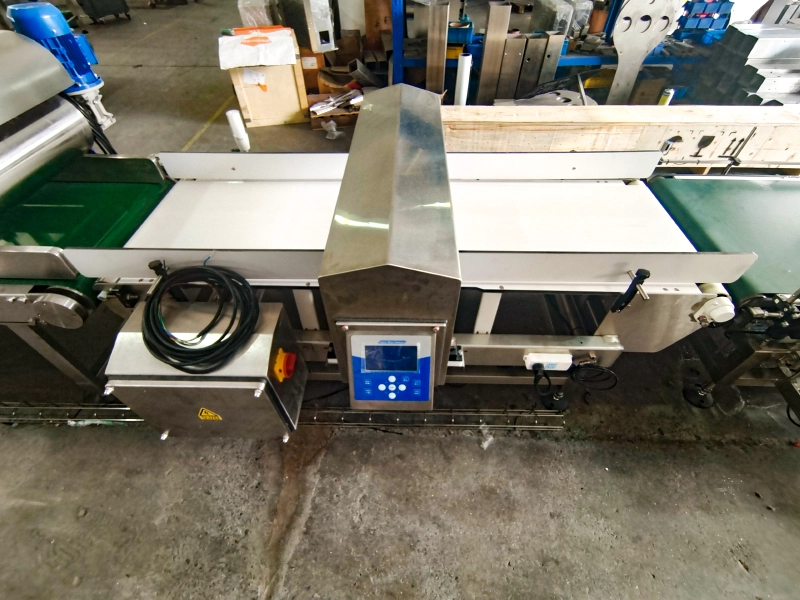
The factory evidence shows the physical logic behind the line: enclosed stainless-steel stations, blue inspection windows, a bag magazine conveyor, green belts, roller transfer sections, adjustable guides, control cabinets and emergency-stop protection. One indexed image shows a kraft-paper milk powder bag held at an automatic clamp station; another shows angled rollers used for industrial bag handling. Together, these details support a guided handoff rather than an unsupported claim about capacity or customer performance.
Reference configurations include a nominal 25 kg application, while published variant data ranges from 1.5–2 bags/min on one 11889 line list to 1–3 bags/min for a DS25K reference. A 5 kW main power reference and SUS304 body are also configuration-dependent inputs. Confirm the bag dimensions, material, target weight, powder properties, closure sequence, air supply, dust extraction, detector effect and checkweigher datasheet during project engineering.
| Line point | What Mipline addresses | What to confirm |
|---|---|---|
| Bag supply and clamp | Magazine, pickup, opening and bag clamp alignment | Bag construction, dimensions and opening behavior |
| Powder filling | Bottom-up lift fill with three-stage screw dosing | Bulk density, flowability, target weight and dust control |
| Closure and handoff | Sealing or sewing sequence with guided roller or belt transfer | Closure method, line speed and downstream layout |
| Final inspection | Settling, shaping, metal detection, checkweighing and reject path | Approved detector and checkweigher configuration |
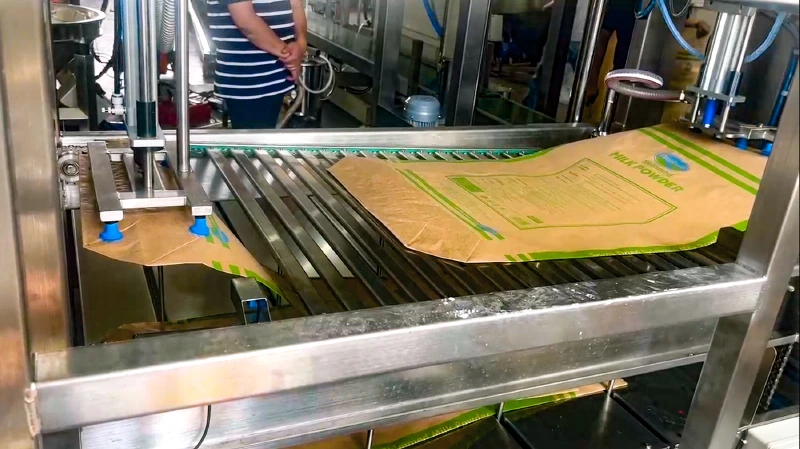
Specify the powder, bag and sewing handoff
For a milk powder packaging machine or another dry powder packaging equipment project, share the material, bag type, target weight, required closure, speed and palletizing route. BPM can then define the suitable filling, transfer, inspection and reject configuration instead of applying a generic line specification.
Discuss Your Powder Packaging Line English
 Русский