
25 kg Powder Bagging Line: Dust Control at the Bag Mouth
A dairy or flour plant rarely replaces a filler because the dosing screw is slow. The complaint that starts the project is quieter: powder escapes at the bag mouth, the seam area is dirty, and someone stands at the last metre wiping and straightening every bag by hand. A 25 kg powder bagging line has to solve that mouth problem before it solves anything else, and that is exactly where a free-fall filler stops being useful.
Where the dust at the bag mouth actually comes from
Free-fall filling is still the default on a lot of older 25 kg powder bagging line layouts. The bag hangs on two hooks or is held upright by an operator, powder drops from a fixed spout into an open mouth, and the displaced air carries fine particles upward. On milk powder, flour, starch and blended food powders that cloud is not a cosmetic issue: it settles inside the mouth fold, on the inner liner and along the paper-tape path.
The consequences chain fast. The sewing head stitches through powder, the heat-sealing bar presses contaminated film, and the seam either leaks or is caught later at the checkweigher. Operators compensate the only way they can, by wiping the mouth with a cloth and re-straightening the bag before closure. On a 25 kg powder bagging line running 1.5–2 bags/min that becomes a standing job, and it is the step plants ask us to remove.
A fixed spout, a bag held by hand, a dusty mouth, and a manual wipe just before the sewing head. The 25 kg powder bagging line gets blamed for slow sewing, but the root cause sits upstream in the fill geometry.
Clamp first, fill from the bottom, then close
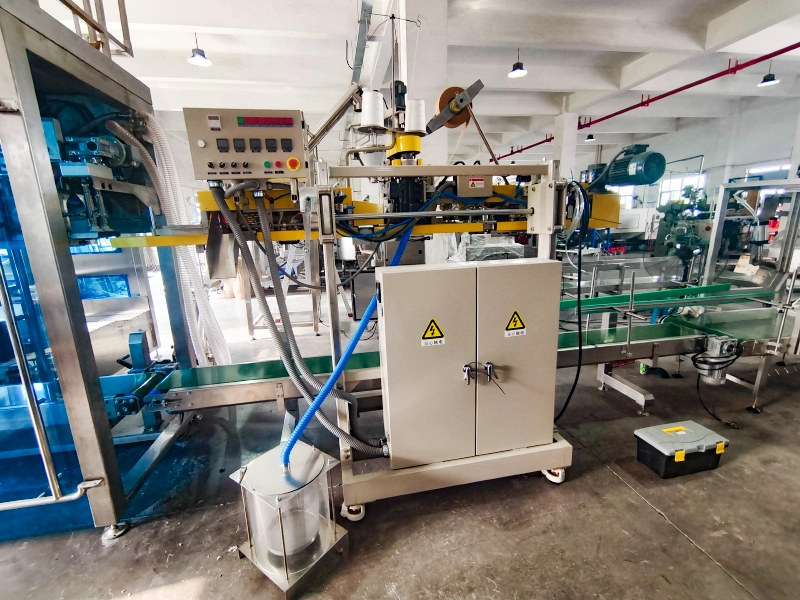
On a Mipline line the sequence is inverted. The bag is pulled from the magazine, opened and clamped in the bagging station before any powder moves. The filling head rises with the bag: a lifting platform follows the fill level, so the outlet stays close to the material surface instead of pouring through a metre of air. That single change removes most of the cloud a free-fall 25 kg powder bagging line throws up at the mouth, and it is why dairy plants running kraft bags ask for this configuration first.
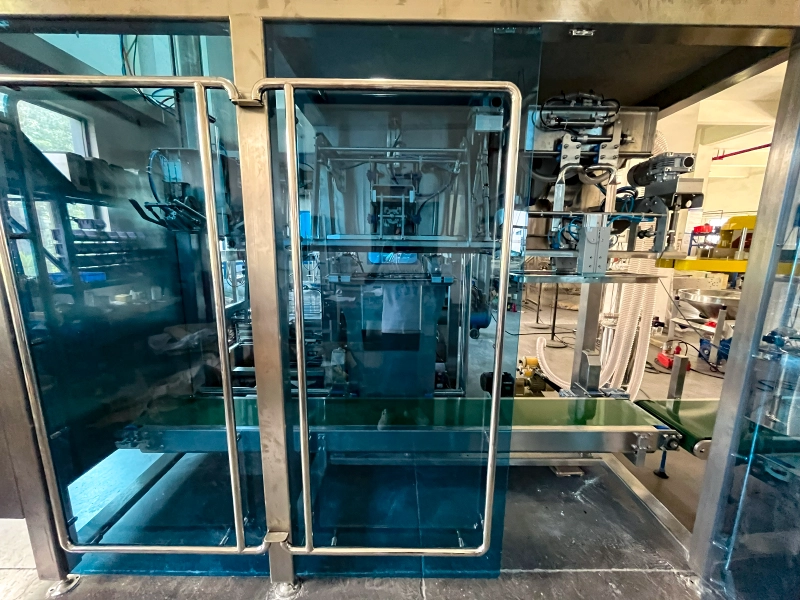
Dosing is three-stage — fast, medium, slow final trim — weighed through a PLC and HMI. Our 25 kg references state ≤±0.1–0.2% accuracy and 1.5–2 bags/min for that build. Where the powder is aerated, vacuum extraction is configured before closure, 63 m³/h on the DS-class reference, so the bag is not closed while still inflated. The station itself is an enclosed SUS304 frame with blue inspection windows and guarding: the bag stays inside the machine and nobody holds the mouth by hand.
Engineering note: capacity, accuracy, residual oxygen and dust figures belong to one specific configuration. Ask for the datasheet of the build you are buying and test your own powder — milk powder, flour and starch do not share one number.
Guides and transfer decide whether the mouth stays square
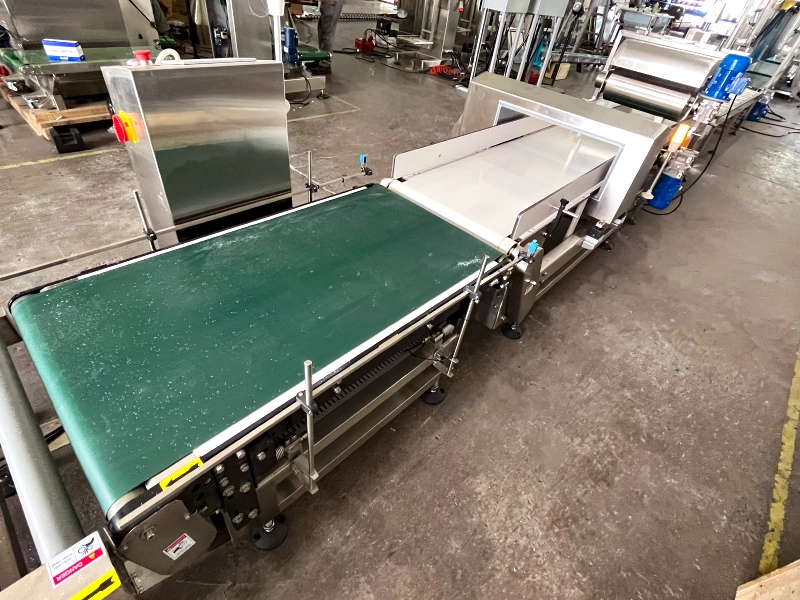
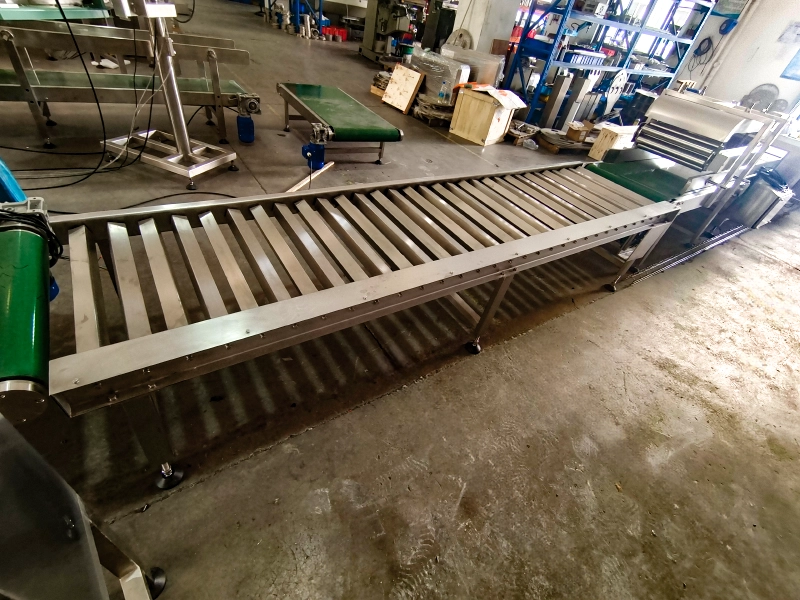
A clean mouth is only half the problem. A filled 25 kg bag that leaves the clamp unguided will lean, twist or slump, and the sewing head then receives a skewed mouth on a bag that is no longer square. Mipline treats transfer as part of the 25 kg powder bagging line rather than optional hardware: adjustable side guides on the belt run, a shaping section at 600 mm belt width, a twin-belt transfer that holds both faces, and roller sections carrying the bag to inspection and discharge.
Control points are placed where operators actually stand: an emergency-stop box at the transfer, a touch-screen HMI, and leveling feet on a welded stainless frame so the whole line can be squared to the floor. Bags then reach the metal detector and checkweigher settled, flat and at a repeatable height — we describe that handoff in our note on settling before checkweighing, and the dairy variant is covered in the milk powder bag handoff walk-through.
| Element | Reference figure | Why it matters at the mouth |
|---|---|---|
| Nominal bag | 25 kg kraft paper, paper-plastic composite, coated woven | Bag construction sets clamp pressure and closure method |
| Filling | Bottom-up lifting fill, three-stage screw | Outlet stays near the material surface, less airborne dust |
| Stated accuracy | ≤±0.1–0.2% on the 25 kg reference build | Weight stays stable before final trim |
| Stated capacity | 1.5–2 bags/min on the same build | Manual straightening becomes the bottleneck above it |
| Vacuum extraction | 63 m³/h where configured | Bag is de-aerated before closure, not sealed inflated |
| Body and control | SUS304 frame, PLC + HMI, 5 kW main power | Washdown-friendly surfaces, parameters visible and logged |
| Closure options | Dust removal, trimming, inner heat sealing, sewing, paper tape | Every one of these steps needs a clean mouth first |
| Transfer | Green-belt runs, twin-belt guides, roller conveyor | Bag reaches sewing square and at repeatable height |
Check the bag mouth before you buy
Send us your powder, bag construction, target weight and floor layout. We will mark on the drawing where the bag is clamped, where air is extracted and where the bag is guided before closure on a 25 kg powder bagging line, and tell you which reference build those figures come from.
Request a line review English
 Русский