
How a Russian Salt Plant Stabilized Woven Sacks Before Sewing and Palletizing
For a bulk-material plant, the problem was not only filling bags. The real issue was keeping woven sacks aligned after discharge, so sewing, transfer, and palletizing could run with fewer jams and less manual rework. This is where the ppline bagging line fits: it combines controlled filling, guided outfeed, and a layout that keeps the sack path predictable from hopper to pallet.
Why the older bag handling method started to fail
The customer was dealing with a familiar bulk-packaging problem: once the filled sack left the filling point, the bag no longer stayed perfectly square. If the discharge path was too loose, the sack shifted before sewing; if the line was too narrow, operators had to intervene by hand. That creates a chain reaction—slower throughput, more physical handling, and more risk of scuffed bags or poor stacking quality.
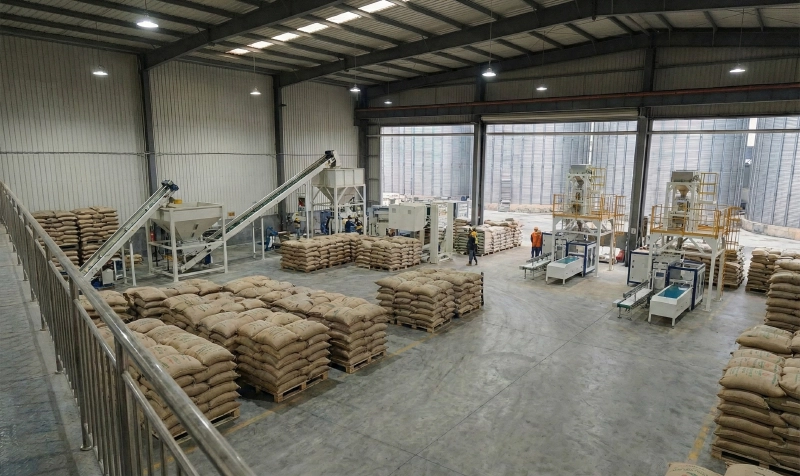
The first image shows the right kind of plant logic for this issue: a defined material flow, clear line separation, and palletized output ready for the next step. A bagging warehouse only performs well when filling, conveying, and stacking are treated as one system instead of three disconnected machines.
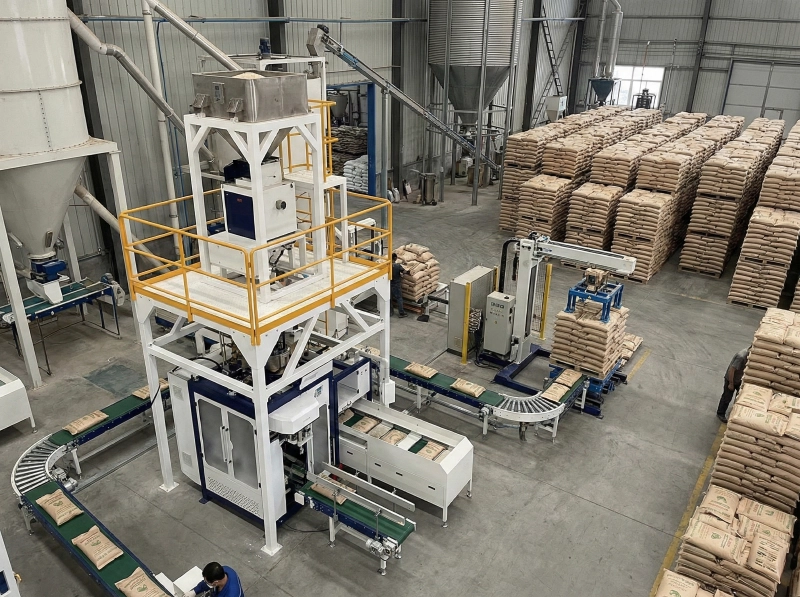
Bulk sacks often arrive at sewing or stacking in a twisted position. That makes the next station unstable, especially when the plant wants fewer operators and a cleaner transfer from bagging to palletizing.
Why ppline suits this kind of bulk-product line
ppline is a good fit because the line architecture is built around control, not just capacity. The image set shows the core elements clearly: a bulk bagging machine with hopper feed, a gravity dosing or weighing stage, an HMI touchscreen, a discharge conveyor, and an elevated steel platform with safety rails. In larger layouts, the same line can be connected to twin storage silos, an inclined conveyor, and a palletizing zone.
That matters for salt and other free-flowing bulk products because the line needs steady feeding and a repeatable outfeed. Once the sack leaves the filling station in a stable position, the plant can keep sewing and palletizing consistent without constantly correcting the bag by hand.
bpmpack Engineering Insight: In bulk packaging, the biggest productivity loss is often not the filling process itself but the transition after filling. A stable outfeed path, guided conveyor section, and clear platform layout can reduce the small handling errors that accumulate into stoppages over a full shift.
Structure and parameter logic visible in the images
The visual evidence matters here. One product image shows a dual-machine packaging concept with HMI control, filling spouts, bag clamps, and an optional sewing closure. Another image shows a high-angle operational plant view with twin stainless silos, conveyors, and palletized sacks. Together they prove the line is not a single bagging point—it is a complete bulk-material handling system.
For the buyer, that means the decision is simpler: if the current pain is unstable sack transfer, the solution is not a bigger filler alone. It is a better line structure with controlled discharge, enough platform access, and a downstream layout that protects the sack shape until it reaches sewing or stacking.
| Buyer concern | What the line must solve | ppline response |
|---|---|---|
| Sack misalignment | Keep the bag square after filling | Guided discharge and conveyor transfer |
| Manual rework | Reduce operator intervention | Integrated outfeed and palletizing flow |
| Plant safety | Provide stable access and guarding | Elevated platform, ladder, and safety rail structure |
| Throughput stability | Keep the whole line synchronized | HMI-controlled modular packaging layout |
Need a line that keeps woven sacks stable before sewing?
For bulk products, the best packaging line is the one that protects bag shape after discharge and keeps the whole transfer path predictable. If you want a layout for salt, grains, or other free-flowing materials, ppline can be configured around your bag size, output target, and downstream handling method.
Request a bulk packaging layout English
 Русский