
How Bibpu Keeps Salt Bag Handoffs Steadier Before Sewing
When a line must move small primary packs into a woven secondary sack and send the sack to sewing without bulging, skewing, or rework, the weak point is usually not filling. It is the handoff. Bibpu is built for that exact handoff: controlled grouping, firm clamping, controlled compression, and a guided transfer path that keeps the bag shape usable for the next station.
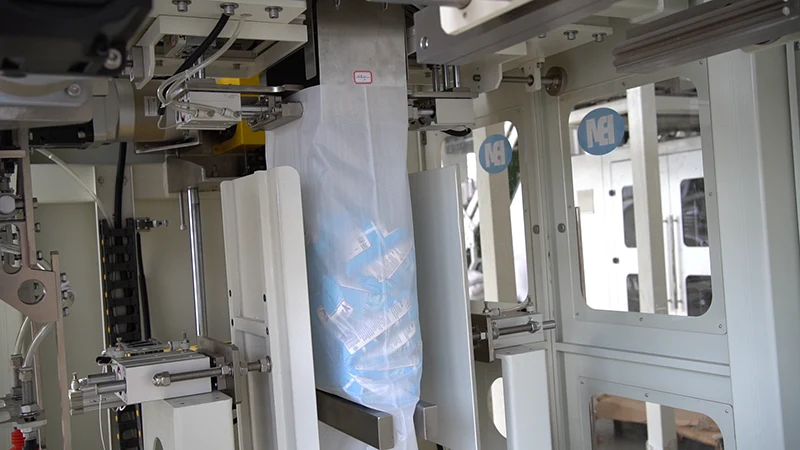
From unstable manual handoff to controlled secondary packing
In salt and similar bulk-product operations, the old method is usually a mix of manual bag straightening, loose stacking, and a separate sewing step that depends on operator speed. That approach creates three recurring problems: the bag opening shifts out of line, the sack body swells after fill, and the sewing head receives a bag that is already under stress.
Bibpu addresses that sequence as one continuous job. The line does not only fill a bag; it groups the product, holds the secondary sack open, compresses the loaded sack back into a sewable shape, and moves the mouth to the closing station in a predictable position.
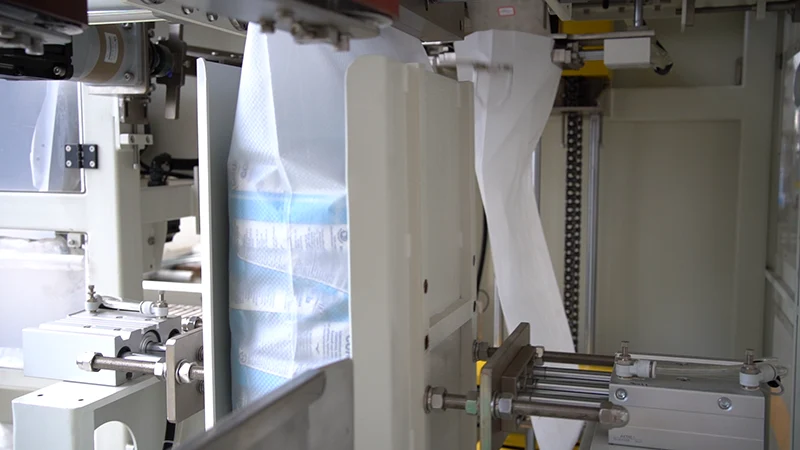
Without guided clamping and controlled compression, operators spend time re-squaring the sack, the sewing head gets inconsistent mouth alignment, and the finished load is harder to stack. That means more rework, slower throughput, and less stable pallets.
Why Bibpu fits this secondary packaging job
The core advantage is mechanical control. Bibpu uses a grouped transfer path, dual-side holding, and a guided feed into sewing so the sack remains square enough to be handled. The photo evidence matters here: the clamping section shows the loaded sack being compressed in a controlled way, not crushed randomly, which is exactly what a sewing station needs before closure.
For lines handling salt, granules, or other dense products, this matters because the product itself is not fragile in the same way as the package. The real risk is geometry loss. If the sack loses shape, the stitching head has to compensate. Bibpu reduces that burden by stabilizing the bag before the stitch cycle begins.
Practical takeaway: the line is not designed around a single machine moment. It is designed around the transfer between moments, where most packaging instability usually appears.
What the transfer, clamp, and sewing stages show in the images
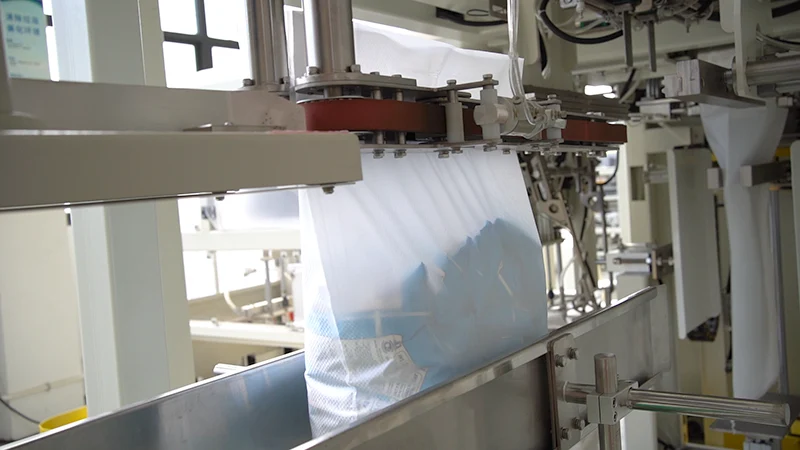
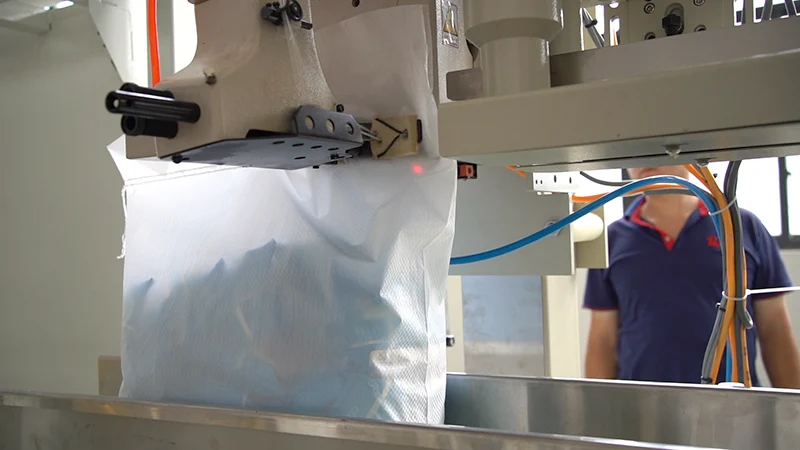
The conveyor and clamp sequence shows how the system keeps the bag centered before sewing. The belt feeder image shows the mouth of the filled woven bag being held and advanced in a straight path. The sewing-head image then confirms the final step: the bag reaches the stitch station with a controlled opening and a clean feed angle.
This is the key result buyers usually want from secondary packaging automation: fewer corrections at the last station, a more regular bag shape after fill, and a closure process that can keep up with the upstream packing rhythm. In simple terms, Bibpu turns the weak link of the line into a managed step.
| Stage | Old method | Bibpu result |
|---|---|---|
| Bag handoff | Manual straightening and inconsistent positioning | Grouped transfer with guided alignment |
| Sack shape | Bulging bag body before closure | Controlled compression before sewing |
| Closure station | Operator-dependent feed into sewing | Stable feed into the stitch head |
| Final outcome | More rework and uneven pallet geometry | Cleaner handoff, steadier closure, easier stacking |
When the bag must reach sewing in shape, control the handoff
Bibpu is a good fit when the line needs secondary packaging automation that does more than fill. It groups the product, stabilizes the loaded sack, and feeds the closure station with a bag that is much easier to sew, stack, and ship.
Request a packaging line discussion English
 Русский