
25 kg Fertilizer Bagging Line: FFS Cooling for Stable Pallet Output
For a fertilizer plant shipping 25 kg ammonium phosphate or compound fertilizer, an automatic bagging line must do more than weigh bulk material. FFS online bag forming, controlled filling, heat sealing, cooling, checkweighing and pallet handling create a cleaner route from granules to a forklift-ready load.
Why a 25 kg fertilizer line outgrows open bags and sewing
A fertilizer producer supplying distributors, agricultural warehouses or export logistics often starts with open woven or kraft bags, manual weighing and a bag-closing machine. That route is familiar, but every extra handoff adds variation: an operator holds the bag, another corrects the weight, a third sews the mouth, and finished sacks still need manual transfer and pallet building. The result is a packaging process rather than a controlled packaging line.
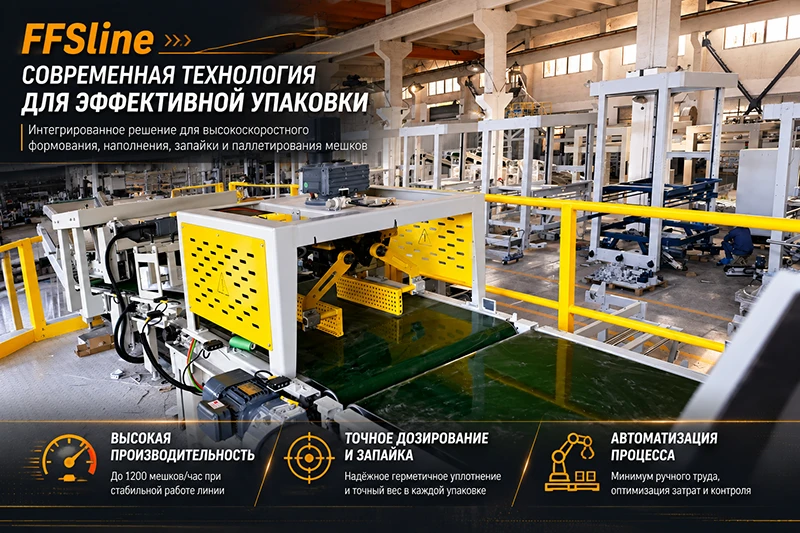
For granular fertilizer with reasonably stable flow, FFSline changes the sequence. PE or PP roll film is formed into the bag at the machine, then filled and sealed without a separate pre-made bag store. The target is not a universal speed promise: a 25 kg project is confirmed against bulk density, particle size, moisture, film specification, continuous feeding and the agreed acceptance test. In the right conditions, the line can be designed around a 500 bags/h project level, with higher published ranges treated as configuration- and material-dependent.
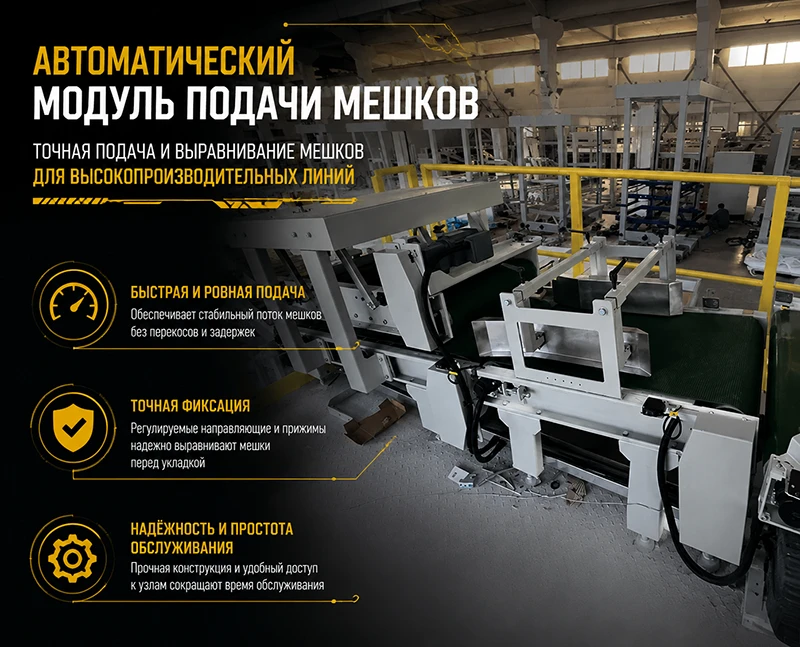
Manual bag opening, weighing and sewing can hide unstable feed, bridging, dust at the filling point, impact on a fresh seal and inconsistent bag presentation. If inspection, labeling and palletizing are separate, the plant may produce filled sacks but still lack a repeatable dispatch unit.
Why FFS cooling and controlled filling fit fertilizer granules
The adaptation starts upstream. A project may use a 3 m³ transition hopper as a buffer and add vibration, anti-bridging or sampling devices when the fertilizer tends to form a bridge. A servo weighing unit, PLC and HMI then coordinate the dosing cycle. The common 25 kg format should be checked with the product density and the selected M-type heavy film rather than copied from a different material.
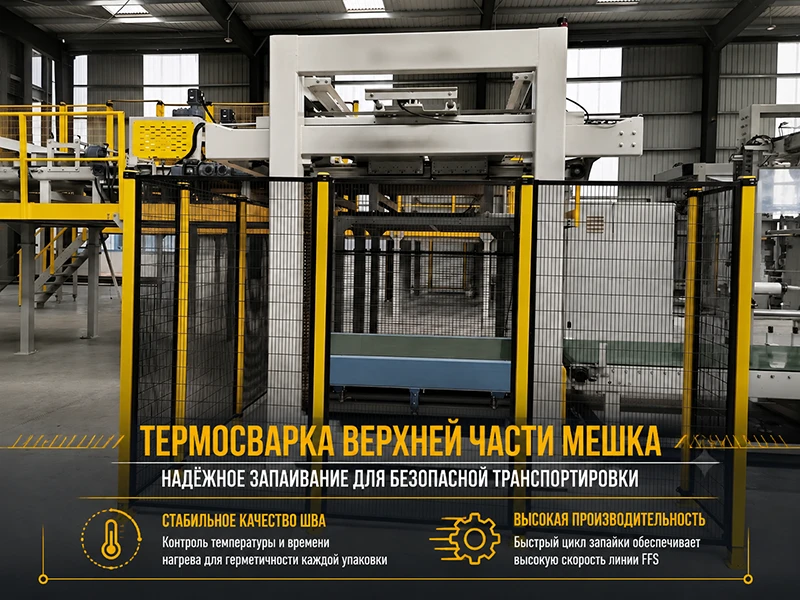
The sealing point is equally important. FFSline forms the bottom seal, fills the bag and closes the mouth with heat sealing; pneumatic cooling at the bag bottom and mouth helps protect the seal from puncture while the filled sack enters the transfer section. The indexed heat-sealing station shows the physical relationship between the sealer, conveyor and safety enclosure. Optional checkweigher-and-reject equipment can remove over- or underweight bags, while metal detection and industrial dust collection are added when the product and quality plan require them.
Engineering note: A 25 kg FFS specification should state film width, film thickness, roll diameter, bag geometry, target throughput, accuracy, air supply and downstream layout together. Typical reference values such as 350–450 mm film width, 0.14–0.18 mm film thickness and a 1,500 mm maximum roll outside diameter are starting points for confirmation, not blanket guarantees.
From sealed sack to traceable, pallet-ready output
A fertilizer packaging line is complete only when the accepted bag can be identified, grouped and moved. Bag-level date or batch marking and a pallet labeling machine serve different traceability tasks. The line can also include bag shaping, a high-level palletizer or robotic palletizing system, an automatic pallet magazine and a stretch hood machine. These modules are selected against the bag rate, pallet pattern, building height and forklift route; they should not be treated as automatic standard equipment.
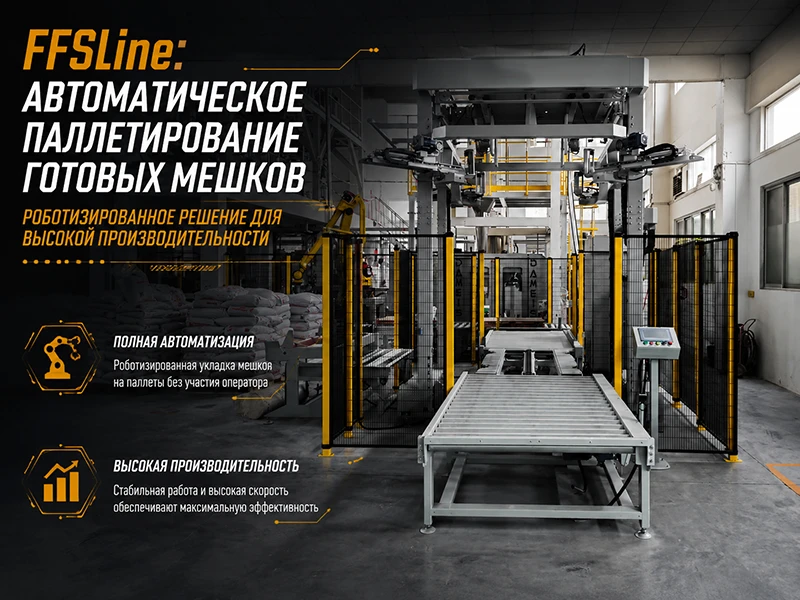
The factory palletizing station provides the final physical proof: guarded conveying, a robotic handling area and a controlled pallet interface. Together with online forming, filling, sealing and inspection, this turns bulk material bagging into a repeatable logistics unit. Labor is moved away from lifting and sewing toward supervision, quality checks and planned changeover.
| Line point | FFSline evidence | Project confirmation |
|---|---|---|
| Bag and fill | PE/PP roll film, online bag forming and controlled weighing | Material flow, 20/25/50 kg format and film specification |
| Seal protection | Heat sealing with bottom and mouth cooling logic | Seal temperature, cooling time and bag-drop conditions |
| Quality loop | Checkweigher/reject and metal detection available as options | Accuracy, reject policy and inspection standard |
| Dispatch | Conveyor, labeling, palletizing and stretch-hood modules can be linked | Bag rate, pallet pattern, ceiling height and forklift flow |
Specify the material before specifying the machine
Share the fertilizer type, bulk density, target bag weights, film data, required bags per hour, building constraints and pallet pattern. BPM can then size the form-fill-seal packaging machine, checkweigher reject system and palletizing route around the actual acceptance conditions.
Discuss a 25 kg FFS packaging line English
 Русский