
Why the 25 kg Bagging Line Starts on a CAD Drawing
For a feed, seed, fertilizer, plastic pellet or mineral granule plant, a 25 kg bagging line only behaves on site when the layout was solved on paper first. This is how BPMpack plans the flow before any steel leaves the workshop.
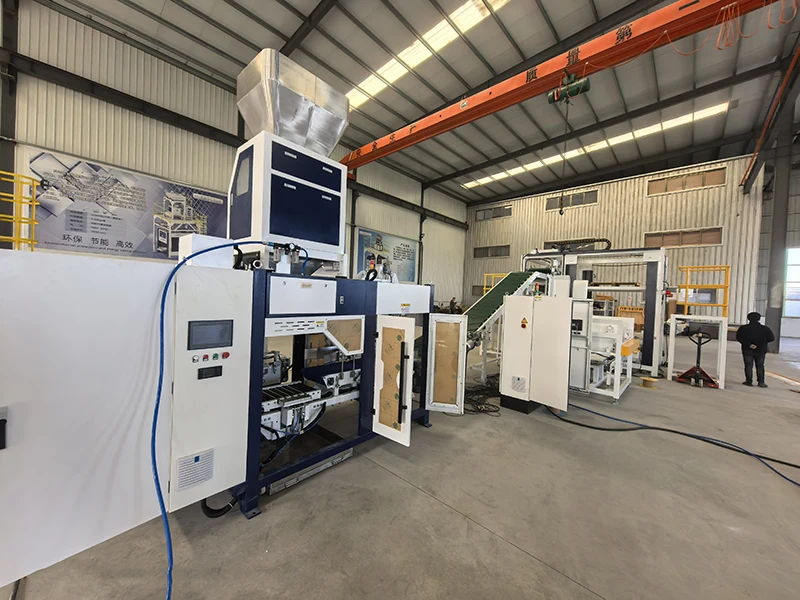
The 25 kg Bagging Line Problem Is Layout, Not the Machine
Talk to any plant engineer who has run a 25 kg bagging line for more than two years and the same complaint comes back. The filling head works. The sewing unit works. The checkweigher works. What does not work is the gap between those stations — the bag transfer, the outfeed turn, the incline bridge, the buffer before the palletizer. That gap is a layout problem, not a machine problem, and it only shows up when the line is standing on the real floor.
For 10-50 kg heavy-bag projects running at 700-900 bags per hour, those gaps add up fast. A bag that stops for half a second at the wrong height costs the line five to eight bags per shift, every shift. Over a year that is the difference between meeting the dispatch target and missing it. BPMpack treats the line as one continuous flow from bag magazine to pallet exit, which is why the layout conversation starts before the proposal.
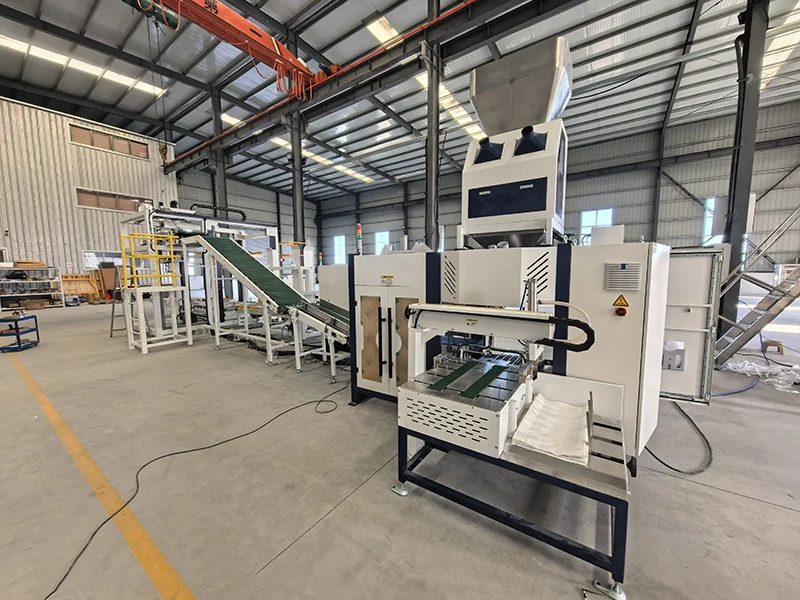
Forklift aisles that do not line up with the palletizer exit. Columns nobody flagged in the first call. A buffer hopper dropped into the only forklift turning radius. A heavy-bag line that technically fills bags but blocks the dispatch lane. The buyer signs for throughput and ends up with congestion. None of these problems are visible in a single-machine photo. They only show up on a CAD drawing of the actual plant.
Why the 25 kg Bagging Line Quote Begins With a Site Drawing
When a buyer asks BPMpack for a 25 kg bagging line, the first file we ask for is not the bag spec and not the target throughput. It is the factory CAD drawing with column positions, ceiling height, forklift aisle widths, and the planned pallet exit direction. Without those numbers any line layout is just a guess. With them the line becomes a real engineering object — bag magazine, single-head servo scale or double-bucket scale, vertical bag conveyor, right-angle turner, incline conveyor, checkweigher, reject conveyor, labeler, and palletizer — placed in the only sequence that actually fits the room.
The same data also decides the secondary choices that quietly change the project. PLC brand — Inovance for standard builds, Siemens for higher-demand projects — only matters once the cycle time and the I/O count are confirmed from the layout. Sealing option — heat seal, sewing, or heat seal plus sewing plus hot-melt tape — depends on the bag spec and the dispatch environment. Even the air supply at 0.5-0.7 MPa and the total power around 15 kW are recalculated against the real run length, not a generic number. That is how the line becomes a flow the buyer’s plant can actually run.
Field note. On recent projects, switching from a one-line-per-machine plan to a CAD-driven 25 kg bagging line layout shortened installation time by roughly a week and removed three on-site modification cycles. The savings did not come from the equipment itself; they came from solving the layout before the truck arrived.
Evidence From the 25 kg Bagging Line Drawings and Operating Scenes
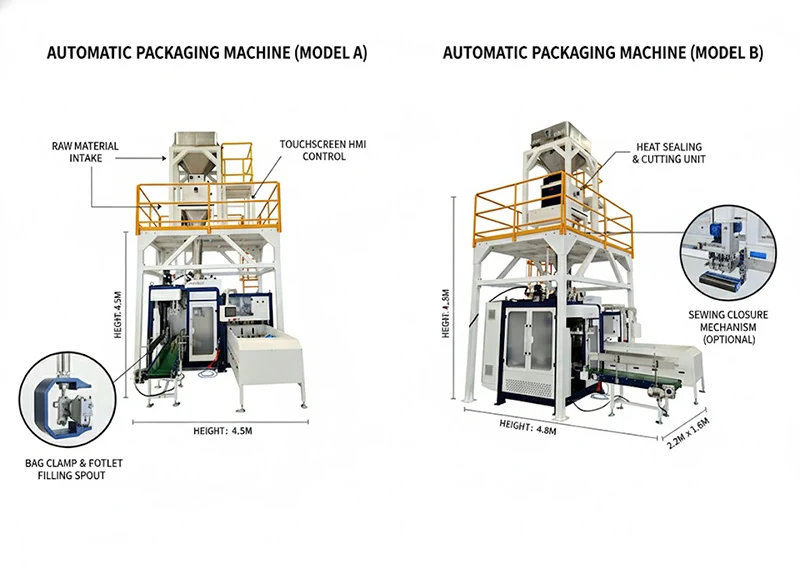
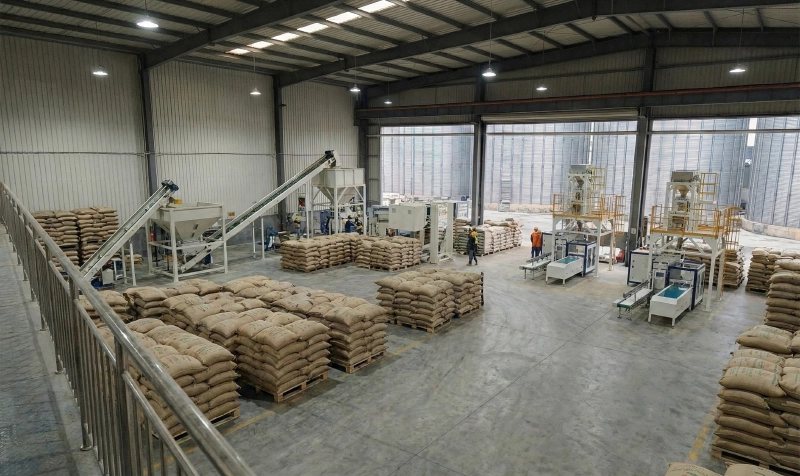
The first piece of evidence is mechanical. The 3D CAD render shows two model variants side by side — bag clamp, filling spout, HMI control, heat sealing, and an optional sewing closure — built around a single steel tower with safety railings. That is the same configuration BPMpack drops into the buyer’s CAD drawing. The second piece of evidence is the layout render, which places two QZK-1200 bagging towers inside a real warehouse envelope with inclined conveyors feeding from the silo side and palletized sacks leaving on the dispatch side. Neither of those images is a showroom mockup. Both come from projects where the heavy-bag line was sized against an actual factory floor.
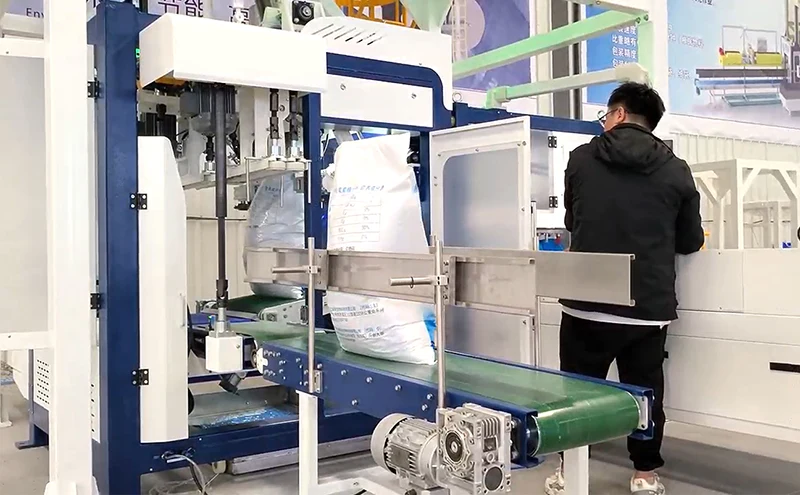
The third piece of evidence is operational. The transfer section photo shows a guided outfeed belt with steel guide rails and a motorized green belt keeping each 25 kg sack aligned before pallet handoff. Combined with typical ±0.2% weighing accuracy on standard projects, the right-angle turner, the buffer hopper before the palletizer, and a checkweigher set to roughly ±10 g across 100 recipe memories, the line produces bags that are square, weighed, sealed, and ready to stack. That is what a buyer actually signs a 25 kg bagging line PO for.
| Layout Decision | What BPMpack Reads From Your CAD Drawing | What It Sets on the 25 kg Bagging Line |
|---|---|---|
| Forklift aisle width | Pallet exit direction and clear width in mm | Right-angle bag turner placement and buffer hopper length |
| Column positions | Steel frame width and tower footprint | Single-head servo scale or double-bucket scale selection |
| Ceiling height | Vertical bag conveyor clearance and HMI swing-arm reach | Elevated platform height and safety cage ladder position |
| Bag spec and dispatch environment | Bag type, weight tolerance, dust level | Sealing option, dust hood, checkweigher reject path |
| Throughput target | Bags per hour per shift | Scale type, PLC brand, number of outfeed conveyors |
Send Your Factory Drawing to Plan a 25 kg Bagging Line
If you are evaluating a 25 kg bagging line for feed, seed, fertilizer, plastic pellet, mineral granule, or grain projects, the fastest path to a working layout is a factory CAD drawing and the planned bag spec. BPMpack returns a 2D layout, a parameter table, and a quote that matches your site, not a generic showroom plan.
Request a 25 kg Bagging Line Proposal English
 Русский